The pink spodumene of Mawi, Kolum and Kantiwa: the largest kunzite crystals in the world, how their colour is made and why it fades, what they cost, and how to care for them.
The evening stone
Kunzite, from the valleys that produce most of it
Kunzite is the pink to lilac gem form of spodumene, the lithium mineral, and Afghanistan is its greatest source. The Mawi and Kolum workings in the Nilaw-Kolum pegmatite field of western Nuristan have given more fine kunzite than anywhere on earth since they were opened in the early 1970s, in crystals that reach a metre long, and most of what is sold as Afghan kunzite, Nuristan kunzite or Mawi kunzite comes from these two valleys, with more from Kantiwa, Paprok and the Pech valley of Kunar.
This page is written from Nuristan for people who own kunzite or are thinking of buying it. It covers where the stone comes from, how big and how fine the crystals are, how its colour is made and why it fades, what it costs and why it costs so little for so beautiful a stone, how to look after it, and how to tell it from the things sold in its place. The wider guide to the province's stones is on the Nuristan gemstones page.
Mineral
Spodumene, lithium aluminium silicate
Colour
Pink to lilac and violet; also blue, green and yellow spodumene
Main field
Nilaw-Kolum: the Mawi and Kolum mines in Du Ab, Nilaw in Mandol
Also from
Kantiwa, Paprok, and the Pech valley in Kunar
Crystals
Up to a metre; a 1,243 gram gem crystal pictured in 1985
Recorded output
Over 1,260 kg of gem kunzite in 1973 to 1975
Hardness
6.5 to 7, with two perfect cleavages
Known as
The evening stone, because its colour fades in sunlight
The mineral
Spodumene, the lithium stone, when it grows clear
Spodumene is a lithium aluminium silicate and the main ore of lithium. Most of it is grey and opaque, and in Nuristan it fills the pegmatite veins by the tonne: the Soviet estimates of lithium in the province rest on it. Now and then, in a pocket in the vein, spodumene grows clear, and traces of manganese colour it pink or lilac. That is kunzite, named in 1903 after the gemmologist George Kunz. Iron and chromium give greens, and the clear colourless to yellow stone is also cut.
The Soviet geologist Rossovsky, who studied the Nuristan veins in the 1970s, found that most jewellery kunzite had formed by the regeneration of earlier spodumene at 160 to 270 degrees, in pockets ten centimetres to three metres across, and called Kolum a unique kunzite deposit. The kunzite grows with pink and blue tourmaline, pollucite, cassiterite and manganotantalite, and the pockets are lined with cleavelandite and lepidolite.
The mines
Where Afghan kunzite comes from
The Nilaw-Kolum field, Du Ab and Mandol, western Nuristan
Mawi and Kolum
The great kunzite mines of Afghanistan, worked since the early 1970s. The Kolum deposit has ten albitised dikes in old gabbro; the main dike runs 3,000 metres, and a 150 metre dike that geologists named the Kunzite Dike carried cavities holding 90 to 150 kilograms of spodumene crystals each. The Soviet accounts record 615 kilograms of gem spodumene from 1,056 tonnes of rock mined, and more than 1,260 kilograms of gem kunzite in the three years 1973 to 1975. In 1985 Mawi was the most active mine in the field, about 500 miners worked the pegmatites daily, and the rough was carried on foot to the Pakistani border. Since 2025 the provincial mines directorate has sold Mawi rough by open auction in Du Ab, in lots of up to eleven tonnes of kunzite, beryl, quartz and garnet. Older labels say Laghman; the published coordinates fall inside Du Ab.
Kantiwa district, central Nuristan
Kantiwa
A field of about 130 square kilometres west of Parun where the dikes carry kunzite, green tourmaline, smoky quartz and tantalite. The US Geological Survey records a 300 metre dike and cavities lined with kunzite and smoky quartz. Listed as an intermittent small producer in 1995.
Kamdesh district, eastern Nuristan
Paprok
Famous for tourmaline, but the Paprok dikes also carry spodumene and gem kunzite, and specimens of kunzite from Paprok are in the mineralogical databases.
Dara-i-Pech, Kunar province, not Nuristan
The Pech valley
Kunzite from the Pech valley fields over the provincial line is widely sold as Nuristan kunzite. The Darra-i-Pech deposit is recorded as having economic concentrations of lithium, beryllium, tantalum, tourmaline and kunzite.
The crystals
The largest kunzite in the world
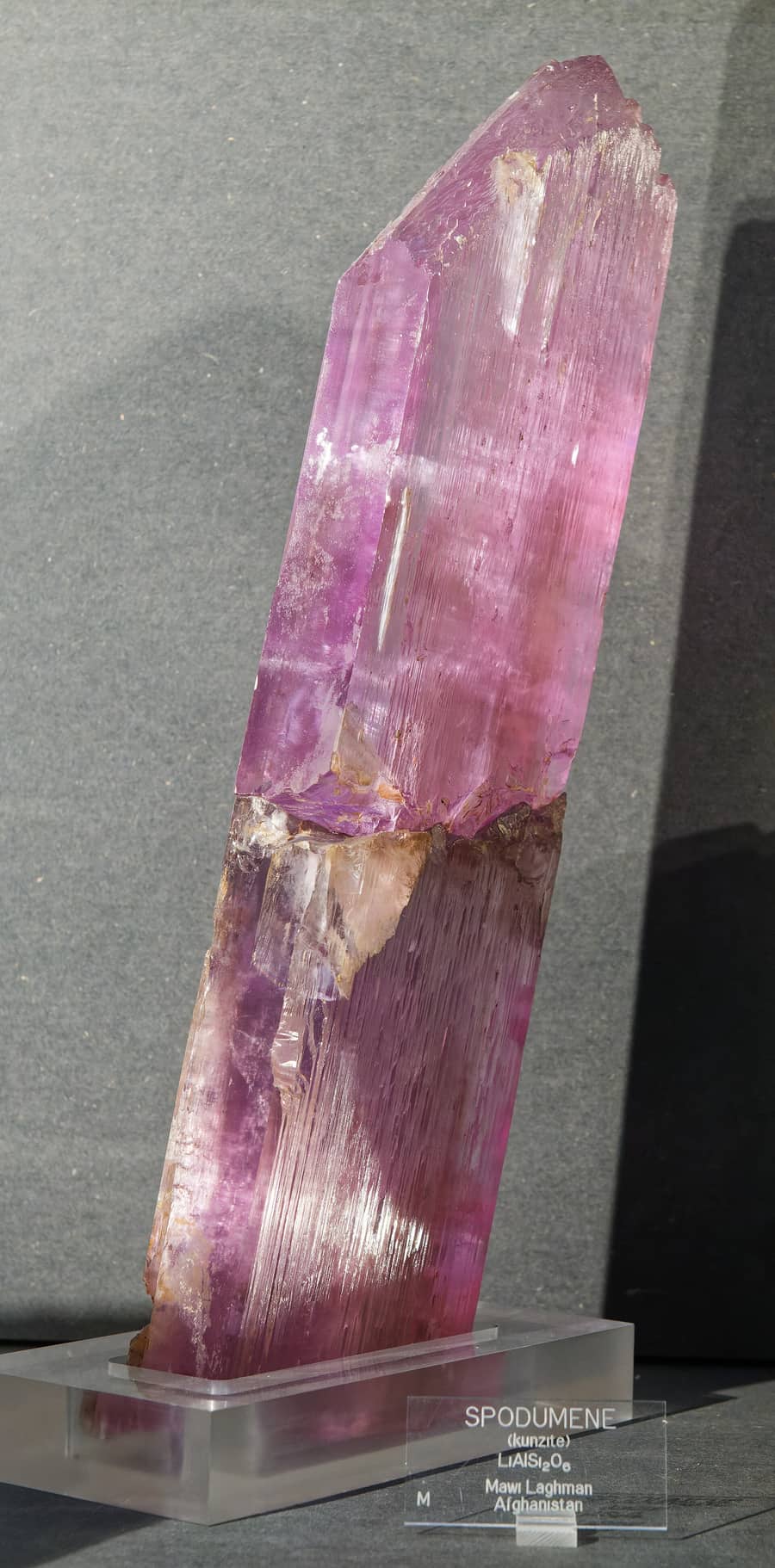
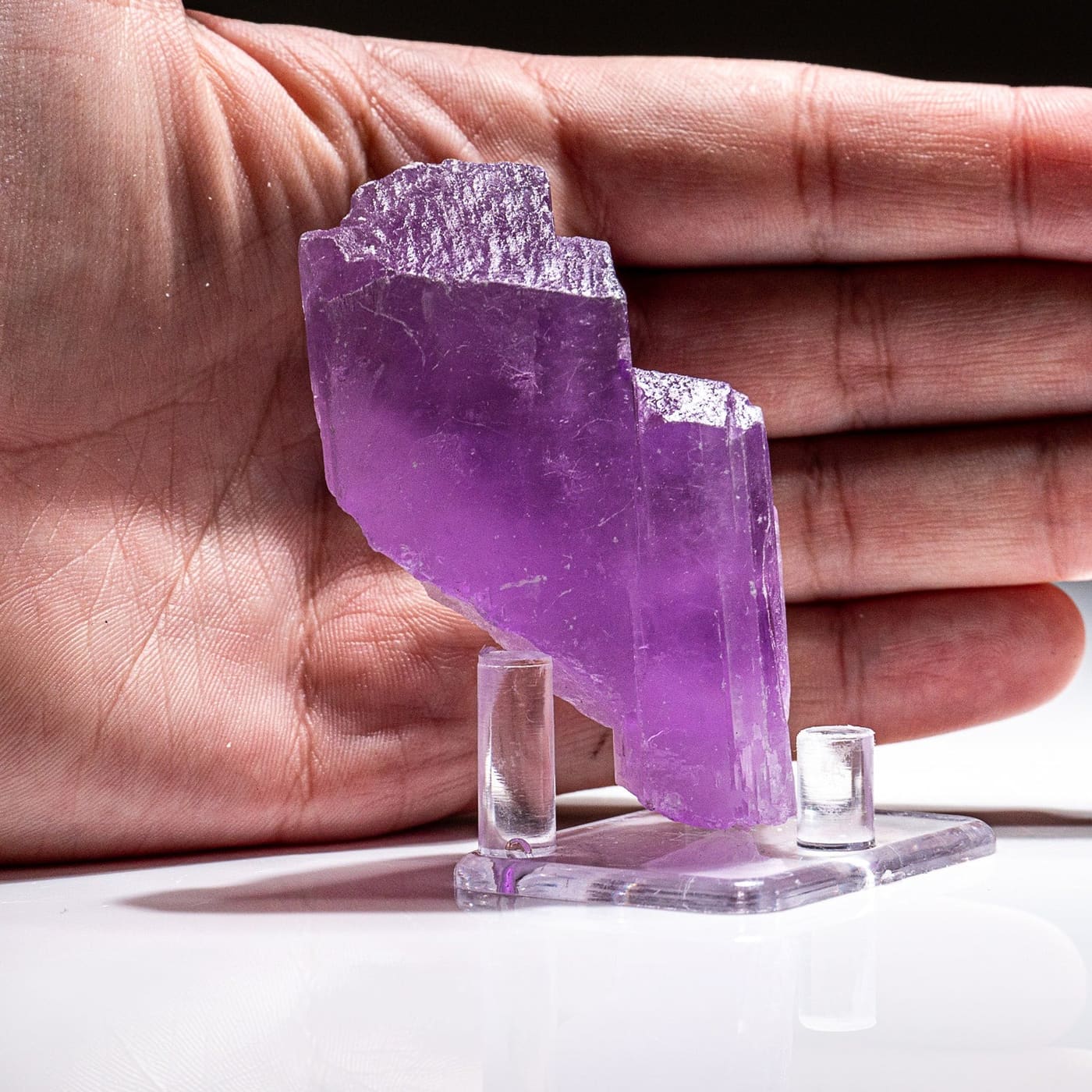
Nuristan's kunzite crystals are the largest known. Bowersox recorded crystals to a metre in 1985 and pictured one of 1,243.7 grams, with cut stones of 290.87, 58.52 and 40.88 carats and a 45 carat pear from the same material. The Sorbonne's collection in Paris holds a 20 centimetre kunzite and a 15 centimetre twinned crystal from Mawi, given by the mineralogist Pierre Bariand in the 1970s, and the Royal Museum for Central Africa in Belgium has a clear 14 centimetre prism he donated in 1972. The crystals are flattened and striated along their length, and the colour is deepest looking down the length, which is why fine kunzite is cut with the table across the crystal's long axis.
Against these figures the kunzite of other countries is modest. Brazil, Madagascar and California produce it, and the Smithsonian's famous 880 carat heart is Brazilian, but when a dealer says a kunzite is large, clean and Afghan, those three words usually belong together.
Colour and fading
How the pink is made, and how it is lost
Kunzite's colour is not what comes out of the ground. Bowersox reported that freshly mined Nuristan spodumene is blue-violet or green, and that the miners leave it in the sun for several days, often after boiling it, until it turns pink or purple. The same study heated pink fragments to 400 degrees for six hours and bleached them, and left pink stones in direct sunlight for a week and found them nearly colourless. Irradiation turns them back. Its pink comes from manganese, and light and heat undo it.
The trade uses the same chemistry on purpose. GIA states plainly that kunzite can be irradiated and then heated to deepen its colour, and that both treated and natural colour can fade with exposure to heat and bright light. Buyers and gemmologists on the trade forums report that irradiation is common in the Pakistani market through which Afghan kunzite passes, and is seldom disclosed; a dealer page that says Afghan kunzite is not routinely treated is contradicted by the people who buy it there. Irradiated green spodumene fades fastest of all, in hours of sunlight, which is why the green Afghan stones sold as hiddenite are not hiddenite. True hiddenite is coloured by chromium and keeps its colour. An Afghan green that pales in a shop window was made by radiation.
Hence the old name, the evening stone: a kunzite worn at night and kept in its box by day will keep its colour for a lifetime, and one left in a sunny window will not.
Prices
What kunzite is worth, and why so little
Prices asked or paid at the dates stated, with sources. There is no official price list for coloured stones.
Prices of kunzite, with sources
Stone
Price
Source
Kunzite in general, fine stones under 5 carats
About 10 US dollars a carat
GemSelect value guide
Kunzite in general, fine stones over 10 carats
15 to 20 US dollars a carat; price per carat barely rises with size
GemSelect value guide
Afghan kunzite, 4.9 to 18.3 carats, US dealer asking price, 2026
60 to 80 US dollars a carat
The Natural Gemstone Company listings
Pale pink kunzite, about 5 carats, wholesale, January 2024
About 60 US dollars a carat
International Gem Society forums
Light pink and vivid pink kunzite, trade talk
5 to 10 US dollars a carat for light pink; up to about 30 for vivid
Quora answer, undated
Mawi rough, about 9,000 kg of mixed kunzite, beryl, morganite and quartz, state auction, September 2025
95.1 million afghanis, roughly 10,500 a kilogram, quality unstated
Bakhtar News Agency
Mawi rough, about two tonnes of kunzite with beryl, quartz and morganite, state auction, September 2026
122.5 million afghanis
AtlasPress
Kunzite is cheap for a gem of its beauty, and people search for the reason. The reason is supply and character together. Nuristan alone has produced it by the tonne in crystals that cut clean stones of fifty and a hundred carats, so size and clarity, which make other gems rare, are ordinary in kunzite. Its colour is pale in small stones and fades in light. It cleaves in two directions, so cutters lose material and jewellers set it with care. None of that makes a fine deep lilac stone of twenty carats anything but lovely; it does keep the price per carat in tens of dollars rather than hundreds.
The figures above are asking or paid prices at the dates given, not a price list. The vivid bubblegum pinks and strong violets command the premiums; the pale pinks that make up most of the production do not.
Care
Keeping a kunzite pink
Keep it out of the sun and away from heat. Do not leave kunzite in a shop window, on a dashboard or in a steam cleaner, and do not let a jeweller heat it in a setting. Clean it in warm soapy water with a soft brush and nothing more.
Mind the cleavage. Kunzite splits easily along two directions, so a sharp knock on a ring can cleave it; it is a stone for pendants, earrings and careful rings rather than everyday hard wear. It is hard enough, at 6.5 to 7, to resist scratching in normal use.
Real or not
How to tell kunzite from what is sold in its place
Kunzite has no commercial synthetic, so the question is whether a pink stone is kunzite at all, and whether its colour is natural. Glass, pink quartz and pale pink topaz are sold in its place. A gemmologist separates kunzite in minutes: a refractive index of about 1.659 to 1.677, a specific gravity near 3.20, strong pleochroism (two shades of pink or pink and colourless as the stone is turned), and a glow under ultraviolet light that Bowersox described as strong orangy pink under long-wave and bluish pink under short-wave, followed by a red afterglow of about a minute. Glass and quartz do none of these things.
Whether the pink was deepened by irradiation no laboratory can say with certainty, and a report will not state origin for kunzite. What a report gives you is confirmation that the stone is natural spodumene and its weight, which is worth having for any stone above a few hundred dollars. GIA charges from about 75 US dollars for an identification report; the Swiss laboratories charge more and take longer. For a low-priced stone, the seller's written statement of treatment and a week in a drawer rather than a window will tell you most of what you need.
Chiefly from the Nilaw-Kolum pegmatite field in western Nuristan, where the Mawi and Kolum mines have been worked since the early 1970s, and also from Kantiwa, Paprok and the Pech valley of Kunar province. Older sources file Mawi under Laghman province, but its coordinates fall inside Nuristan's Du Ab district, and the stones are now sold at auction there.
How much is 1 carat of kunzite worth?
Very little in small sizes: about 10 US dollars a carat for fine stones under 5 carats on the GemSelect value guide, 15 to 20 dollars a carat over 10 carats, and 60 to 80 dollars a carat asked by US dealers for clean Afghan stones in 2026. Vivid pinks and violets command more; pale pinks less.
Is kunzite valuable?
Kunzite is a genuine gemstone but not an expensive one. Large, clean crystals are so plentiful from Nuristan that size and clarity do not make it rare, its colour is pale in small stones and fades in light, and it cleaves easily. Fine deep lilac stones of twenty carats and more are prized by collectors, yet prices stay in tens of dollars a carat rather than hundreds.
Why is kunzite so cheap?
Because Nuristan and its neighbours produce it by the tonne in big clean crystals, because its pink is pale and fades in sunlight, and because its two perfect cleavages make it awkward to cut and set. Beauty is not the limiting factor; supply and durability are.
Does kunzite fade?
Yes. The pink comes from manganese and is undone by light and heat. Pink Nuristan kunzite left in direct sun was nearly colourless after a week in a published test, and irradiated green spodumene fades in hours. Kept out of the sun and away from heat, the colour lasts a lifetime, which is why kunzite is called the evening stone.
Is Afghan kunzite treated?
Often. Freshly mined crystals are blue-violet or green and are sunned by the miners to turn them pink, and in the trade kunzite is commonly irradiated and heated to deepen the colour, usually without disclosure. Treated and natural colour fade alike. Green Afghan spodumene sold as hiddenite is irradiated and will fade.
Can kunzite be worn every day?
With care. It is hard enough not to scratch in normal wear, but it cleaves easily, so a ring can split on a sharp knock, and daily sunlight will fade it. It suits pendants and earrings, and evening rather than everyday rings.
How can you tell real kunzite?
Kunzite shows strong pleochroism, two shades of colour as the stone is turned, a refractive index of about 1.66 to 1.68, and a strong orangy pink glow under long-wave ultraviolet light with a red afterglow. Glass and pink quartz, the usual substitutes, show none of these. There is no commercial synthetic kunzite. A laboratory identification report settles it for a stone of any value.
What is the difference between kunzite and morganite?
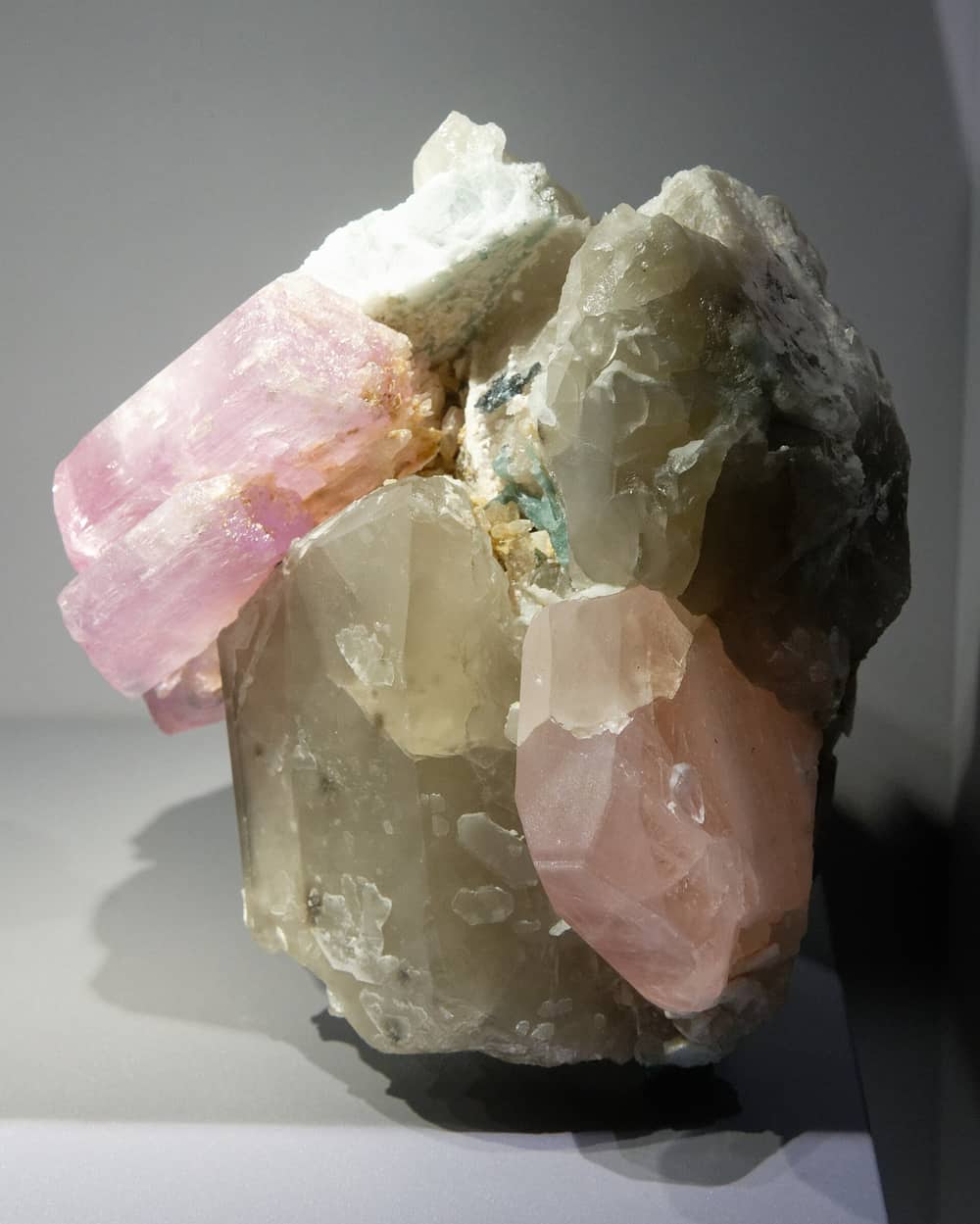
They are different minerals that often grow in the same Nuristan pockets. Kunzite is pink spodumene, a lithium mineral, with two perfect cleavages and a colour that fades in light. Morganite is pink beryl, the same mineral as aquamarine and emerald, harder, without the cleavage problem and stable in colour, and it costs more per carat for the same size.
Ready to plan a visit, source Nuristani products, or discuss an investment? Your message goes to Obaid, who is from Nuristan, and his team in Afghanistan and the UK. We reply to every message.