Kamdesh
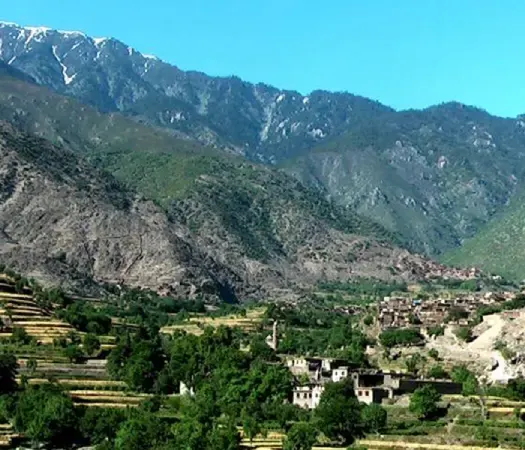
The lower Bashgal valley in eastern Nuristan: home of the Kom, the tiered village Robertson lived in, and the Paprok gem workings.
About Kamdesh
Kamdesh is the lower and middle Bashgal valley, in the east of the province, where the Landai Sin comes down from Bargi Matal and turns east to leave Nuristan for the Kunar near Barikot. Kamdesh village, Kombrom to the Kom, stands high on a spur they call Clay Ridge, above the meeting of the Landai Sin and the Kushtoz stream, at about 1,850 to 2,100 metres and some 600 metres above the river. The district centre is down on the valley floor at Urmul. Side valleys come in from both banks: Kushtoz and Kamu on one side, Mirdesh, Saret and Pitigal on the other, and Paprok far up to the west.
It is the home country of the Kom, who speak Kamviri, a form of Kamkata-viri, the language of the Bashgal. They share the district with others: the Kshto at Kushtoz, the Mumo at Mandagal, whose Mumviri sits between Kamviri and the speech of the upper valley, and Kata families at Paprok and Purstam. The Kom country runs on over the provincial line into Kunar, where in some villages Pashto has taken over.
Kamdesh is the village people picture when they think of Nuristani building. Robertson found about six hundred houses in three divisions, rising in places like a giant's staircase, so that the roofs were the only level ground, used for drying grain and for dancing. The carved shrines of the old gods Gish and Moni stood near the eastern division, and the carved timber walls of the mosque of Kamdesh were photographed by Herbert Maeder in 1968.
Sir George Scott Robertson made Kamdesh his base for nearly a year, from 1 October 1890 to 22 October 1891, and wrote The Kafirs of the Hindu Kush from what he saw there and on his journeys to Bargi Matal and Parun. It is still the classic account of old Kafiristan. He watched archery as the sport of early spring, the men and boys in two sides shooting at marks on opposite slopes of a gully, with team contests at festivals; archery tournaments are still held in Nuristan today, in Parun. Four years after he left, in December 1895, the Amir's army reached Barikot, and in January 1896 it marched up the Landai Sin and took Kamdesh.
The Kom farm maize, wheat, millet and beans, keep goats and cattle on the high pastures in summer, and grow walnuts, mulberries and other fruit. Morels and wild cumin gathered in Pitigal are sold to traders, and the forests have been cut hard for timber since the 1990s. High in the far west of the district, at about 4,000 metres above Paprok, are the pegmatite workings that give tourmaline in many colours, kunzite and beryl.
On the night of 28 July 2021 a flash flood tore through Mirdesh: at least 113 bodies were recovered in the first days, and the Red Cross later put the dead at more than 260, with seven bridges and three mosques destroyed. Many people first hear the name Kamdesh from 3 October 2009, when about 300 fighters attacked Combat Outpost Keating, the American base on the valley floor at Urmul, and eight American soldiers were killed. The book and film The Outpost tell that story; our account of the battle, and of the valley the film does not show, is linked below.
The road in comes from Kunar: up the Kunar river to Barikot, then about 38 kilometres west up the Landai Sin to Urmul. A road from Ishtavi in Parun towards Kamdesh was being built in 2021, but in 2023 people from Kamdesh and Bargi Matal still had to go round through Kunar to reach their provincial capital.
- Setting
- Eastern Nuristan, the lower and middle Bashgal valley
- River
- The Landai Sin (Bashgal), joining the Kunar
- Centre
- Urmul, on the valley floor below Kamdesh village
- Population
- About 30,600 (2024 estimate)
- People
- The Kom; also the Kshto, Mumo and Kata
- Known for
- Tiered timber villages, Robertson's base, Paprok tourmaline
Other districts of Nuristan
Plan your Nuristan journey
Ready to plan a visit, source Nuristani products, or discuss an investment? Your message goes to Obaid, who is from Nuristan, and his team in Afghanistan and the UK. We reply to every message.