Six thousand years of ultramarine from the Sar-e Sang mines of Badakhshan: the grades, the dye and the fakes, what it sells for by the kilogram, who it has paid, and how to buy it.
The stone
The oldest gemstone in trade
Lapis lazuli is the stone Afghanistan is famous for, and nearly all of the world's fine blue lapis has always come from one place: the mines of Sar-e Sang above the Kokcha river in Badakhshan, in the far north-east of the country. They have been worked for more than six thousand years. Their blue went into the beads of Mehrgarh, the royal tombs of Ur, the funeral mask of Tutankhamun and, ground to ultramarine, the robes of the Virgin in Renaissance painting. Marco Polo wrote of the mountain where the finest azure in the world was found, and did not see it; the first European to reach the mines was an East India Company officer in 1838.
This page is for people who want to buy it, from a single cabochon to blocks by the kilogram. It covers where the stone comes from and how it is mined, what the grades mean and how to read them, how lapis is dyed and imitated and how to test it, what it sells for with the source and date of every figure, the trade and the questions about who it has paid, the law for buyers abroad, and how to buy well. We are from Nuristan; Badakhshan is our neighbour, and we source its lapis at first hand and sell it as what it is, Sar-e Sang lapis.
The mine
Sar-e Sang, Kokcha valley, Kuran wa Munjan district, Badakhshan
Altitude
Workings at 2,700 to 3,400 metres; camp at 2,500
Season
June to September; snow closes the mine for the rest of the year
The rock
Lenses of lazurite with pyrite in marble, one to four metres thick
Output
About 9,000 kilograms a year, on the only published estimate
Mined since
The seventh millennium BC; the oldest working mine on earth
Best grade
Even, deep, slightly violet blue, little pyrite, no calcite
Hardness
5 to 6; a stone for cabochons, beads and carving
The mine
Sar-e Sang, the stone summit
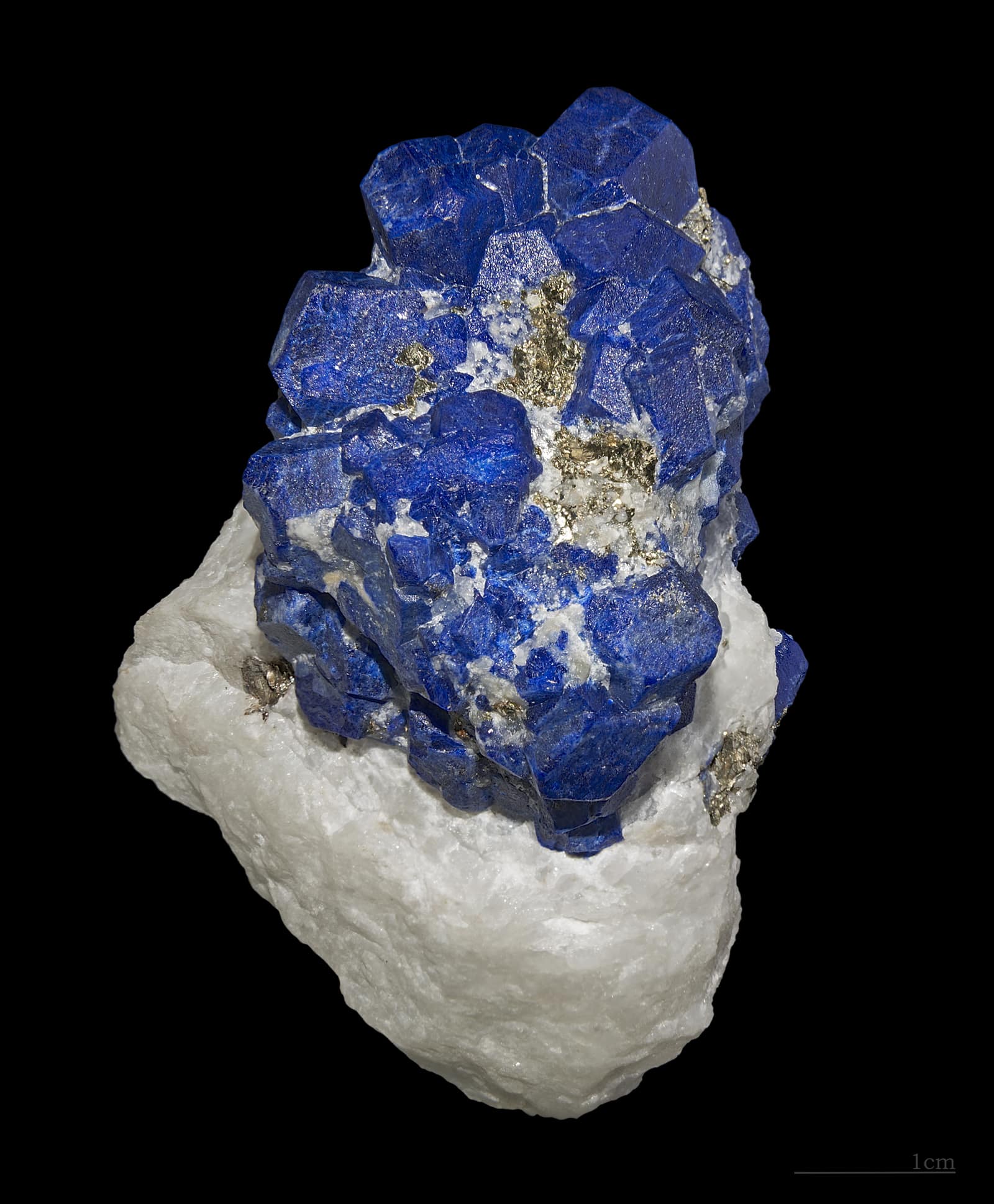
Sar-e Sang means the stone summit. The settlement sits in the Kokcha valley in Kuran wa Munjan district, in the Hindu Kush of Badakhshan, under peaks of 3,500 to 5,500 metres; the miners' camp is at about 2,500 metres and the workings run between 2,700 and 3,400. The lapis lies in a band of marble several hundred metres thick, as lenses and beds one to two metres thick, sometimes four and by one modern account six, that run twenty to a hundred metres along the hillside. The blue is the mineral lazurite, almost always grown with brassy pyrite, in a white ground of calcite and dolomite. The ancient miners cracked the rock with wood fires; today they use dynamite, and detached blocks of many kilograms come out, rarely more than a hundred.
Winter closes the mine. The two tracks to it are open only from June to November and the workings themselves are usable for perhaps five months, which the British Geological Survey narrows to June to September. Before the war of 1979 about a tonne a year was extracted and most of it exported, the rest sold to lapidaries in Kabul; the journey from the mine to Kabul by way of Jurm and Faizabad took at least nine days. The only published modern estimate is about 9,000 kilograms a year, with reserves put, speculatively, at 1,300 tonnes. Accounts of how many mines there are disagree, from seven old workings reduced to one to twenty-three shafts driven 250 metres into the mountain; the Peshawar dealers rank the stone from the working they call Mine Four highest of all, for a vivid blue with almost no pyrite or calcite.
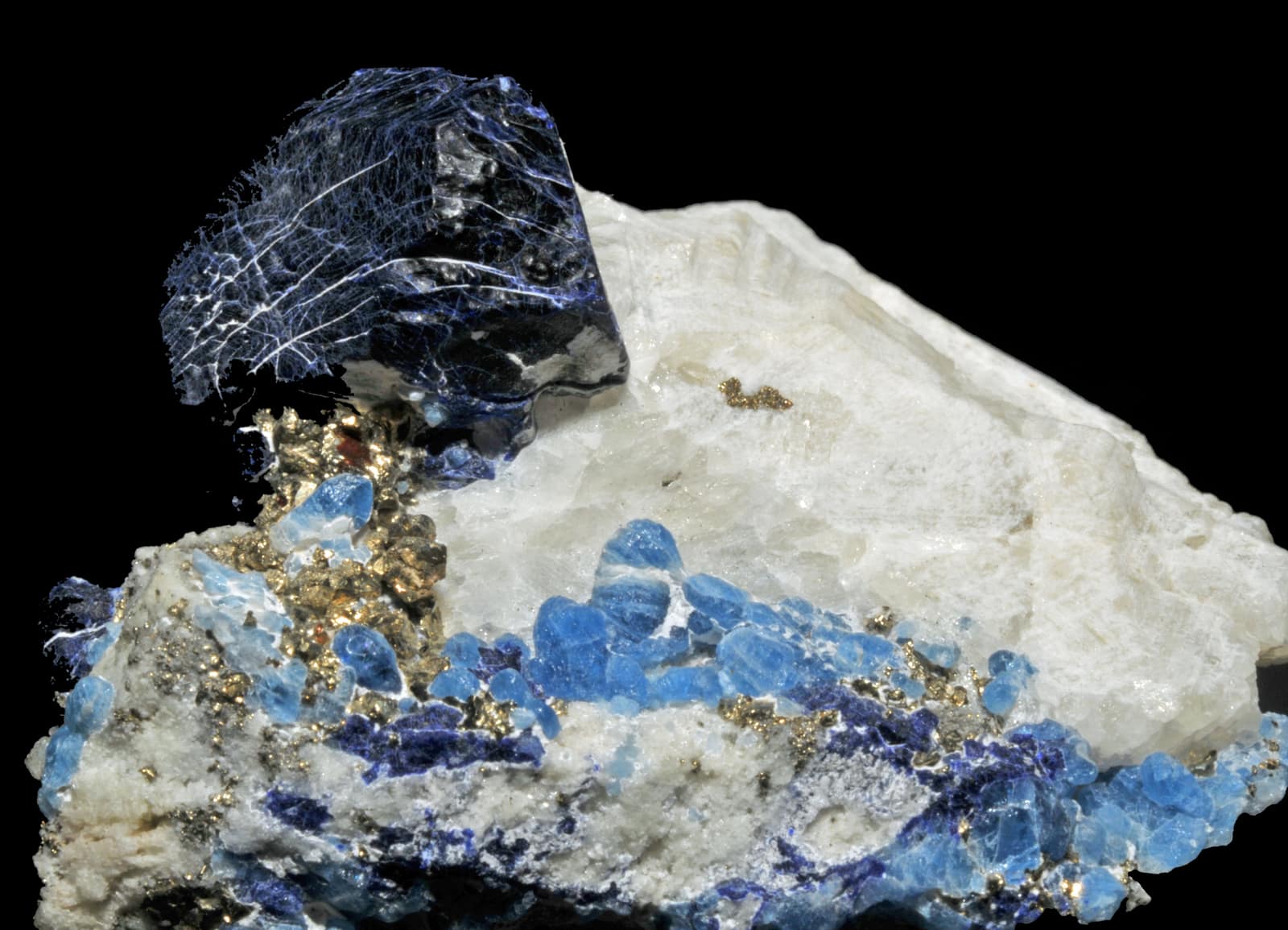
Lazurite, the mineral of the blue, as a crystal from Sar-e Sang.
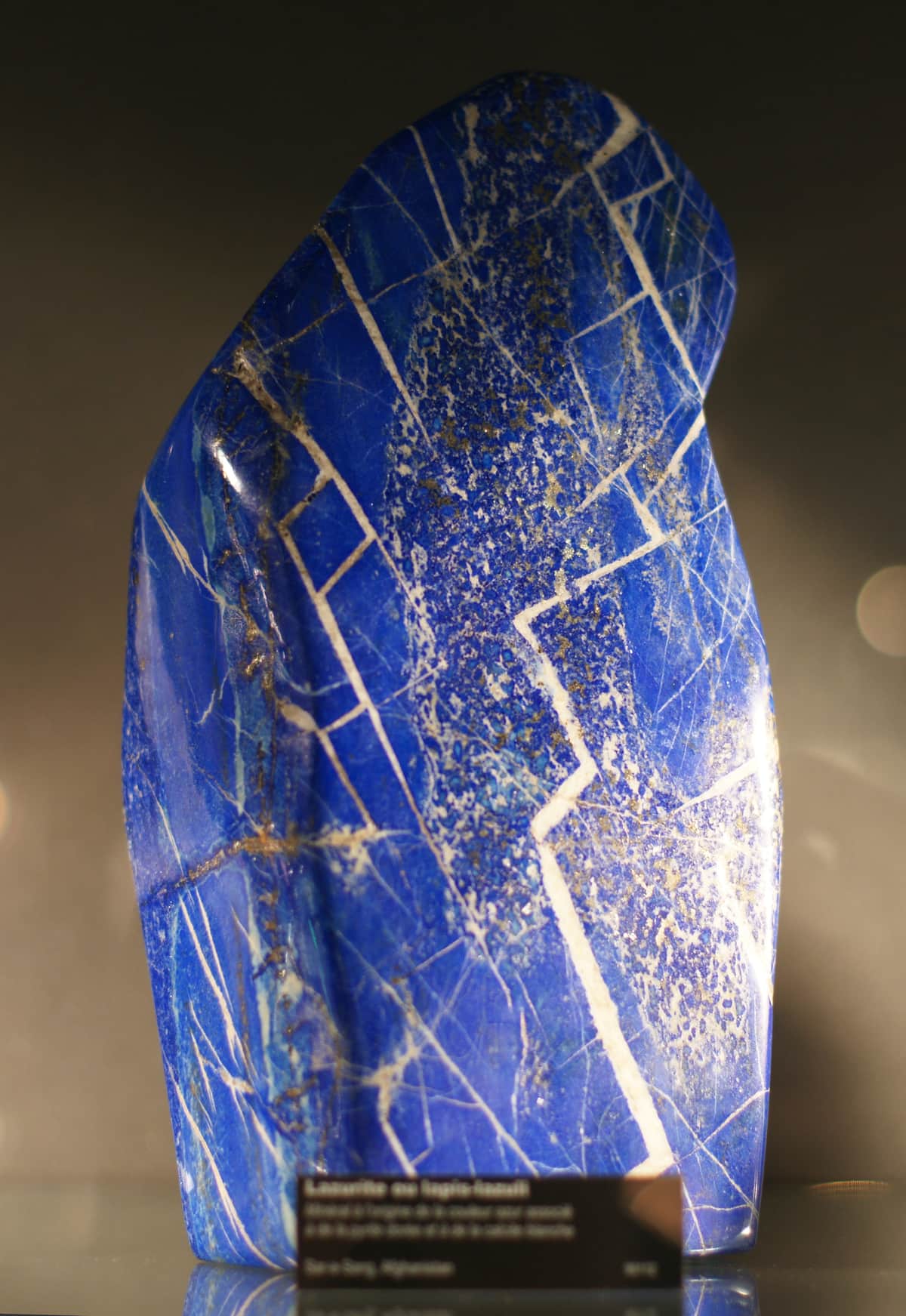
Polished Sar-e Sang lapis: blue lazurite, gold pyrite and the white calcite that lowers the grade.
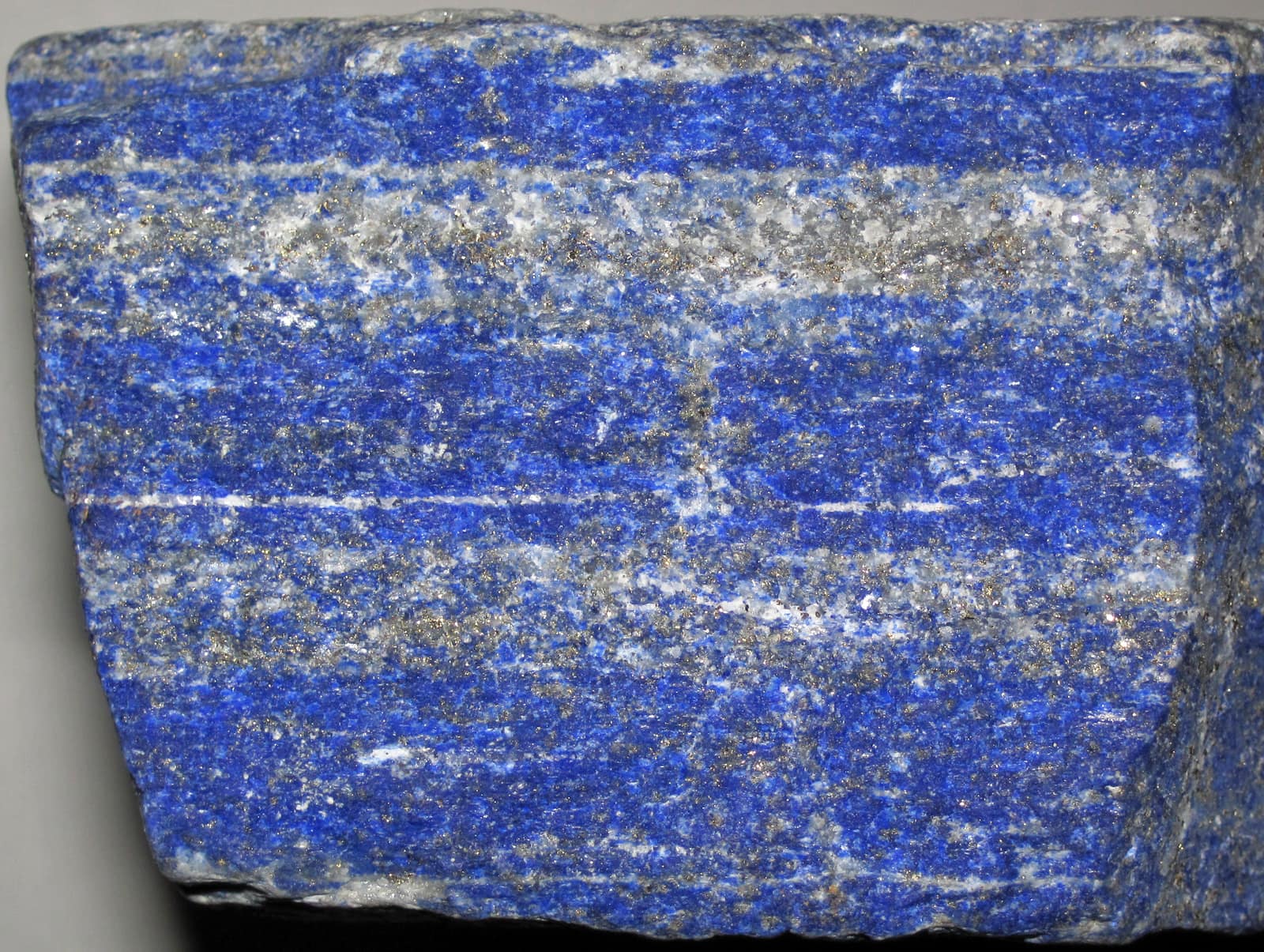
A block of the first grade, the kind that leaves the mine by the kilogram.
Six thousand years
From Ur and Tutankhamun to the painters of Europe
Lapis from Badakhshan is the oldest traded gemstone in the world. Beads of it lie in Neolithic burials at Mehrgarh in Baluchistan and as far as the Caucasus and Mauritania; the workshops of Shortugai on the Oxus cut it for the Indus cities; the Sumerians of Ur buried it with their kings in the third millennium BC, and analysis in the 1960s traced their stone to these mines. It is in the gold mask of Tutankhamun. Chinese writers knew the region by the sixth century, and the Arab mineralogist al-Tifashi described the extraction of its pigment in the thirteenth. Marco Polo heard of the mountain of the finest azure in 1271. John Wood of the East India Company reached the mines in 1838 and described them in 1841.
The name carries the place in it. Lapis is Latin for stone; lazuli goes back, through Arabic and medieval Latin, to the Persian lāzhward, the name of the stone itself and, on one old reading, of a place where it was mined. From the same word came the English azure and the Spanish and Portuguese azul, so the word for blue in several European languages began as the name of the stone from Badakhshan.
The pigment is the stone's second life. Ultramarine, the blue from beyond the sea, was ground from Badakhshan lapis for the cave temples of Afghanistan in the sixth and seventh centuries and for every great European painter until a French chemist synthesised it in 1826; Dürer complained in 1508 of paying a hundred florins for less than half a kilogram. The natural pigment is still made and sold by the gram.
Grades
Nili, asmani, sabzi, and what the letters do not mean
Nili, the first grade
An even, deep, slightly violet blue with little or no pyrite and no visible calcite. This is what the trade means by Afghan or Persian grade, and what GIA describes as the top of the hierarchy. The Peshawar dealers' Mine Four material is the type.
Asmani, the sky grade
A paler, lighter blue, still even, often with more pyrite. Good material for beads and carving, priced well below nili.
Sabzi or sufsi, the green grade
Blue tinged or mottled with green, with more calcite. The cheapest Afghan grade, and the one most often dyed or waxed to look like the first.
Pre-war state grading
Before 1979 the Ministry of Mines sorted the output into five categories, the first fetching three times the price of the last: about two per cent were massive deep blue blocks without inclusions or cracks, fourteen per cent smaller pieces of the same quality, both for jewellery, and the rest for ornamental work.
What to look for is simple to say and hard to find: an even blue in the medium-dark range, a tone of roughly 75 to 85 per cent, with a hint of violet rather than green, a few small flecks of pyrite scattered like stars rather than clustered, and no white calcite showing. Too much pyrite dulls the stone and turns it greenish; stones darker than about 90 per cent tone fall sharply in price. Chilean lapis is paler, greener and heavy with calcite; Russian stone from Lake Baikal varies and carries pyrite and calcite; the Badakhshan mines have produced most of the finest material in history and still do.
Dealers' letters mean nothing. AAA, AA and A are not a grading system but a seller's enthusiasm, and the same block can be sold under all three. Grade by eye in daylight, or by the Afghan names above, and remember that a stone with no variation in its blue at all has probably been dyed.
Lapis is sold as rough blocks by the kilogram, graded, for cutters and carvers; as slabs for inlay; as cabochons and beads for jewellery, where the pyrite stars are prized by American buyers; as carvings, boxes and objects; as watch dials; and as pigment, in grades from a few euros to two hundred euros for ten grams. It is opaque, so clarity does not apply, and it is soft at 5 to 6 on the Mohs scale, so it is set in pendants, earrings and brooches rather than everyday rings.
Dye and fakes
How lapis is improved, imitated and tested
Lapis is dyed to deepen the blue and hide the calcite, and the dye has only fair stability; undyed stone is often impregnated with wax or oil to improve its colour and lustre, and pale material is sometimes heated. GIA notes that a gemmologist can detect all three. The imitations are old and new: sodalite, which is lighter and coarser; dyed howlite, magnesite or jasper, the last sold as Swiss lapis; glass; synthetic spinel; pyrite fragments set in blue plastic; and the Gilson imitation, made with and without pyrite.
The tests the trade uses are within anyone's reach. A cotton bud wetted with acetone and rubbed on an unseen spot lifts dye from a dyed stone. Real lapis varies: a uniform, flawless blue suggests dye or imitation, and the pyrite should be scattered at random rather than arranged. Dyed howlite shows grey web-like veining; sodalite lacks pyrite. Under ultraviolet light the calcite in natural lapis glows orangy pink in spots. For a carving or a block of value, a laboratory identification report from GIA or AGL will name the treatments it finds.
Prices
What lapis lazuli sells for
Prices asked or paid at the dates stated, with sources, from low-grade rough by the kilogram to the pigment by the gram.
Prices of Afghan lapis lazuli, with sources
Stone or lot
Price
Source
Rough by grade, 2013
Low grade about 5 US dollars a kilogram; medium 400 to 1,000 euros a kilogram; the purest upwards of 10,000 euros a kilogram
Saudi Aramco World
Rough, US lapidary trade, 2012
High grade about 300 US dollars a kilogram; low grade wholesale in Germany about 17 euros a kilogram
Ganoksin Orchid forum
Kabul market, 2019
About 20 US dollars a kilogram on average, against about 500 a decade earlier, after years of smuggling
Times of Central Asia
Low grade inherited lot of 70 kilograms, 2020
50 to 80 US dollars a kilogram realistic; 150 on the high side
International Gem Society forums
Kabul prices, 2022
Reported down about 70 per cent on earlier years because of shipping restrictions
Rapaport Magazine
Dealer asking prices on social media, 2025 to 2026
100 to 200 US dollars a kilogram for stone sold as top quality
Instagram and Facebook dealer posts
Cabochon, 9.09 carats, Afghan, no enhancement, 2026
73 US dollars, about 8 a carat or 40 a gram
The Natural Gemstone Company
Bead strands, 3 to 10 millimetre, US retail, 2026
16 to 53 US dollars a strand
US bead retailers
Natural ultramarine pigment, 2013
About 8 to 200 euros for ten grams by grade
Kremer Pigmente via CHSOS
Lapis is priced by the kilogram as rough and by the piece as finished work, and the spread between grades is a hundredfold. The figures above are what was asked or paid at the dates given; there is no official price, Namak Mandi quotes a stranger one price and a known buyer another, and Kabul's prices have moved with war, blockade and smuggling more than with demand. What has not changed is the premium for the first grade: even, deep, violet blue with little pyrite and no calcite is scarce in any year.
The trade and the law
Down the mountain on mules, and who has been paid
The stone comes down from the mine on mules and ponies, then by lorry to Kabul, Peshawar and Karachi, or overland into China; from Karachi it has gone by container to Hong Kong, and traders have shipped containers straight from Kabul to China. Peshawar sorts most Afghan gems, and the Chinese market took much of the lapis of the 2010s. Afghanistan's recorded exports of all precious stones were about 7 to 9 million US dollars a year in 2022 to 2024; estimates of the lapis trade alone have run to 200 million dollars for 2014 and 2015 together, and to 2,000 tonnes in a single year worth 60 to 120 million dollars on which the state received 230,000.
That gap is the stone's modern history. In 2016 Global Witness published War in the Treasury of the People, which found that armed groups had taken about 20 million US dollars from the Kuran wa Munjan and Deodarra mines in 2014, about 12 million in 2015 with the Taliban's share rising to around 4 million, and that by mid-2016 the Taliban were reported to take at least half; it called the lapis that supplies much of the world market a conflict mineral by any reasonable definition and asked for supply-chain due diligence and a United Nations investigation. A fifteen-year contract awarded in 2013 was seized in 2014 and later cancelled; the government blocked the roads out in 2015 and 2016; the Taliban's own stones commission took about 6 million dollars from Badakhshan lapis in 2016 and captured the district in 2019. Since 2021 the authorities have taxed extraction and trade, the United Nations monitoring team reported in 2024 that mineral revenues had risen while contracts went to the well connected, and the mines have been closed and reopened: in December 2025 the ministry promised licences for the Badakhshan workings, and in July 2026 miners protested a month-long closure under a decree against illegal mining while sites linked to powerful figures kept working.
No law bars the stone. The European Union's conflict-minerals regulation and the American Dodd-Frank rule cover tin, tantalum, tungsten and gold and nothing else, so lapis is not a designated conflict mineral anywhere, despite the 2016 call. The United Kingdom and the European Union have no ban on Afghan goods and charge no duty on lapis under tariff heading 7103; the United States admits unworked stone free and allows commercial imports under its Afghanistan general licence with the conditions explained in our buying guide. What a buyer with a conscience can do is ask which mine, which year and which road, and prefer a seller who can answer in writing. We can, for what we source, and we say when we cannot.
Buying
How to buy Afghan lapis well
Buy lapis in daylight, by grade rather than by letters, and test it: acetone on a hidden spot, a look for random pyrite and for the natural variation a dyed stone lacks, a loupe for grey veining or coarse grain. Weigh rough before and after it goes to a cutter. For blocks, carvings or large lots, pay for a laboratory identification report, which is cheap against the price of a kilogram of first-grade stone. Ask where it was mined and how it came out; a seller who says Sar-e Sang and can name the working and the year is telling you more than one who says Afghanistan.
If you want lapis sourced, as graded rough by the kilogram, as slabs, cabochons or beads, or as carving stone, write to us with grade, form, quantity, budget and your import country. Our wholesale page sets out how an order works and what we put in writing.
No, but Afghanistan is the oldest source and gives the finest stone. Lapis is also mined near Ovalle in Chile and west of Lake Baikal in Russia, and in small amounts in Tajikistan, Pakistan, Burma, Angola, Canada, Italy and the United States. Chilean lapis is paler, greener and heavy with calcite, Russian stone variable; most of the finest lapis in history has come from Sar-e Sang in Badakhshan.
Where is lapis lazuli mined in Afghanistan?
At Sar-e Sang in the Kokcha valley, in Kuran wa Munjan district of Badakhshan province, in the far north-east of the country. The workings lie at 2,700 to 3,400 metres and can only be worked in the summer months.
How much is lapis lazuli worth?
It depends almost entirely on grade. Rough has sold from about 5 US dollars a kilogram for low grade to 400 to 1,000 euros a kilogram for medium and over 10,000 euros a kilogram for the purest (2013 figures), while Kabul's average price fell to about 20 dollars a kilogram in 2019 after years of smuggling. A nine carat Afghan cabochon retails at about 8 dollars a carat. Every figure on this page carries its source and date.
What colour of lapis lazuli is the most valuable?
An even, deep, slightly violet blue of medium-dark tone, with little or no pyrite and no visible white calcite. The Afghan trade calls it nili. Greenish lapis, lapis heavy with calcite, and stone so dark it reads black are all worth much less.
How can you tell real lapis lazuli?
Real lapis varies in its blue, carries pyrite scattered at random, and is opaque. A uniform flawless blue suggests dye or imitation; acetone on a cotton bud lifts dye; dyed howlite shows grey veining; sodalite has no pyrite and a coarser grain; glass and plastic feel warm and light. Under ultraviolet light natural lapis shows orangy pink spots from its calcite. A laboratory report settles any stone of value.
Is Afghan lapis lazuli dyed?
Low grades often are, to deepen the blue and hide the calcite, and undyed stone is often waxed or oiled for lustre. Both have only fair stability and both can be detected. Ask for the treatment in writing and test with acetone; first-grade stone needs no help.
Is lapis lazuli a conflict mineral?
Not in law: the European and American conflict-minerals rules cover tin, tantalum, tungsten and gold only. In fact, Global Witness found in 2016 that armed groups took about 20 million US dollars from the Badakhshan lapis mines in 2014 and called the stone a conflict mineral by any reasonable definition. Since 2021 the revenue has gone to the Afghan authorities. A buyer who cares should ask which mine, which year and which road, and prefer a seller who can say.
Is it legal to import lapis lazuli from Afghanistan?
Yes, in the United Kingdom, the European Union and the United States, provided the seller is not a sanctioned person. Lapis falls under tariff heading 7103 and carries no import duty in the UK and EU, with VAT due; unworked stone enters the United States free. The United States allows commercial imports under General License 20 with conditions on payments to the authorities, which our buying guide explains.
What is ultramarine?
The pigment ground from lapis lazuli, named for the blue that came from beyond the sea. Badakhshan lapis coloured Afghan cave paintings in the sixth century and European altarpieces until 1826, when a synthetic ultramarine was made in France. Natural ultramarine from lapis is still sold by the gram for painters and restorers.
Ready to plan a visit, source Nuristani products, or discuss an investment? Your message goes to Obaid, who is from Nuristan, and his team in Afghanistan and the UK. We reply to every message.