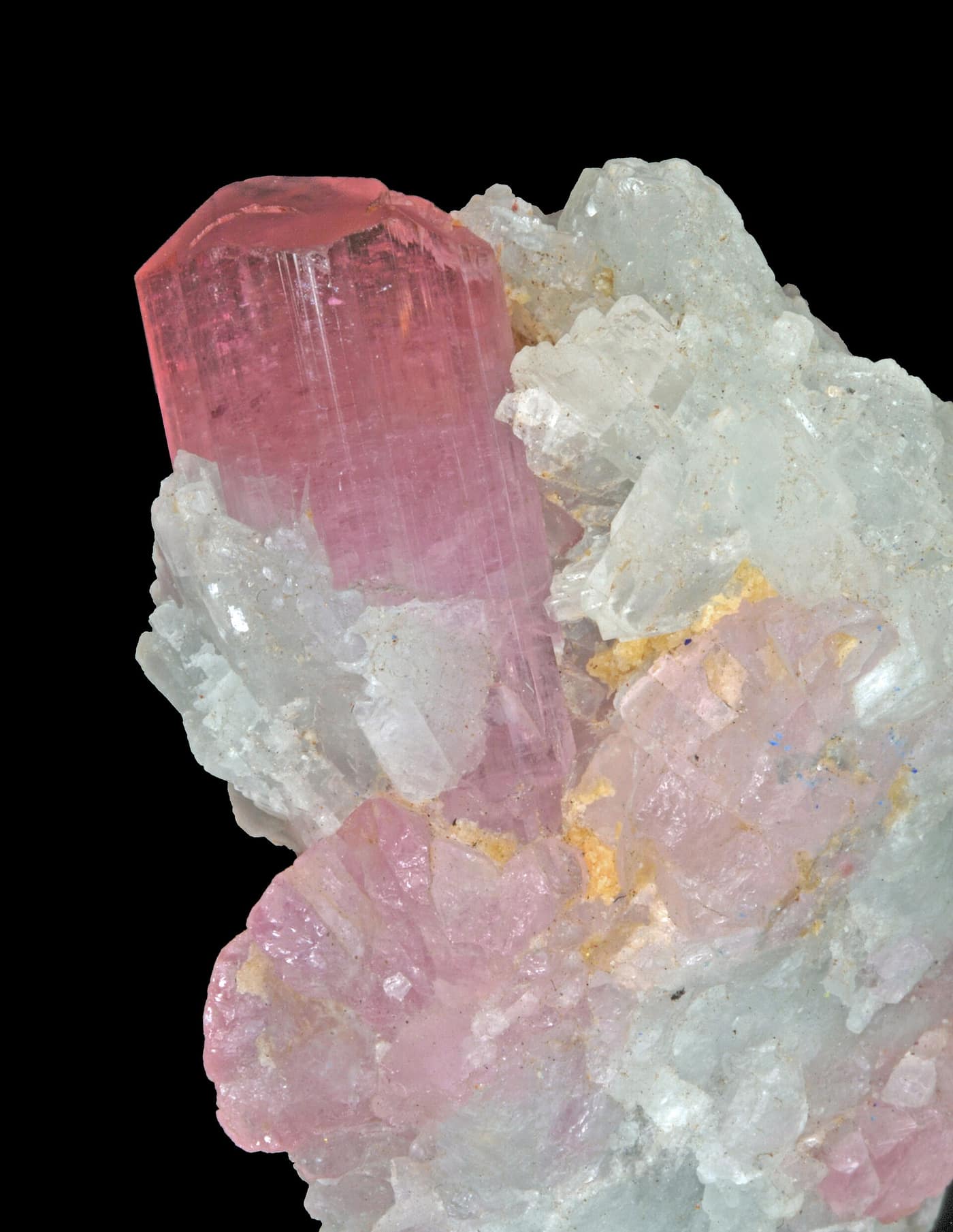
The gemstones of Nuristan
The stones, the mines they come from, how they reach the market, and what a buyer should know.
Stones the world knows, from valleys it does not
Nuristan is one of the great gem countries of the world, and very few people who own its stones could find it on a map. The pink and green tourmalines sold as Paprok, the kunzite sold as Mawi or simply as Afghan, and much of the aquamarine and morganite that reaches the market through Peshawar come out of the granite veins of these valleys and the two provinces beside them.
This page is a plain guide to them: what the stones are, where each field actually lies, how they are mined and sold, what is known about the lithium in the same rock, and what a buyer should watch for. We are from Nuristan and not geologists, so the geology here follows the published surveys, which are listed at the foot. Where the surveys disagree about a place, we say so, because a good many stones are sold under the wrong name.
- Main stones
- Tourmaline, kunzite, aquamarine, morganite
- The rock
- Lithium-rich granite pegmatite, of Oligocene age
- Best-known mine
- Paprok, in Kamdesh district
- Kunzite
- The Nilaw-Kolum field, with the Mawi mine, and Kantiwa
- Largest crystals
- Gem spodumene up to 45 cm; tourmaline pencils to 20 cm
- Lithium
- About 2.1 million tonnes of lithium oxide estimated, undrilled
- Sold through
- Peshawar and Kabul; state auctions in Du Ab since 2024
- Mined by
- Local miners, by hand, in small workings
Why the stones are here
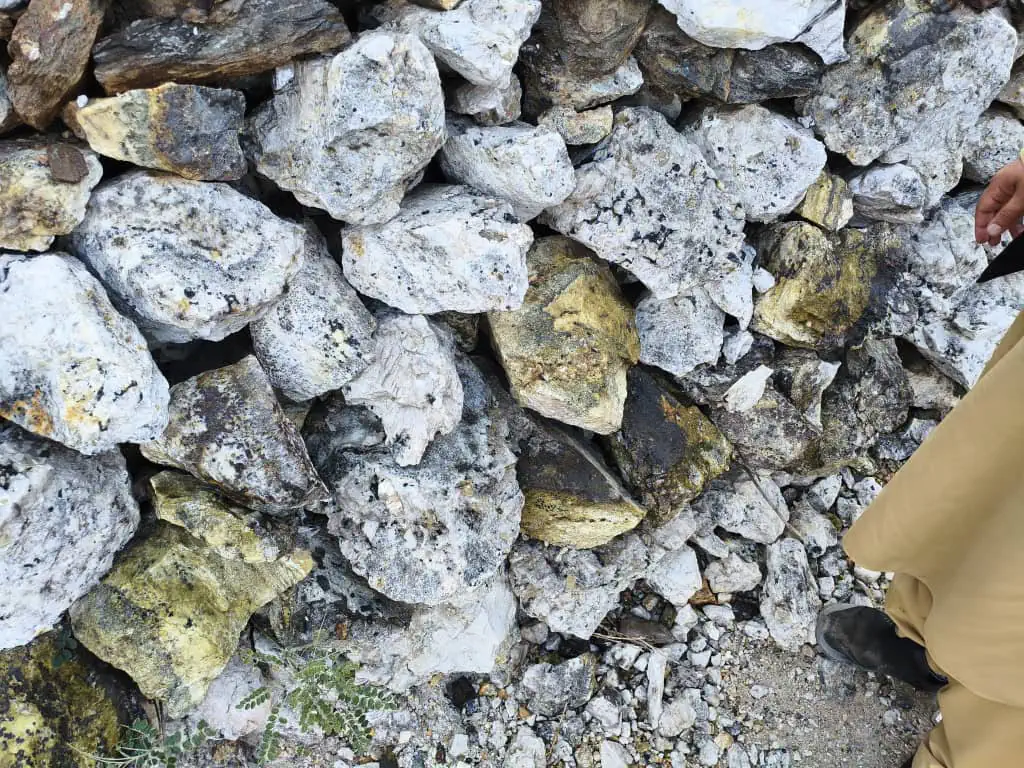
Veins of coarse granite
The stones come from pegmatites: veins of very coarse granite that formed when the last, water-rich part of a body of molten rock was squeezed into cracks in the surrounding stone and cooled slowly. The granites behind Nuristan's pegmatites are of Oligocene age, around thirty million years old, and they pushed up into far older gneiss, schist and marble.
What makes these veins special is their chemistry. They belong to the family geologists call LCT, for lithium, caesium and tantalum, and they also concentrate beryllium and boron. Lithium gives spodumene, whose gem form is kunzite. Boron gives tourmaline. Beryllium gives beryl, which is aquamarine when blue and morganite when pink. The gem crystals grow in pockets inside the vein, some of them half a metre across and filled with clay, and the miner's whole skill is in finding the pockets.
Soviet geologists who mapped the area in the 1970s called it the largest concentration of lithium-bearing pegmatites in the world. The veins run in two belts on either side of the Alingar granite: one through Parun, Kantiwa, Pachigram and the Pech, the other through Mandol, Nilaw-Kolum and the Alingar. Single veins are commonly two to five kilometres long and anything from a metre to sixty metres wide.
Crystal-bearing rock broken out on a slope in the Pashagar valley of Nurgaram. Our own photograph.
Where each field really is
Stones are sold under the name of a mine, a valley or a province, and the three do not always agree.
| Field | What is found | Notes |
|---|---|---|
| PaprokKamdesh district, Nuristan | Tourmaline in pink, green, blue and two colours together; kunzite; topaz; smoky quartz | The most famous name in Afghan tourmaline. The workings are in a side valley south of Paprok village, at roughly 4,000 metres, and were already being heavily worked by local miners in 1974. |
| KantiwaKantiwa, central Nuristan | Kunzite, green tourmaline, smoky quartz | Gem pegmatites spread over an area of about ten kilometres by twenty. Older tables file it under Parun district, which it was part of, and some wrongly under Nangarhar. |
| Nilaw-Kolum, with MawiDu Ab and Mandol, western Nuristan | Kunzite above all; tourmaline, morganite, beryl, spessartine garnet | The great kunzite field, mined since the early 1970s. More than 1,260 kilograms of gem kunzite came out between 1973 and 1975. Many labels and the US survey say Laghman; the mine's published coordinates fall inside Du Ab district on the government's district map. |
| KorgalNurgaram district, southern Nuristan | Green tourmaline | Also written Kurghal. Mined around 1995. The US survey lists it under Laghman, and its coordinates fall just inside Nurgaram. |
| Parun and PachigramParun and Bargi Matal, Nuristan | Mostly lithium veins; some kunzite, blue and watermelon tourmaline | The Parun field runs about 65 kilometres from north to south, and Pachigram has about a hundred veins between 3,100 and 4,700 metres. These are the lithium fields more than the gem fields. |
| Dara-i-Pech and Gur SalakKunar province, not Nuristan | Morganite, kunzite, green to indigo tourmaline, aquamarine | The Pech valley fields are over the provincial line in Kunar, though their stones are often sold as Nuristan. The label Dara-i-Pech can mean anywhere in the Pech valley. |
Why the muddle over provinces? Nuristan became a province only in the late 1980s, from valleys that had been governed as parts of Laghman and Kunar. The Soviet surveys of the 1970s, and the American tables built on them, use the old provinces. A stone labelled Laghman or Kunar may well be from what is now Nuristan, and the reverse is true too.
What comes out of the pockets
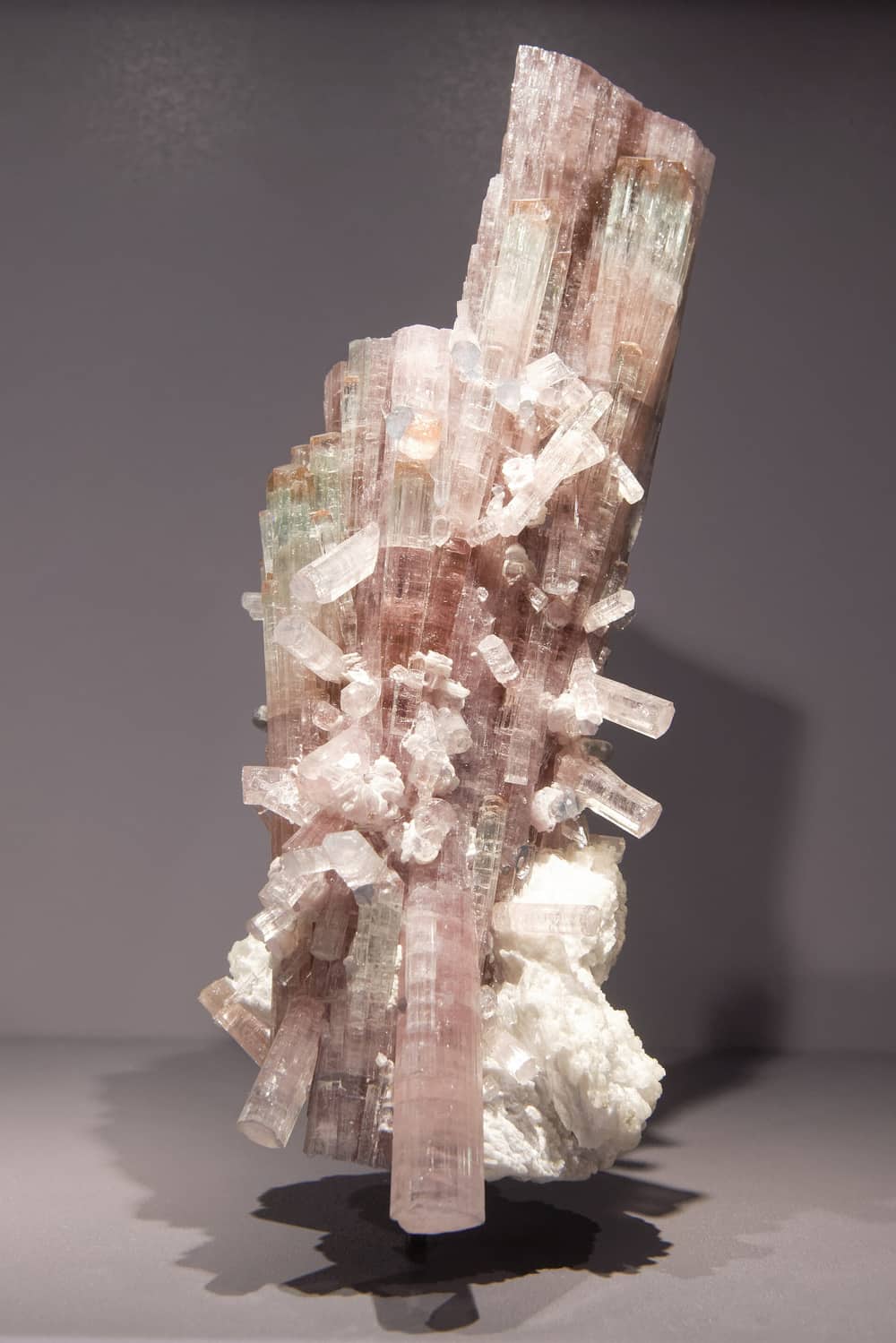
Tourmaline from Paprok, in the Paris natural history museum.
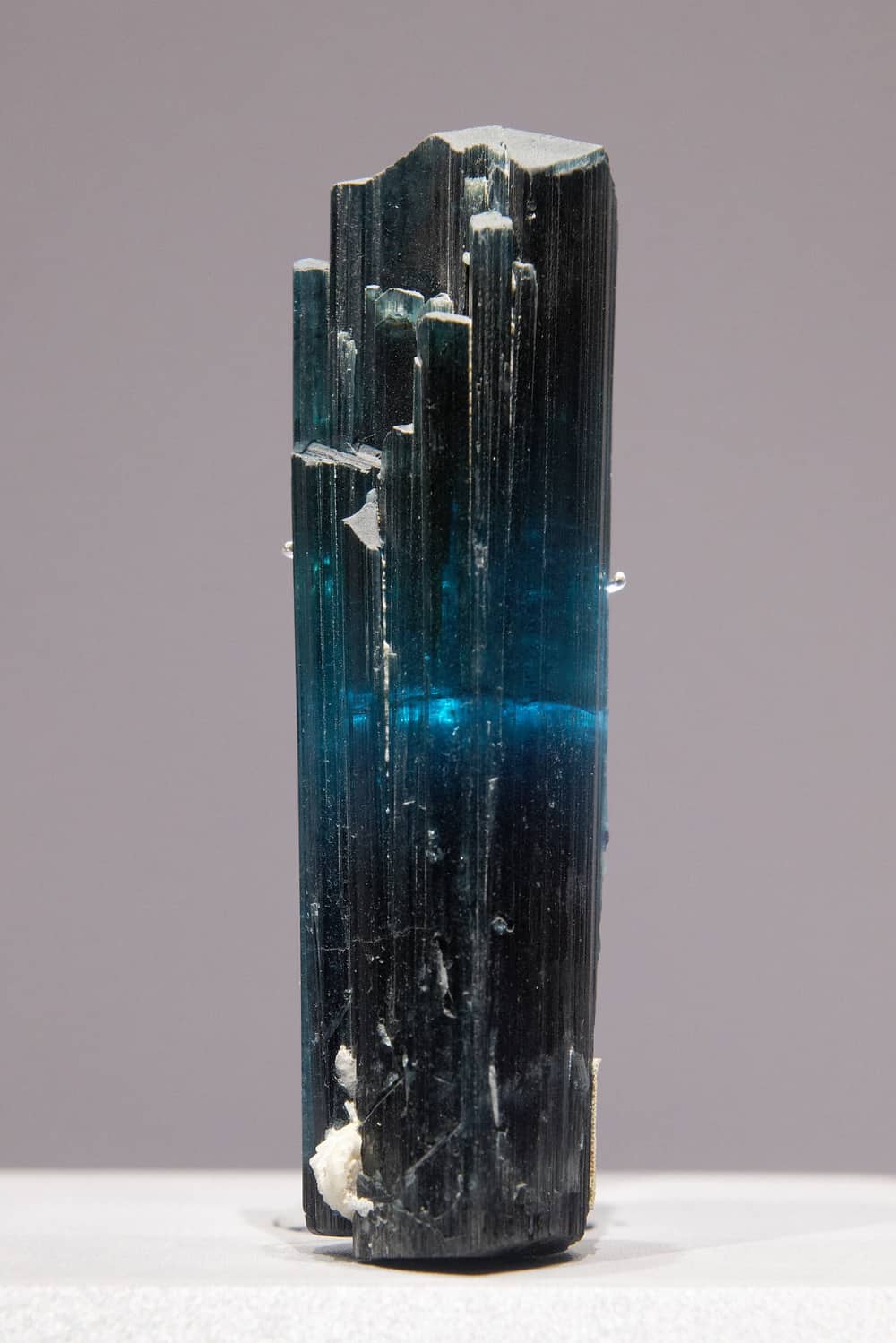
Blue tourmaline, indicolite, from Paprok.
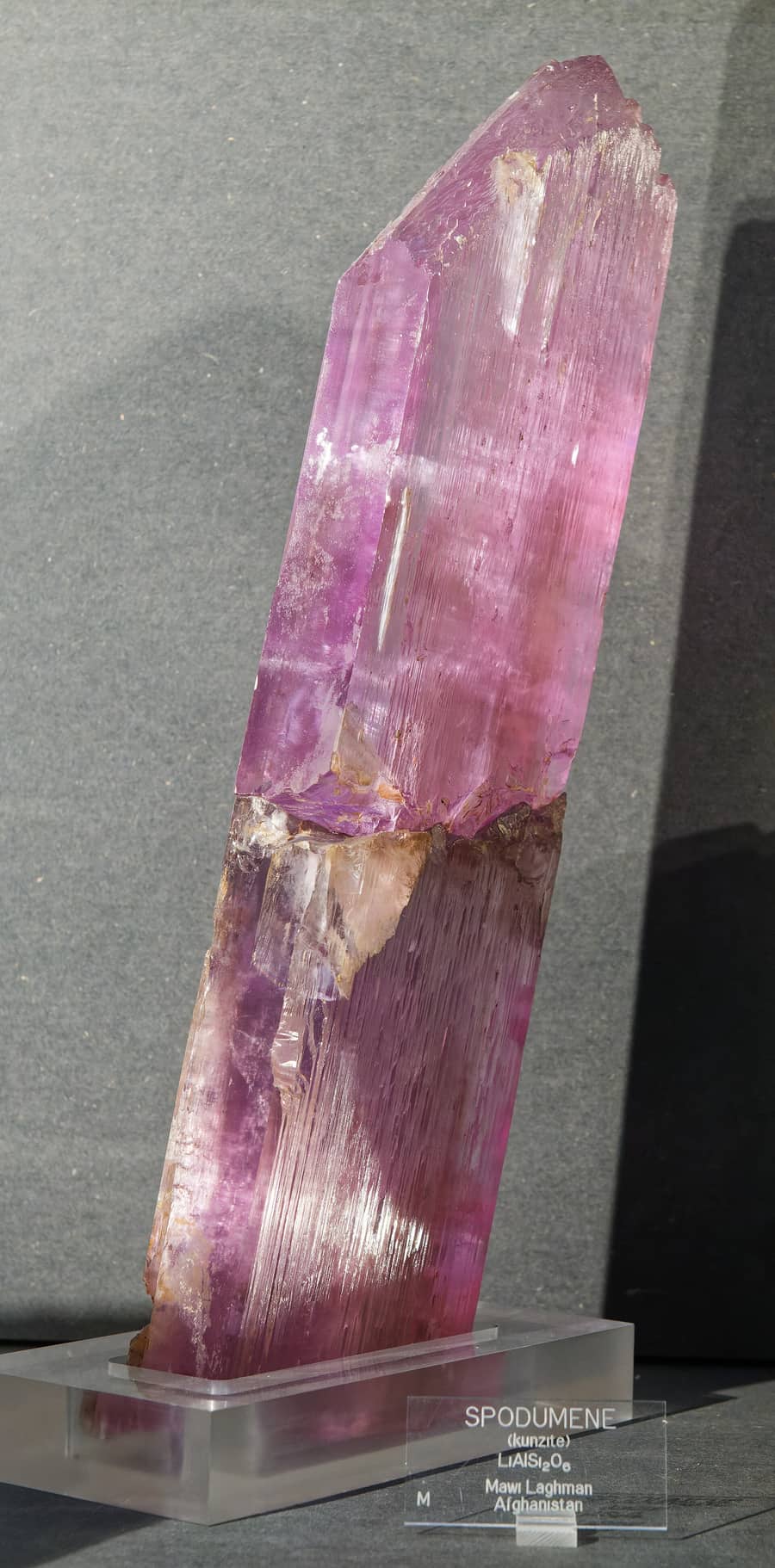
Kunzite from Mawi, in the Sorbonne's mineral collection.
Elbaite
Tourmaline
Pink, green, blue and crystals that change colour along their length or from core to rim, the kind sold as watermelon. Paprok's are the best known, often on a bed of white feldspar or clear quartz. Blue tourmaline is called indicolite and the red-pink rubellite.
Gem spodumene
Kunzite
The lilac to pink form of spodumene, the main ore of lithium. Nuristan's crystals are among the largest known, with gem pieces to 45 centimetres on record. It comes out of the ground blue-violet or green and is often turned pink by leaving it in the sun.
Beryl
Aquamarine and morganite
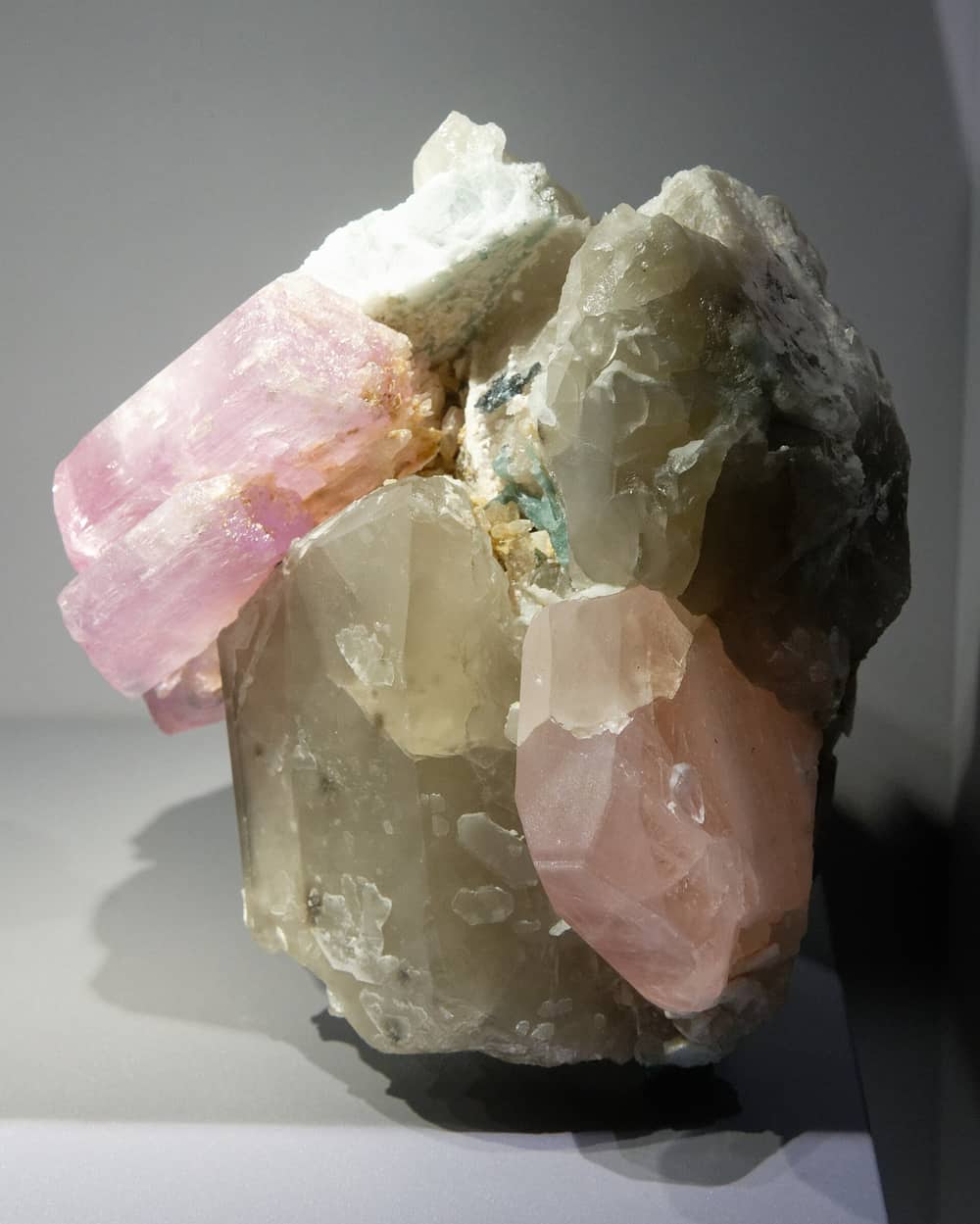
Blue and pink beryl. The aquamarine is best known from Gur Salak in Kunar, in crystals to seven centimetres, light to dark blue. Morganite, pink to peach, is reported from Mawi and the Pech.
Topaz, quartz, garnet and rarer things
The rest of the pocket
Topaz, smoky quartz, orange spessartine garnet and lilac lepidolite mica come from the same veins, with collectors' minerals such as pollucite, the ore of caesium, and hydroxylherderite.
Three famous Afghan stones are not from Nuristan, whatever a label says. The emeralds are from Panjshir, the rubies from Jegdalek near Kabul, and the lapis lazuli from Sar-e Sang in Badakhshan. One reference does list small emerald workings in Nurgaram district.
The metal in the same rock
The same veins that give kunzite hold lithium in quantity, because kunzite is only the clear, coloured form of spodumene, and most spodumene is grey and opaque. The Soviet surveys estimated about 2.1 million tonnes of lithium oxide to a depth of a hundred metres in six fields of Nuristan, the largest at Pasghushta. Vein samples ran at between one and a half and just over two per cent.
Those figures need to be read with care, and the American geologists who republished them say so. They are estimates made in the 1970s from what could be seen at the surface, with no sign of drilling or trenching, in mountains where the veins lie between 3,000 and 4,700 metres with no road to most of them. They describe a possibility. The veins also carry tantalum, beryllium and caesium.
From the pocket to Peshawar
Mined by hand, sold abroad
Gem mining in Nuristan is done by local men in small workings, as it always has been. A report of 1985 counted about five hundred miners at the kunzite field, working year round with hand drills, following a vein ten to twenty metres down and scraping the crystals out of the pocket clay by hand. A reporter who visited workings in Parun and the Pech in 2023 found home-made explosives, jackhammers run off generators, picks, and no safety equipment at all. In July 2026 a landslide killed three men at a gem mine at Pachigram in Bargi Matal.
The stones have always gone east. In the 1980s they were carried on foot for hundreds of kilometres to the Pakistani border, and since the 1970s the market for them has been Namak Mandi in Peshawar, where Afghan dealers long made most of the sales. For much of that time the trade was outside the law: mining and selling gemstones in Nuristan was illegal until 2009, when an association of Nuristani gem miners reached an agreement with the Ministry of Mines. The World Bank has estimated that nine-tenths or more of Afghanistan's gemstones leave the country unrecorded.
Little of the value stays in the valleys. The rough stone goes out with traders, and the cutting and grading are done elsewhere. Five tourmaline crystals from Paprok were offered at auction in the United States in 2018 with an estimate of thirty to fifty thousand dollars.
Since December 2024 there has been a second route. The provincial Directorate of Mines and Petroleum gathers rough, chiefly from the Mawi workings in Du Ab, and sells it by open auction to domestic traders, with about ten per cent of each sale to the state treasury. The announced sales have run from 8 million afghanis for tourmaline in Parun to 122.5 million afghanis for about two tonnes of kunzite with beryl and morganite in September 2026. The figures are the directorate's own; our account of the auctions, sale by sale, is on its own page.
Morganite, kunzite and tourmaline grown on quartz, from the Pech valley in Kunar, in the Paris natural history museum.
What a buyer should know
Kunzite fades. Its colour weakens in strong light and heat, and a test on pink Nuristan kunzite found it nearly colourless after a week in direct sun. Wear it in the evening, as jewellers say, and keep it out of a shop window. Kunzite is also often irradiated and heated to deepen the colour, and that colour fades as well. It splits easily along two directions, so it needs a careful setting.
Tourmaline is commonly heated, which is stable and cannot be detected, and sometimes irradiated, which can fade. Most aquamarine on the market has been heated to make it a purer blue. Glass and synthetic spinel are still sold as aquamarine.
Ask where a stone is from and expect a loose answer. Nuristan, in the trade, has long covered the fields of Laghman and Kunar as well, and a famous name such as Paprok sells better than an obscure one. A seller who can tell you the valley, and who mined it, is worth more than a certificate with one word on it.
Asked about Nuristan's gemstones
What gemstones are found in Nuristan?
Tourmaline in pink, green and blue, kunzite, aquamarine, morganite, topaz, smoky quartz and spessartine garnet. They all come from granite pegmatites, veins of coarse crystalline rock that run through the mountains of Nuristan and the neighbouring provinces of Laghman and Kunar.
Where is the Paprok mine?
In Kamdesh district in eastern Nuristan, Afghanistan. The workings are in a side valley south of the village of Paprok, at roughly 4,000 metres, and are famous for pink, green and bicoloured tourmaline.
Is Nuristan tourmaline valuable?
Fine crystals are. Paprok tourmaline is among the most sought-after in the world by collectors, and five crystals from the mine carried an auction estimate of 30,000 to 50,000 dollars in 2018. Ordinary rough is far cheaper, and the miners themselves see little of the final price.
How are Nuristan's gemstones sold now?
Two ways. Miners still sell rough to traders who carry it to Kabul and to Namak Mandi in Peshawar, as they have for fifty years. Since December 2024 the provincial mines directorate has also sold rough by open auction, mostly in Du Ab from the Mawi workings, with about ten per cent of each sale going to the state treasury; single sales have passed 120 million afghanis.
Are emeralds and lapis lazuli from Nuristan?
No. Afghanistan's emeralds come from the Panjshir valley and its lapis lazuli from Sar-e Sang in Badakhshan, both neighbours of Nuristan. Nuristan's stones are the pegmatite gems: tourmaline, kunzite, aquamarine and morganite.
On this site
- Gemstones of Afghanistan: emerald, lapis, ruby and the rest, province by province
- Wholesale gemstones from Afghanistan, for the trade
- Afghan tourmaline: colours, mines, prices and how to buy
- Afghan kunzite: Mawi, the pink spodumene, its price and care
- How to buy gemstones from Afghanistan: law, prices, reports and scams
- Nuristan's gemstone auctions: the state sales of 2024 to 2026
- Mining in Nuristan: gemstones, lithium, rare metals and the rules
- Kamdesh, the district of the Paprok mine
- Kantiwa, the kunzite valley
- Du Ab and the western valleys
- Nuristani products, including gemstones and jewellery
- Investing in Nuristan
- Nuristan's neighbours: Panjshir emeralds and Badakhshan lapis
- Nuristan National Park and the land above the mines
- The ten districts, with the map
- US Geological Survey: the Nuristan pegmatite area of interest (Open-File Report 2011-1204, chapter 24A)
- US Geological Survey: Preliminary Non-Fuel Mineral Resource Assessment of Afghanistan 2007, gemstones chapter
- Gary Bowersox, A Status Report on Gemstones from Afghanistan (Gems and Gemology, 1985)
- Mindat: Paprok, Kamdesh District, Nuristan
- Mindat: Mawi pegmatite
- Mindat: Nilaw-Kolum pegmatite field
- Mindat: Kantiwa pegmatite field
- Mindat: Dara-i-Pech pegmatite field, Kunar
- GIA: kunzite buyer's guide (fading and treatment)
- GIA: Namak Mandi, a pioneering gemstone market in Pakistan (Gems and Gemology, 2021)
- USAID: legalising Afghanistan's gemstone sector (the 2009 agreement with the Nuristani Gemstone Association)
- Al Jazeera: the gem miners of Parun and the Pech (18 August 2023)
- KabulNow: landslide at a gem mine in Bargi Matal (July 2026)
- The Irish Times: Paprok tourmaline crystals at auction (2018)
Photographs
- Pink tourmaline on quartz, Paprok mine: photograph by Géry Parent, CC BY-SA 3.0, via Wikimedia Commons
- Tourmaline from Paprok, in the Paris natural history museum: photograph by Marie-Lan Taÿ Pamart, CC BY 4.0, via Wikimedia Commons
- Blue tourmaline, indicolite, from Paprok: photograph by Marie-Lan Taÿ Pamart, CC BY 4.0, via Wikimedia Commons
- Kunzite from Mawi, in the Sorbonne's mineral collection: photograph by Marie-Lan Taÿ Pamart, CC BY 4.0, via Wikimedia Commons
- Morganite, kunzite and tourmaline on quartz, Dara-i-Pech: photograph by Marie-Lan Taÿ Pamart, CC BY 4.0, via Wikimedia Commons
The museum specimens are shown under their licences. The photograph from the Pashagar valley is our own.
Plan your Nuristan journey
Ready to plan a visit, source Nuristani products, or discuss an investment? Your message goes to Obaid, who is from Nuristan, and his team in Afghanistan and the UK. We reply to every message.