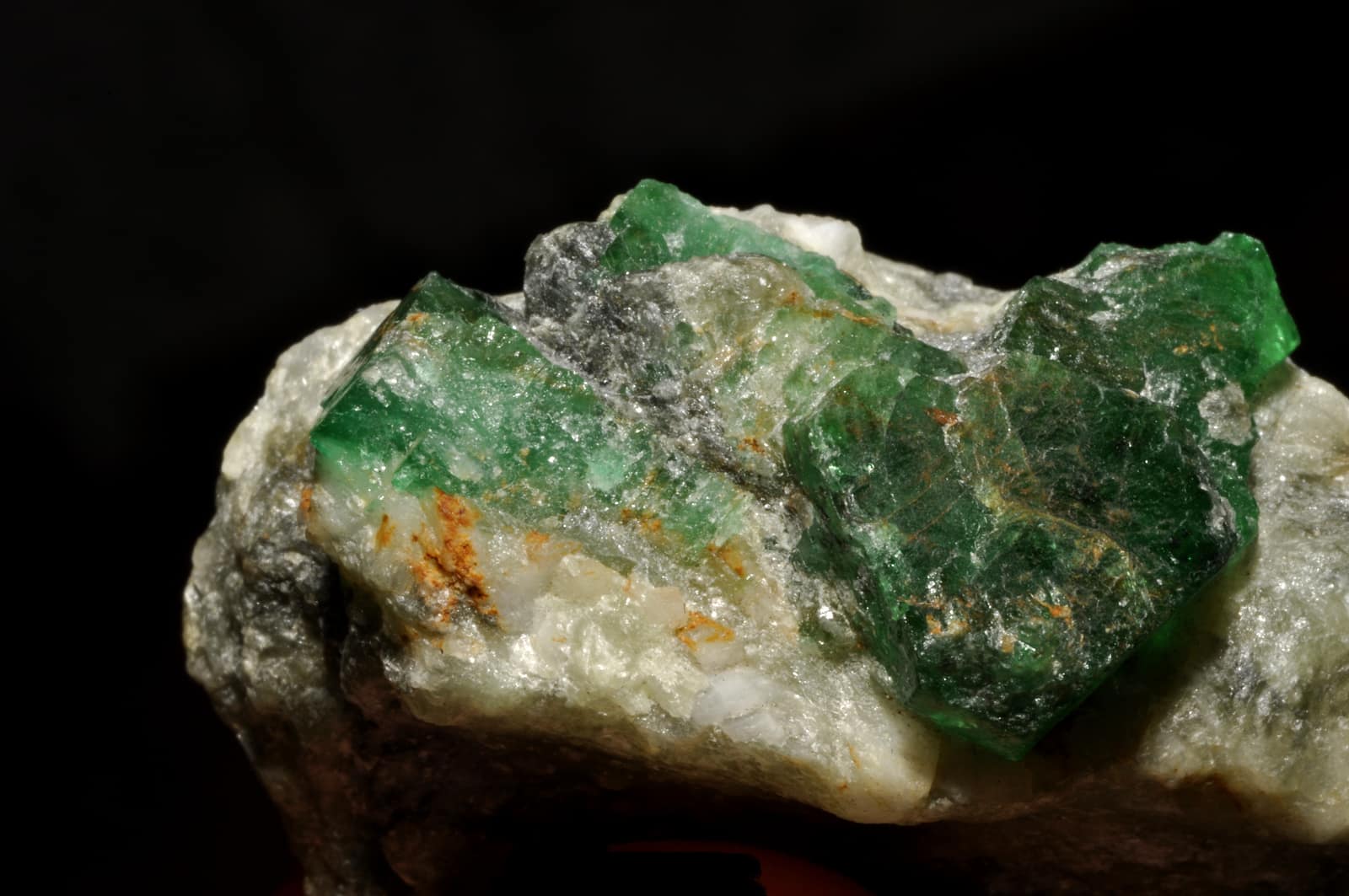
Panjshir emerald
Bluish green emerald from the valley north of Kabul: where it is mined, how a laboratory tells it from Colombian stone, how it is treated, what it sells for, and how to buy it.
Colombia's cousin in the Hindu Kush
Panjshir emerald is Afghanistan's great precious stone: a bluish green emerald from the side valleys above the Panjshir river, about 110 kilometres north-east of Kabul, whose finest crystals have been compared since the 1980s with the best of Colombia's Muzo mine. The deposit was found around 1970, mined in earnest from the late 1970s, paid for a war in the 1990s, ran outside the law for most of the years after, and since 2023 has been sold by licence and weekly auction in the provincial capital, Bazarak. In 2015 a 10.11 carat Panjshir stone sold at Christie's in Hong Kong for 2.28 million US dollars, the highest price a carat of non-Colombian emerald has ever fetched.
This page is written for people thinking of buying it, as a stone or in quantity. It covers where the mines are and what the geology is, what the stone looks like under a loupe and how a laboratory tells it from Colombian and Zambian emerald, how it is treated and how that is graded, what it sells for with the source and date of every figure, how it reaches the market now, and the questions of law and conscience that come with it. We are from Nuristan; Panjshir is not our valley, but we source its emeralds at first hand and sell them as what they are, Panjshir emerald.
- Where
- Panjshir valley, Panjshir province, 110 km north-east of Kabul
- The mines
- Khenj, Mikeni, Darkhenj, Butak, Buzmal, Bakhi, Darun, Rewat
- Altitude
- 2,000 to 4,000 metres, in a belt 16 km by 3 km
- Colour
- Bluish green from chromium and vanadium, with iron
- Typical size
- Most faceted stones under 5 carats; crystals over 120 grams tested
- Record
- 10.11 ct sold for 2.28 million US dollars, Christie's, 2015
- Treatment
- Oiled or resin-filled as a rule; graded minor, moderate, significant
- Origin
- Confirmable by GIA, SSEF and Gübelin
Khenj, Mikeni, Buzmal and the veins above the river
The emerald country lies on the southern slopes of the Hindu Kush, south of the Panjshir river, in a belt about sixteen kilometres long and three wide that runs north-east from the village of Khenj, 115 kilometres from Kabul by road, at 2,000 to 4,000 metres. The mines the trade names are Khenj itself, Mikeni, Darkhenj, Butak, Buzmal, Bakhi, Darun and Rewat; in 1977 six were active and the road ended at Buzmal, at about 3,000 metres. Miners have always said the best colour comes from Mikeni and Darkhenj. Panjshir became a province in 2004, carved out of Parwan, which is why older papers file the mines under Parwan or Kapisa.
The emerald grows in thin quartz and ankerite veins, up to fifteen centimetres thick, cutting metamorphosed limestone, slate and schist, with pyrite as the miners' indicator mineral. The modern reading is that the stones formed about 23 million years ago, in the Oligocene, at around 400 degrees, from salty fluids that had leached ancient evaporites: the same kind of fluid that made the emeralds of Colombia, but at a higher temperature and in metamorphic rock rather than black shale. That shared chemistry is why Panjshir stones can look so like Colombian ones, and why the laboratories had to learn to tell them apart.
Mining is by hand and dynamite. In 1985 about a thousand men worked the valley, a hundred of them at Buzmal, following the veins in pits and tunnels a few metres deep. A satellite study published in 2022 found the workings becoming more concentrated and shifting from tunnels to mechanised surface excavation.
Found in 1970, fought over since
Russian geologists are said to have found the deposit around 1970, and serious mining began about 1975. Through the Soviet war the valley was Ahmad Shah Massoud's stronghold and the emeralds were his treasury: the trade is reckoned to have been worth around ten million dollars a year by 1990, and far more in the following decade, when Massoud's front nationalised the mines, sold through a Polish trading company and, by several accounts, bartered emeralds for weapons. A reporter in the valley in 2000 was told a single stone had fetched 300,000 dollars, about 6,000 dollars for each man in the crew that found it.
After 2001 the mines stayed in the hands of the local families who had always worked them. Only about five per cent were ever registered, duties and royalties were reckoned to exceed half a stone's value, and the rough went to Peshawar, Kabul and Dubai as it always had. Mining was banned for two years after 2021 and resumed in August 2023 under a licence system. By June 2025 the authorities counted 586 licences and more than 75,000 carats sold through their auctions for about 4.7 million US dollars; since March 2026 some 72,000 carats have gone through eleven auctions for over 101 million afghanis, and in September 2026 six professional licence holders were invited to sell by tender. The valley's own people, surveyed in 2025, mostly called this plunder, and there have been clashes over mining sites.
What the loupe and the laboratory see
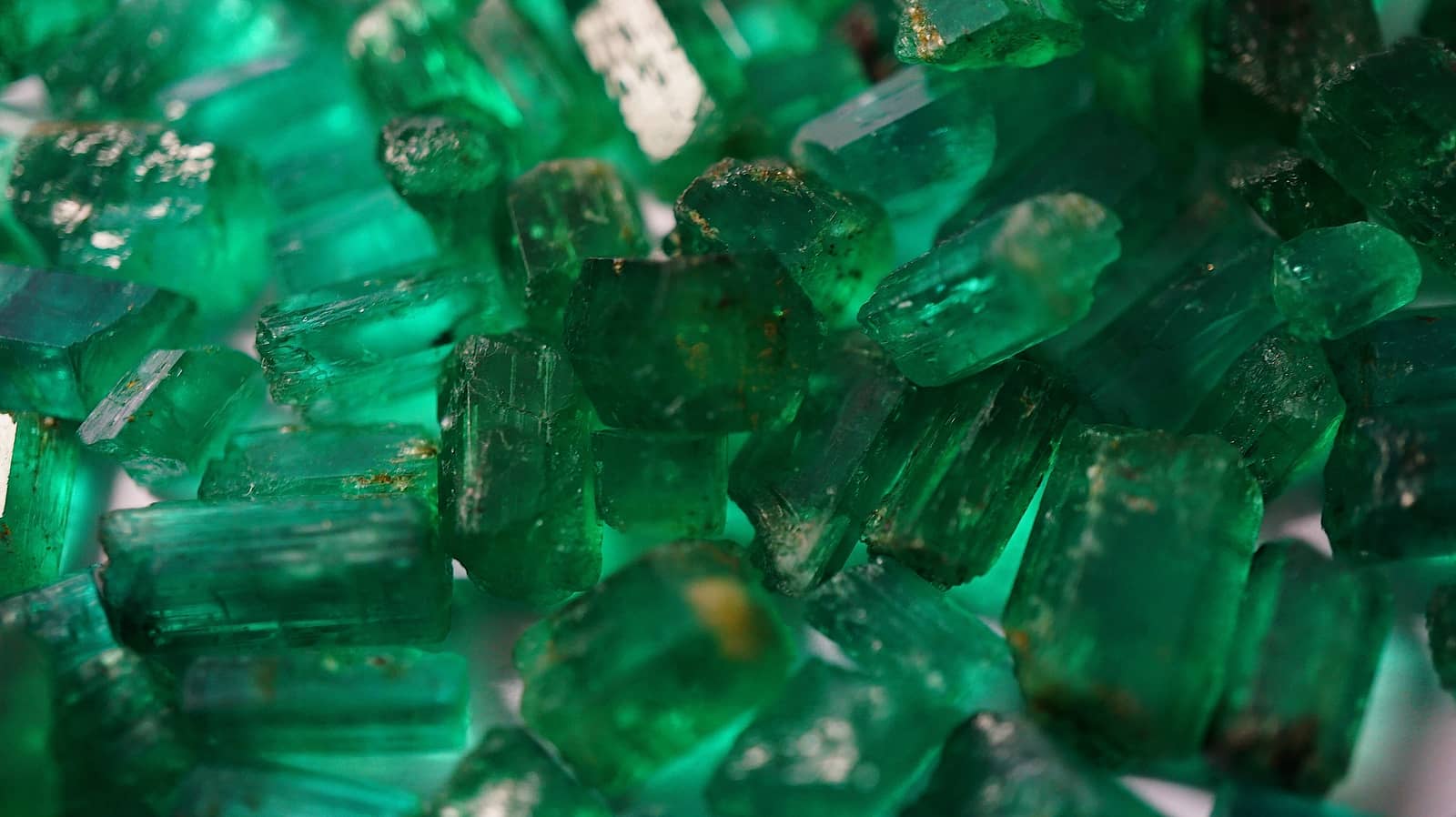
Under the loupe Panjshir emerald is a classic emerald: a refractive index of about 1.578 to 1.585, a specific gravity of 2.71, inert to ultraviolet, with the chromium lines in the spectrum. Its colour comes from chromium and vanadium in roughly equal measure, with more iron than Colombian stone and the highest scandium the GIA has measured in any emerald. The colour is a rich green with a blue cast, deepening from core to rim, and the crystals cut cleaner and larger than Pakistan's Swat emeralds from across the border.
What tells a laboratory it is from Panjshir are the inclusions and the chemistry together. GIA's 2014 study found elongated, needle-shaped multiphase inclusions more often than the jagged three-phase inclusions typical of Colombia, often holding several small transparent crystals, which Colombian stones do not. SSEF describes spiky, salt-bearing multiphase inclusions, a weak absorption band in the near infrared that most Colombian stones lack, and iron that outweighs the chromium and vanadium. Plots of lithium against caesium, or sodium against scandium, separate Panjshir from Colombia and from Davdar in China. GIA, SSEF and Gübelin all issue origin reports naming Afghanistan, which they do not do for Nuristan's tourmaline or kunzite.
Between 2017 and 2021 the Swiss laboratories saw a second kind of stone sold as Panjshir: more than a hundred emeralds of one to thirty carats and more that matched the finest Muzo material in colour, inclusions and chemistry, lacking only Colombia's gota de aceite texture and carrying a little more iron. Some had been sold as Colombian. By the end of 2021 at least part of that parcel was believed to be from Musakashi in Zambia instead. For a Panjshir emerald of any value, a current origin report from one of the three laboratories is worth its fee.
Most faceted Panjshir emeralds are under five carats. Crystals of more than 120 grams and cut stones over 85 carats have been tested, a 190 carat crystal came out of Buzmal in 1985, and one American cutting house works Panjshir rough from one millimetre melee up to 70 carat stones.
The comparison everyone asks for
| Aspect | Panjshir | Colombian |
|---|---|---|
| Colour | Rich green with a blue cast; chromium and vanadium with more iron | Pure to slightly bluish green; vanadium-rich at Muzo, less iron |
| Inclusions | Needle-like and spiky multiphase inclusions, often with small crystals inside; near-infrared band | Jagged three-phase inclusions; gota de aceite texture in the finest stones |
| Clarity | Often cleaner for the colour than the price suggests | Fine stones command a premium whatever the clarity |
| Origin report | Afghanistan, from GIA, SSEF or Gübelin | Colombia, with Muzo, Chivor or Coscuez sometimes named |
| Price | Trade press 2022: commercial 800 to 2,000, attractive 5,000 to 7,000 US dollars a carat | Trade press 2022: fine 8,000 to 10,000 US dollars a carat on the wholesale guide |
Oil, resin and the grades that describe them
Nearly every emerald sold is clarity enhanced, and Panjshir is no exception: of a 15,000 carat Afghan parcel examined in 2016, only four stones needed no filling. The fissures that reach the surface are filled with cedar oil, paraffin or a resin such as Opticon or ExCel, which hides them and improves the look. The laboratories grade the degree rather than the substance: GIA writes minor, moderate or significant, sometimes as F1, F2 and F3, and the other laboratories use the same four-step scale from none to significant. Report wording on Afghan stones at auction in recent years has read minor traditional clarity enhancement of an organic variety, moderate amount of oil and resin in fissures, and indications of minor clarity enhancement.
The degree moves the price. The gap between a treated and an untreated emerald of the same look has been put at 20 to 100 per cent, and a certified unenhanced stone at about half as much again. Resin is less welcome than oil because it is harder to remove and reverse. Ask for the degree in writing and for the filler if the laboratory names it.
The imitations in the regional trade are dyed green beryl, synthetic emerald, and synthetic crystals glued into natural rock; GIA's 2025 field report from Pakistan's markets found dyed emerald sold undisclosed and advised buyers to suspect alteration unless it is proved otherwise.
What Panjshir emerald sells for
Prices asked or paid at the dates stated, with sources, from rough at the Bazarak auctions to the record at Christie's.
| Stone or lot | Price | Source |
|---|---|---|
| The Afghan Emerald, 10.11 carats, Christie's Hong Kong, 2015 | 2,275,236 US dollars, about 225,000 a carat; the record for a non-Colombian emerald | Rapaport Magazine; SSEF |
| Panjshir emerald, 3.31 carats, minor oil, Bonhams Los Angeles, May 2023 | 21,675 US dollars, about 6,550 a carat | Bonhams |
| Afghan emerald, 4.52 carats, moderate oil and resin, Phillips Geneva, February 2025 | 58,420 Swiss francs, about 12,900 francs a carat | Phillips |
| Panjshir emerald ring, 3.15 carats, minor oil, Sotheby's London, June 2026 | Estimate 22,000 to 38,000 pounds | Sotheby's |
| Commercial and attractive Panjshir emerald, trade press, 2022 | 800 to 2,000 US dollars a carat commercial; 5,000 to 7,000 attractive | Rapaport Magazine |
| Melee cut from pencil rough, 2017 | 500 to 1,500 US dollars a carat | GIA Gem News |
| US dealer retail, 0.4 to 1.2 carat stones, 2026 | 3,000 to 5,000 US dollars a carat; a matched 6.53 carat pair at about 11,500 a carat | The Natural Emerald Company |
| Panjshir Gems, Dubai, finished stones, 2026 | From 1,000 to 60,000 US dollars a carat | JNA GemsWorld 2026 |
| Marketplace listings sold as Panjshir or Afghan emerald, 2026 | From about 400 US dollars to tens of thousands a stone; averages of 3,800 to 7,600 per listing | 1stDibs category pages |
| Rough lots at the Bazarak state auctions, 2024 to 2025 | About 8 to 137 US dollars a carat by lot, the spread reflecting grade, not a market price | Pajhwok, Zarin TV, Amu TV |
| Rough lots at the Bazarak auctions, August to September 2026 | About 1,000 to 8,600 afghanis a carat by lot | 8am Media, TOLOnews |
There is no official emerald price, and the figures above show why a single number would mislead: the same valley sells rough by the lot at tens of dollars a carat and a finished stone at tens of thousands. Colour, clarity, size, cut, the degree of filling and a laboratory's origin opinion each move the price by multiples. Panjshir stones have generally sold below Colombian stones of the same appearance, and some have been passed off as Colombian for that reason, which is the strongest argument for buying Panjshir on its own name with its own report.
Searches for the price in India and Pakistan run into another trade altogether: Panjshir emerald is sold there as panna, the astrological stone, by sellers whose published rupee prices differ from each other several times over. We quote the market the laboratories and auction houses see.
From Khenj to Bazarak, Peshawar and Dubai
For forty years the rough walked out. In the 1980s it went twenty days on foot to the refugee camps and tribal areas around Peshawar, and from Namak Mandi, where Afghan traders made most of the sales, to Karachi, Bangkok and Tucson; in Kabul the dealers of Chicken Street graded parcels for buyers who cut in India, Sri Lanka or Thailand; and a great deal went quietly to Dubai, where a Panjshir house now mines, cuts and sells its own stones. The recorded exports of all Afghan precious stones were about 8 million US dollars in 2024; the real emerald trade has been put far higher.
Since August 2023 the stones are sold at weekly auctions in Bazarak run by the provincial mines department. Licensed miners consign the rough, buyers bid by the lot, and the stones are released when a ten per cent levy is paid, with the rest to the miners. The buyers named in the reports are mostly from the United Arab Emirates, India, Iran and Thailand, with a few foreign traders at each sale and some three hundred traders at a sale in August 2026. A Kabul dealer told the New York Times he missed the days when buyers came from the United States, Britain, France and Germany. Our account of how the Afghan trade works, and the auctions in our own province, is on the buying guide and the auctions page.
For a buyer abroad the law is the same as for any Afghan stone. The United Kingdom and the European Union have no ban and charge no duty on emerald under tariff heading 7103; the United States allows commercial imports under General License 20 but has not said whether the ten per cent auction levy is a fee relating to a luxury item, so a US buyer needs counsel. Emerald's one advantage over Nuristan's stones is that its origin can be proved: a report that says Afghanistan is a report that says the money went where the seller claims.
Panjshir emerald has paid for one war already and its revenue now goes, in part, to an administration under international sanctions, whose mines minister is on the United Nations list. The valley's own people say they see little of it. None of that is hidden in the stone, and none of it stops a British or European buyer from owning one; it does mean that a buyer who cares should ask which auction a parcel came from, who was paid, and whether the seller can say so in writing. We can, for what we source, and we say when we cannot.
How to buy Panjshir emerald well
Buy Panjshir emerald on its own name, with a current origin and treatment report from GIA, SSEF or Gübelin for any stone of value, and with the degree of clarity enhancement written on the invoice. Prefer oil to resin. Treat a stone sold as Colombian at a Panjshir price, or as Panjshir at a Zambian price, as a question to be answered by a laboratory rather than a bargain. For rough, see it in daylight video with weights before any money moves, remember that most of a parcel will not cut, and expect the melee and the fine stones to come from different lots.
If you want Panjshir emerald sourced, as single stones or as rough lots from the licensed miners and the auctions, write to us with colour, sizes, quantity, budget and your import country. Our wholesale page sets out how an order works and what we put in writing.
Asked about Panjshir emerald
How much is a 1 carat Panjshir emerald worth?
Anything from a few hundred US dollars for a pale, heavily filled commercial stone to 3,000 to 7,000 dollars a carat for a fine, lightly oiled one at retail in 2026, and far more for the exceptional. The 2022 trade-press bands were 800 to 2,000 dollars a carat for commercial Panjshir emerald and 5,000 to 7,000 for attractive stones. There is no official price; every figure on this page carries its source and date.
What is the Afghan emerald price per carat?
The same spread as Panjshir emerald, because Panjshir is Afghanistan's emerald: hundreds of dollars a carat for commercial goods, several thousand for fine stones, and a record of about 225,000 dollars a carat for the 10.11 carat Afghan Emerald sold at Christie's in 2015. Rough sells by the lot at the Bazarak auctions for tens of dollars a carat, which says nothing about a cut stone's value.
Panjshir emerald or Colombian emerald: which is better?
The finest Panjshir stones have been compared with Colombia's Muzo since the 1980s and share the same salty, evaporite-born chemistry; they tend to carry a blue cast and more iron, and their inclusions are needle-like rather than jagged. Colombian emerald still commands the higher price for the same look, and Panjshir stones have been passed off as Colombian because of it. For a buyer the honest answer is that Panjshir offers Colombian beauty at a lower price, provided the report says Afghanistan.
Which emerald is the most expensive?
Colombian emerald, from Muzo above all, sets the top of the market, with fine stones quoted at 8,000 to 10,000 US dollars a carat wholesale in 2022 and far more at auction. The most expensive non-Colombian emerald ever sold was Afghan: 10.11 carats from Panjshir, 2.28 million dollars at Christie's Hong Kong in 2015.
Where are the Panjshir emerald mines?
In the side valleys south of the Panjshir river, about 110 kilometres north-east of Kabul, in a belt sixteen kilometres long from Khenj village, at 2,000 to 4,000 metres. The named mines are Khenj, Mikeni, Darkhenj, Butak, Buzmal, Bakhi, Darun and Rewat. Panjshir has been a province since 2004.
What colour is Panjshir emerald?
A rich green with a blue cast, which the trade calls bluish green, often deepening from the core of the crystal to its rim. The colour comes from chromium and vanadium in roughly equal measure, with more iron than Colombian emerald carries. The finest Panjshir stones have been compared with Colombia's Muzo since the 1980s.
What do the inclusions in a Panjshir emerald mean?
They are the stone's passport. Panjshir emeralds carry needle-shaped and spiky multiphase inclusions, often with small transparent crystals inside, and a weak near-infrared absorption band, where Colombian stones carry jagged three-phase inclusions. Together with the iron, scandium, lithium and caesium content, these let GIA, SSEF and Gübelin state Afghanistan as the origin.
Are Panjshir emeralds treated?
Almost all are clarity enhanced with oil or resin, as emeralds everywhere are; of a 15,000 carat Afghan parcel examined in 2016 only four stones needed none. Laboratories grade the degree as minor, moderate or significant. Ask for the degree and, where known, the filler in writing, and expect to pay a premium for a stone graded none or minor.
Can a laboratory confirm that an emerald is from Panjshir?
Yes. GIA, SSEF and Gübelin all issue origin reports naming Afghanistan, based on the inclusions and trace-element chemistry, and Gübelin collected its reference stones in the valley. This makes emerald the one Afghan gemstone whose origin a buyer can prove.
Is it legal to buy Panjshir emerald?
Yes in the United Kingdom and the European Union, where there is no ban on Afghan goods and no duty on precious stones, provided the seller is not a sanctioned person. In the United States commercial imports are allowed under General License 20, but the Treasury has not said whether the ten per cent levy paid at the Panjshir auctions is a permitted fee, so a US buyer should take legal advice.
What is Panjshir famous for?
Its emeralds, its river gorge, and its history as the valley the Soviet army never took, under the commander Ahmad Shah Massoud, whose war was paid for in large part by the emerald mines above Khenj.
On this site
- Gemstones of Afghanistan: the map, province by province
- Wholesale gemstones from Afghanistan
- How to buy gemstones from Afghanistan: law, prices, reports and scams
- Investing in gemstones from Afghanistan: what holds value
- Afghan ruby: Jegdalek and the marble-hosted stones
- Afghan lapis lazuli: Sar-e Sang
- Nuristan gemstones: tourmaline and kunzite
- Nuristan's neighbours, Panjshir among them
- Gary Bowersox, A Status Report on Gemstones from Afghanistan, Gems and Gemology, Winter 1985
- Bowersox, Snee, Foord and Seal, Emeralds of the Panjshir Valley, Afghanistan, Gems and Gemology, Spring 1991
- Saeseaw, Pardieu and Sangsawong, Three-Phase Inclusions in Emerald and Their Impact on Origin Determination, Gems and Gemology, Summer 2014
- Krzemnicki, Wang and Büche, A New Type of Emerald from Afghanistan's Panjshir Valley, Journal of Gemmology 37(5), 2021
- DeWitt et al., Mapping the extent and methods of small-scale emerald mining in the Panjshir Valley, Geocarto International, 2022 (USGS)
- US Geological Survey Open-File Report 2011-1204, chapter 13A: Panjsher Valley emerald area of interest
- Matthew DuPee, Afghanistan's Conflict Minerals: The Crime-State-Insurgent Nexus, CTC Sentinel, February 2012
- Lucian Kim, Afghanistan's emerald heights, Christian Science Monitor, 25 July 2000
- Rob Bates, What Happens to Afghanistan's Gems?, JCK, 20 August 2021
- New York Times via The Star, 11 February 2025: the Taliban's gemstone gamble (Bazarak auctions, levy, buyers)
- Zarin TV, 18 June 2025: 586 licences and 75,000 carats sold
- TOLOnews via Environmental Peacebuilding, 23 August 2026: 72,000 carats in eleven auctions since March 2026
- Ministry of Mines and Petroleum: tender notice for Panjshir emeralds, September 2026
- Pajhwok Afghan News: Panjshir emerald auction reports, 2023 to 2026
- 8am Media, 29 September 2026: more than 6,000 carats of Panjshir emeralds sold
- Afghanistan International, 2 July 2025: Panjshir residents on the province's mines
- Mary Kavanagh, Ravishing Rubies, Rapaport Magazine, January 2016 (The Afghan Emerald at Christie's)
- Isabella Yan, The Emerald Empire, Rapaport Magazine, 3 May 2022 (trade price bands)
- GIA Gem News, Spring 2016: Afghan emerald and clarity enhancement
- GIA Gem News, Spring 2017: emerald dealing in Afghanistan
- GIA: how GIA grades the degree of clarity enhancement in emerald (F1, F2, F3)
- International Gem Society: emerald value, price and jewelry information
- Bakht and Shah, Gems and Gemology, Winter 2025: deceptive practices in Pakistan's gem trade
- Bonhams, Los Angeles, 2 May 2023: 3.31 carat Afghan emerald
- Phillips, Geneva, February 2025: 4.52 carat Afghan emerald
- Sotheby's, London, 3 June 2026: 3.15 carat Panjshir emerald ring
- The Natural Emerald Company: Afghanistan emerald listings (retrieved October 2026)
- JNA GemsWorld 2026: Panjshir Gems, Dubai
- 1stDibs: Panjshir emerald listings (retrieved October 2026)
- OFAC: General License No. 20 and Afghanistan-related FAQs
Plan your Nuristan journey
Ready to plan a visit, source Nuristani products, or discuss an investment? Your message goes to Obaid, who is from Nuristan, and his team in Afghanistan and the UK. We reply to every message.