Pink, green, blue and watermelon elbaite from Paprok, Kantiwa, Korgal and the Pech valley: where it is mined, what it costs, how it is treated, and how to buy it.
From the pegmatites of the Hindu Kush
What Afghan tourmaline is, and why it matters
Afghan tourmaline is elbaite, the lithium-rich tourmaline that grows in gem pockets inside granite pegmatite veins, and most of it comes from the eastern Hindu Kush: the Paprok, Kantiwa and Korgal workings of Nuristan, the Pech valley of Kunar next door, and the Alingar veins of Laghman. It is sold as Afghan, Nuristan or Paprok tourmaline, and increasingly under colour names such as lagoon, mint and neon. It comes in pink, green, blue and crystals that change colour along their length, and the best of it stands with any tourmaline in the world.
This page is written from Nuristan, for people who are thinking of buying it. It explains where each mine is, what the colours are called and which are rare, what the stones sell for with the source of every figure, how they are treated, what a laboratory can and cannot tell you about origin, and what to ask a seller. The general guide to the province's stones is on the Nuristan gemstones page, and the legal side of buying is on its own page.
Mineral
Elbaite, lithium tourmaline, in granite pegmatite
Colours
Pink, green, blue, bicolour; rarely yellow or colourless
Best-known mine
Paprok, Kamdesh district, about 4,000 metres
Other fields
Kantiwa and Korgal in Nuristan; the Pech valley in Kunar
Crystals
Cuttable crystals to 15 by 4 centimetres on record
Mined since
Organised gem mining from the early 1970s
Hardness
7 to 7.5; durable for rings and daily wear
Sold through
Peshawar, Kabul, and state auctions since 2024
The mineral
Elbaite, grown in gem pockets
Tourmaline is a family of boron silicate minerals, and the gem member of the family is elbaite. Elbaite forms where the last, water-rich part of a cooling granite is squeezed into cracks and crystallises slowly into pegmatite: veins of giant crystals that in eastern Afghanistan run two to five kilometres long and up to sixty metres wide. The pegmatites of Nuristan, Kunar and Laghman belong to the lithium, caesium and tantalum family, which is why they give kunzite and tourmaline together, often in the same pocket, with lepidolite mica and platy white albite called cleavelandite around them.
Soviet geologists discovered these fields between 1971 and 1976 and remarked on their likeness to the gem pegmatites of Pala and San Diego County in California. The gem pockets they described are ten centimetres to three metres across and formed at 120 to 280 degrees. Organised mining of tourmaline, beryl and kunzite in Afghanistan dates only from the early 1970s; before that the stones were known but not dug for sale.
The mines
Where Afghan tourmaline comes from
Six places, five of them in Nuristan. Older survey tables and most dealers use the old provinces, so Laghman and Kunar labels often mean today's Nuristan, and Nuristan labels often mean Kunar.
Kamdesh district, eastern Nuristan
Paprok
Pink, green, blue, bicolour and watermelon; rarely yellow
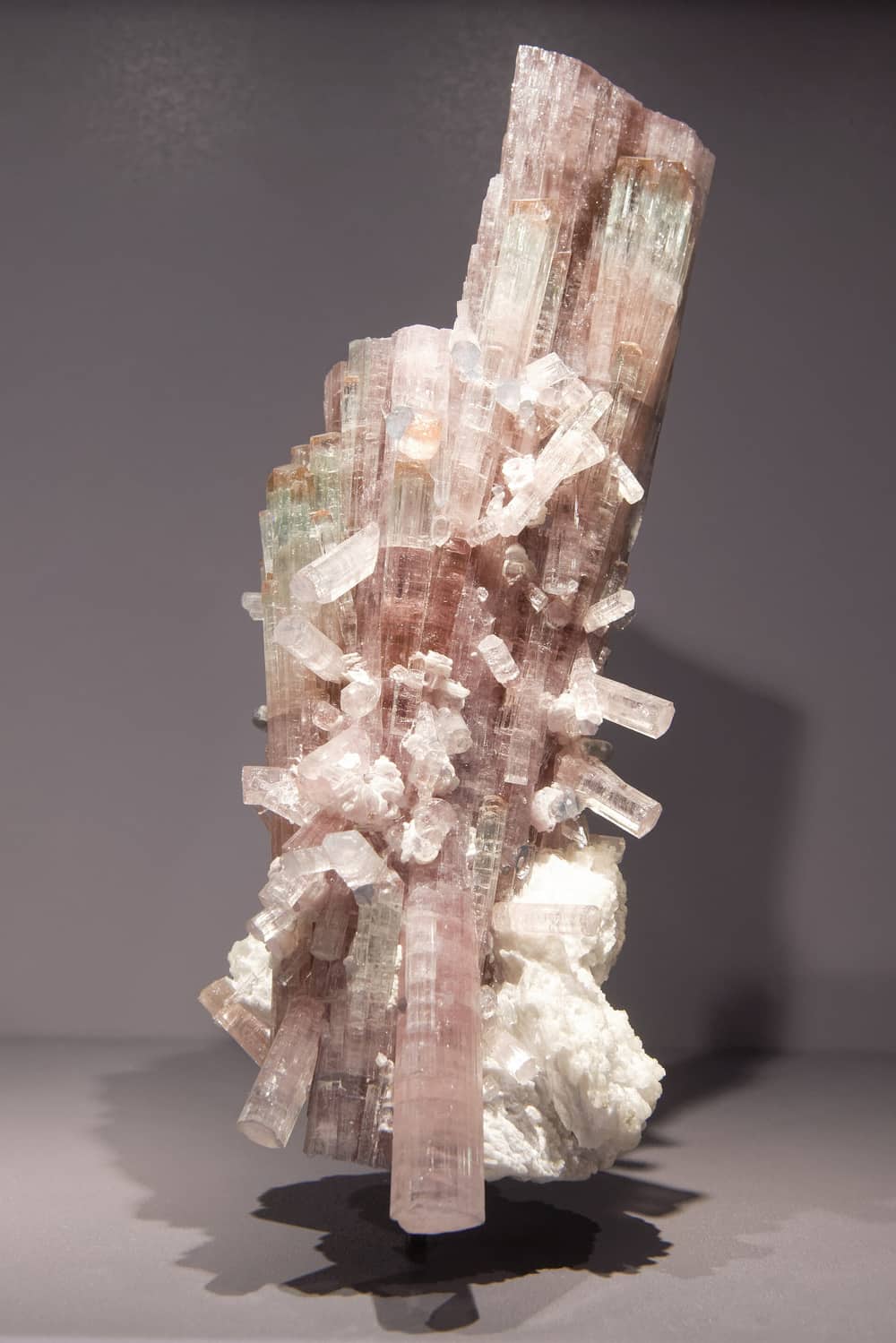
The most famous name in Afghan tourmaline, and the one most often borrowed for stones from elsewhere. The workings lie in a side valley south of Paprok village at about 4,060 metres. The Soviet survey of 1974 recorded dikes 50 to 60 metres long and 5 to 8 metres thick with gem tourmaline crystals to 3 by 7 centimetres, growing with cleavelandite, smoky quartz and lepidolite, and already being worked intensively by local miners. The Smithsonian holds a Paprok crystal from a pocket the miners called the Rainbow Pocket, pink below a sharp yellow band below green, and notes that yellow tourmaline is among the rarest of all. Watermelon crystals from Paprok have been studied in the mineralogical literature. The Pajhwok news agency reported in 2026 that Paprok had been worked without licence for twelve years before a recent government ban; we have not been able to confirm the ban's terms.
Kantiwa district, central Nuristan
Kantiwa
Green, with kunzite and smoky quartz
A field of about 130 square kilometres west of Parun, in old metamorphic rock, where spodumene and albite dikes carry tantalite, kunzite, optical quartz and tourmaline. The US Geological Survey describes one dike 300 metres long and up to 15 metres thick, and a stretch of 150 square metres whose cavities were lined with smoky quartz, green tourmaline and kunzite. Kantiwa's stones often travel under the Paprok or simply the Nuristan name.
Nurgaram district, southern Nuristan
Korgal
Green
Also written Kurghal. Three tourmaline dikes have been mined by hand for green tourmaline: the first 150 metres long and 10 to 15 metres thick, with crystals from a centimetre to about 1 by 4 centimetres; the second with cleavelandite, lepidolite and cassiterite; the third zoned, with violet lepidolite. Older tables file Korgal under Laghman; its published coordinates fall just inside Nurgaram.
Du Ab and Mandol, western Nuristan
Nilaw-Kolum, with Mawi
Pink rubellite, light blue, indigo and bicolour
The great kunzite field also gives tourmaline. The main Kolum dike is 3,000 metres long, and the Soviet accounts record pink, light blue, indigo and polychrome tourmaline from it. The quantities were small beside the kunzite: 4.5 kilograms of gem tourmaline against 615 kilograms of gem spodumene from 1,056 tonnes of rock mined. Rough from these workings is now sold at the state auctions in Du Ab.
Parun, Waygal and Want districts
Parun and the Waygal valley
Pink, blue and watermelon reported
The Parun pegmatite field is first a lithium field, but tourmaline is dug in it. In December 2024 the provincial mines directorate sold tourmaline, which the valleys call biroj, at auction in Parun for 8 million afghanis. Its mines desk lists workings at Astawi, Frons, Diwah, Koshtki, Sosom and Pashki in Parun, and five in the Waygal valley at Watoz, Kishton and elsewhere. Nothing from these has been described in the gemmological literature yet.
Dara-i-Pech, Kunar province, not Nuristan
The Pech valley
Green to indigo, with kunzite, morganite and aquamarine
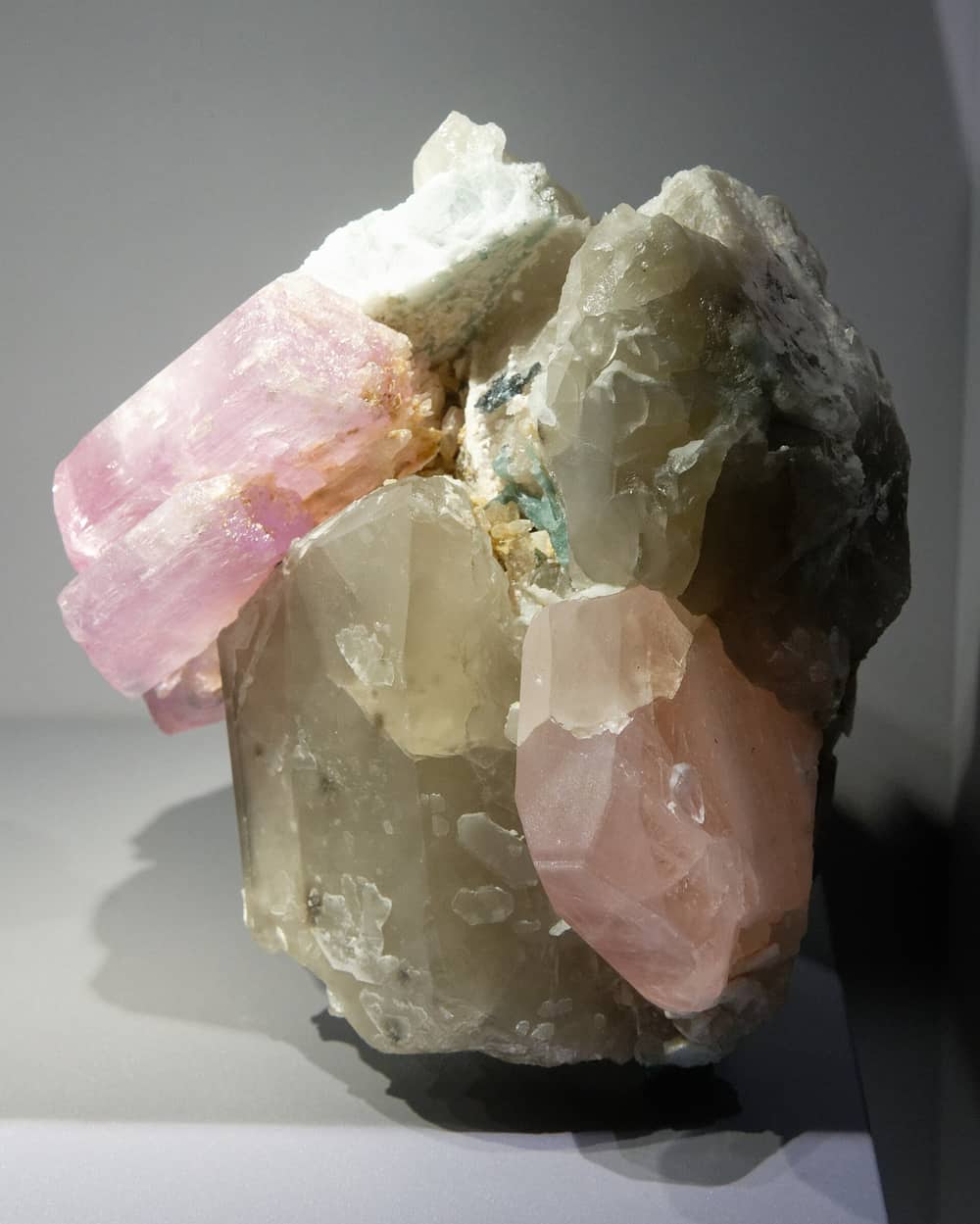
The Darra-i-Pech field covers about 85 square kilometres over the provincial line in Kunar and is often sold as Nuristan. Green and blue-green tourmaline, kunzite, morganite and aquamarine come from it. In 2023 reporters found former soldiers mining pale green tourmaline here with home-made explosives and a jackhammer run off a generator, and one stone had sold for about 3,500 US dollars. In July 2026 Kunar's mines directorate sold more than 1,500 kilograms of Pech tourmaline for about 119.3 million afghanis.
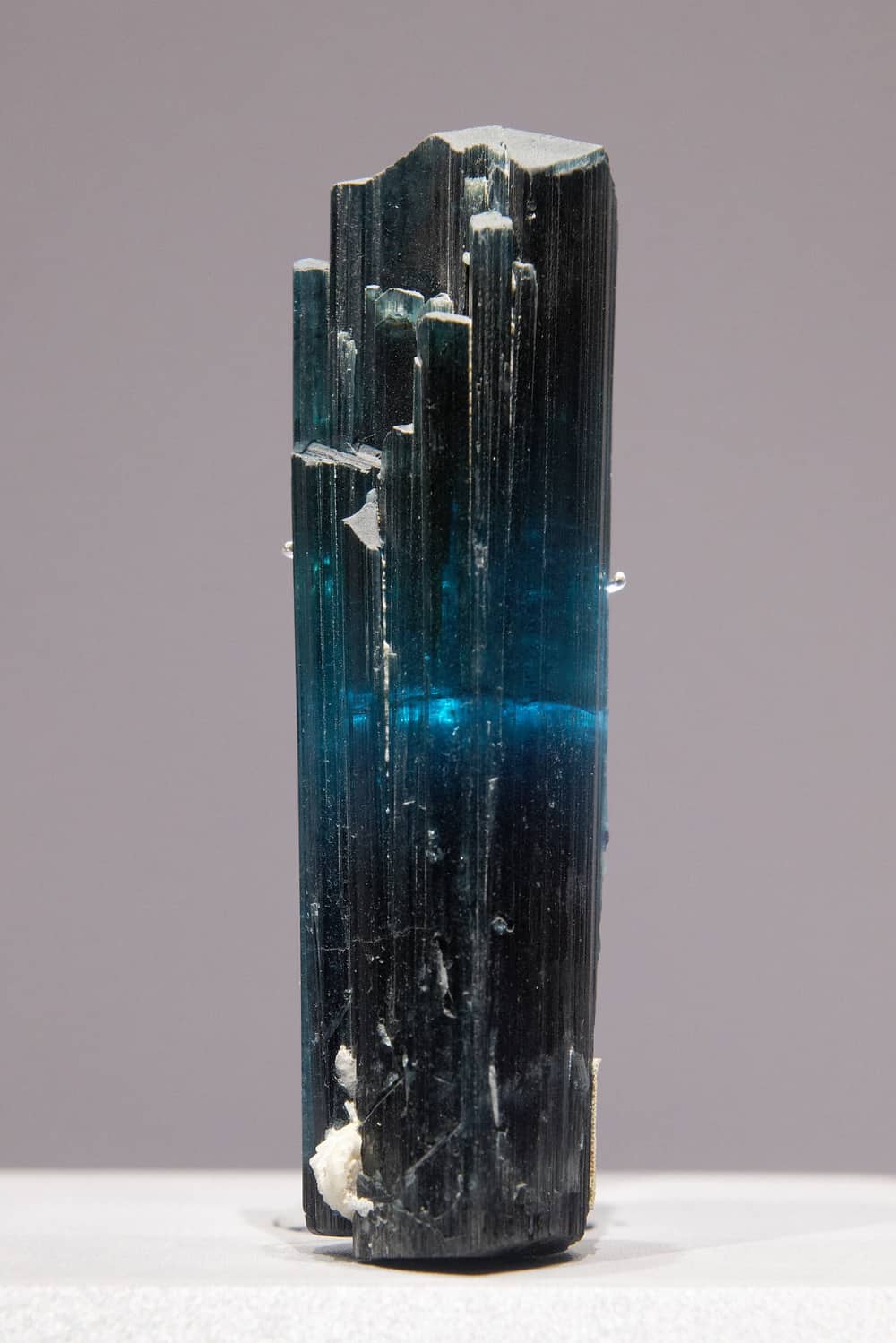
Indicolite, the blue tourmaline, from Paprok. Blue is the rarest and most valued of the Afghan colours.
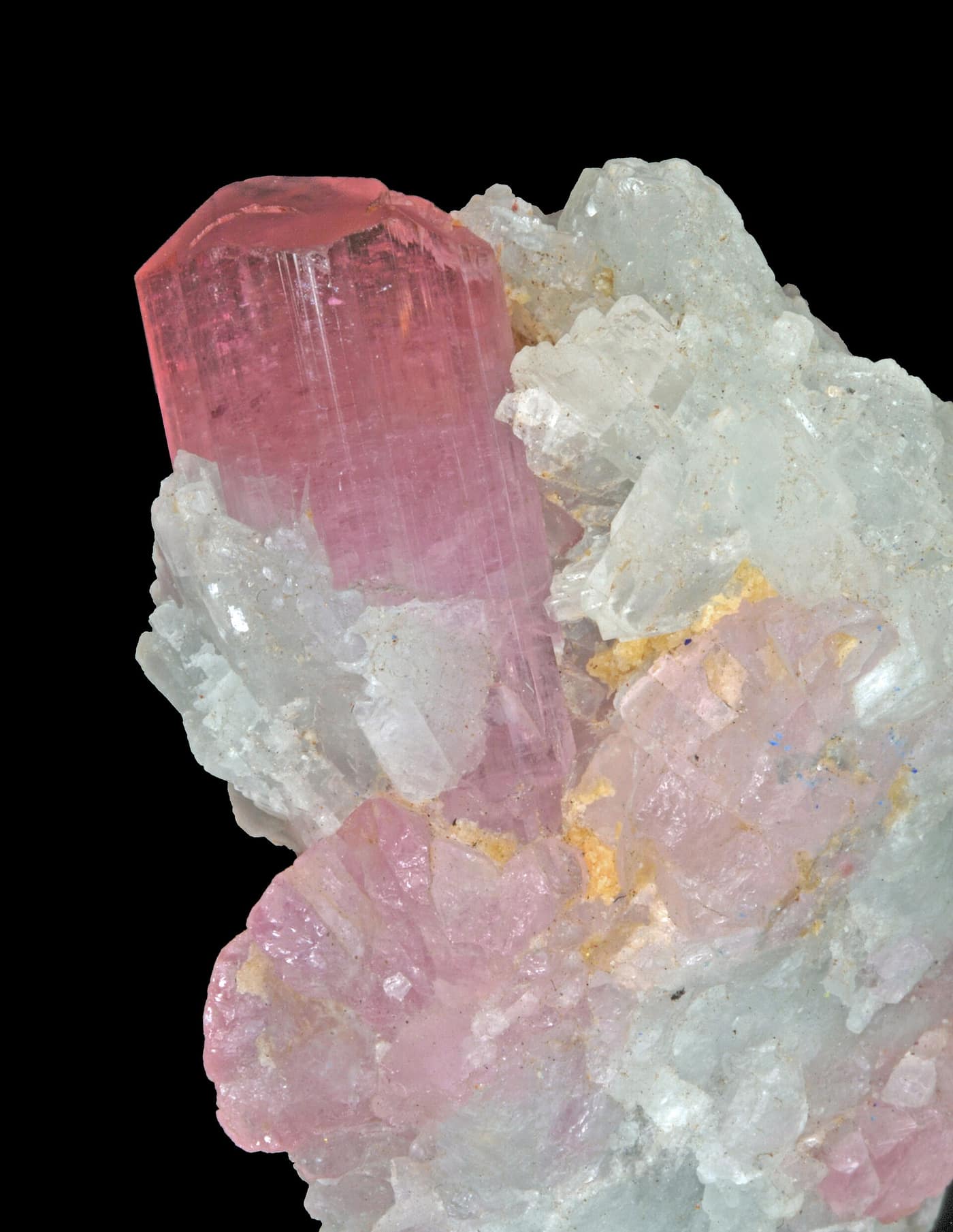
Pink tourmaline on quartz from the Paprok mine in Kamdesh, the most famous name in Afghan tourmaline.
Tourmaline with morganite and kunzite from the Pech valley in Kunar, often sold as Nuristan.
Colours
Pink, green, blue, and the names the trade gives them
Pink and red
Rubellite
Pink is the common colour of Afghan tourmaline, from pale rose to deep pinkish red. The trade calls the saturated reds rubellite, and prices them highest when the red is pure rather than brownish. Pale pinks are sometimes irradiated to deepen them.
Green
Verdelite, mint, chrome green (which this is not)
The Korgal, Kantiwa and Pech stones are mostly green, from yellowish and bluish greens to what the old reports call emerald green. Afghan green tourmaline is coloured by iron, not by chromium, so it is not chrome tourmaline, whatever a listing says. Mint is a trade name for a light, bright bluish green.
Blue
Indicolite; sold as lagoon, neon or paraiba colour
Blue is the rarest of the main colours and the most valued, from Paprok, Kolum and the Pech. Intense blues and blue-greens fetch the highest prices of any Afghan tourmaline. Lagoon, neon and paraiba colour are trade names for bright blue-greens. No laboratory has published a confirmation of copper-bearing, true Paraiba-type tourmaline from Afghanistan: the recognised sources are Brazil, Nigeria and Mozambique, and GIA's origin work on Paraiba covers those three. An Afghan stone sold as paraiba is being sold on its colour, not its chemistry.
Bicolour and watermelon
Polychrome
Crystals that change colour along their length, green at one end and pink at the other, or pink inside a green skin like a slice of watermelon, are a Paprok speciality and are sought by collectors and cutters alike. Cutters keep the colour boundary inside the finished stone.
Yellow and colourless
Achroite
Both are rare. Colourless tourmaline, achroite, was described from Afghanistan in 1974, and the Smithsonian's Rainbow Pocket crystal from Paprok carries a band of yellow that the museum calls one of the ultimate rarities in tourmaline.
Quality
What makes one Afghan tourmaline worth more than another
Colour decides most of the price: saturated blue and blue-green first, then pure red, then clean greens and pinks, with brown or grey overtones pulling every colour down. Clarity comes next, and here Afghan material has a good name, because many of the crystals cut clean. Size matters less than in ruby or emerald; cuttable crystals to 15 by 4 centimetres are on record, so large clean stones exist and the price per carat climbs gently rather than steeply with weight. Cut matters because tourmaline is strongly pleochroic, darker down the length of the crystal, so the cutter has to orient the stone to show the best colour at the top.
Afghan tourmaline measures a refractive index of about 1.617 to 1.639 and a specific gravity of 3.02 to 3.09, and blue stones show absorption bands at 495, 490 and 440 nanometres, figures a gemmologist will recognise but which do not separate it from tourmaline of the same colour from Brazil or Nigeria.
Prices
What Afghan tourmaline sells for
Every figure here is a price asked or paid at the date stated, with its source. There is no official price list for coloured stones.
Prices of Afghan tourmaline, with sources
Stone
Price
Source
Fine Afghan rubellite, 3.65 and 4.50 carats, dealer asking price, 2026
About 164 and 498 US dollars a carat
1stDibs listings
Fine Afghan and Kunar indicolite, 2.3 to 5.35 carats, dealer asking price, 2026
250 to 500 US dollars a gram, cutting yield 28 to 35 per cent
GemologyOnline forum
Rubellite in general, 451 stones, mostly African, unheated, 2026
Typical 196 to 249 US dollars a carat by size; range 23 to 1,730
Star Lanka price analysis
Five Paprok crystals at auction, 2018
Estimate 30,000 to 50,000 US dollars
The Irish Times
1,500 kilograms of Pech valley tourmaline rough, state auction, July 2026
About 119.3 million afghanis, roughly 79,500 a kilogram, quality unstated
Zarin TV
Tourmaline rough, Parun, state auction, December 2024
8 million afghanis, about 113,000 US dollars
Amu TV
There is no official price list for coloured stones. GIA publishes none; the trade uses the GemGuide wholesale guide and the International Gem Society's price tables, both subscription services. The figures above are what was asked or paid at the time stated, and a fine blue Afghan stone can cost several hundred dollars a carat while a pale pink of the same weight costs tens.
Asking prices in Peshawar's Namak Mandi are deliberately high. Dealers there buy Afghan lots blind, take speculative stakes in them and share them among family, and the GIA's study of the market found the first price quoted to a stranger bears little relation to the final one. If you are quoted a per-gram price for rough, remember that a third or less of the weight becomes finished stones.
Treatments
Heated, irradiated, and what can be detected
Heating is common and stable. Many tourmalines are gently heated to lighten dark greens or shift pinks, and the result cannot be detected by any laboratory, so it is not disclosed. Irradiation is used on pale pinks to deepen them towards red; it too is undetectable, and GIA warns that colour produced by irradiation can fade in heat or strong light. Fracture filling with resin is occasional and can be found by infrared spectroscopy or a hot point. Oiling and glass filling of Afghan tourmaline are not documented practices.
The practical rule is the one the GIA's 2025 field report from Pakistan gives for everything in the regional trade: suspect alteration unless it is proved otherwise, and get the seller's statement of treatment in writing before you pay.
Origin and reports
What a laboratory can and cannot tell you
A laboratory report on an Afghan tourmaline will say tourmaline, give its weight and measurements, and say whether any treatment was detected. It will not say Afghanistan. GIA offers geographic origin opinions for emerald, ruby, sapphire, alexandrite, Paraiba-type tourmaline, peridot, red spinel, demantoid and opal, and the other major laboratories follow a similar list. No published method separates pink, green or blue elbaite from Afghanistan from the same stones from Nigeria or Brazil.
Origin, for these stones, therefore rests on the chain of hands. A dealer who can name the valley, the year and the trader is giving you more than any certificate can. Be aware too that a stone dug in Kunar or Laghman will often be sold as Nuristan, a stone from anywhere in the east as Paprok, and that under European and American customs rules a rough Afghan stone cut in Thailand or Pakistan can be labelled with the country where it was cut.
Buying
How to buy Afghan tourmaline well
Buy the stone, not the story. Ask for the treatment in writing, ask which mine and which route, and for anything over a few hundred dollars ask for an identification report from a recognised laboratory, which costs from about 75 US dollars at GIA. Tourmaline has no commercial synthetic, which makes it a safer buy than ruby or emerald, but glass and synthetic spinel are still sold as tourmaline to the unwary, and lots offered on social media from the region often hold one good stone among plain ones.
Our guide to buying gemstones from Afghanistan covers the law for buyers in the United Kingdom, the European Union and the United States, the import duties, the laboratories and their fees, and the fakes that have been documented. If you want stones from Nuristan itself, write to us and tell us what you are looking for; we source cut stones, rough by the gram or the lot, and crystals and specimens, and we will say honestly what we can and cannot do.
Elbaite, the lithium tourmaline, from the granite pegmatite veins of eastern Afghanistan: the Paprok, Kantiwa and Korgal mines of Nuristan, the Pech valley of Kunar and the Alingar veins of Laghman. It comes in pink, green, blue and bicoloured crystals and has been mined for sale since the early 1970s.
How much is Afghan tourmaline worth per carat?
It depends almost entirely on colour. In 2026 dealers were asking about 160 to 500 US dollars a carat for fine Afghan rubellite of 3 to 5 carats and about 330 to 650 dollars a carat for fine indicolite, while pale pinks and greens sell for tens of dollars a carat. A 22 carat blue-green stone wholesaled at about 227 dollars a carat in 2014. There is no official price list; every figure on this page carries its source and date.
How much is 1 carat of tourmaline worth?
Anywhere from a few dollars for a pale commercial stone to several hundred for a fine blue or red, and thousands for Paraiba-type tourmaline from Brazil. A one carat Afghan indicolite of fine colour was valued at 750 US dollars by the International Gem Society; a one carat pale pink might sell for 20.
What is the price of 1 kg of tourmaline?
Rough is sold by weight and quality, and the two state auctions that give a figure for a kilogram say how wide the range is: 1,500 kilograms of mixed Pech valley rough sold for about 79,500 afghanis a kilogram in July 2026, while fine facet-grade rough was quoted at 250 to 500 US dollars a gram, which is 250,000 to 500,000 dollars a kilogram, in 2014.
Is Afghan tourmaline Paraiba?
No confirmed Paraiba-type tourmaline has been published from Afghanistan. Paraiba tourmaline is coloured by copper, and the recognised sources are Brazil, Nigeria and Mozambique. Afghan stones sold as paraiba, lagoon or neon are bright blue-green elbaite coloured by iron, and are priced far below true Paraiba. Ask for a laboratory report if copper is claimed.
Where is the Paprok tourmaline mine?
In Kamdesh district in eastern Nuristan, Afghanistan, in a side valley south of Paprok village at about 4,060 metres. The dikes were already being worked by local miners when Soviet geologists surveyed them in 1974, and the mine is famous for pink, green, blue and watermelon crystals.
Which tourmaline is the most expensive?
Copper-bearing Paraiba tourmaline from Brazil, which can pass 10,000 US dollars a carat for fine stones. Below it come fine rubellite, chrome tourmaline from East Africa and the best indicolite. The most expensive Afghan tourmalines are the intense blues and blue-greens from Paprok, Kolum and the Pech.
Can I buy Afghan tourmaline crystals and specimens?
Yes. Afghan tourmaline is sold as cut stones, as rough for cutting, and as crystals and specimens, the Paprok pieces often on quartz or albite. For a crystal, look for natural terminations and a sound attachment to its matrix, since repaired and reassembled specimens are sold in the regional trade; for rough, see it in daylight with weights before paying. We source all three at first hand.
Is Afghan tourmaline treated?
Often, and usually without anyone saying so. Heating to improve colour is common, stable and undetectable. Pale pinks are sometimes irradiated to deepen the red, which is also undetectable but can fade in heat or strong light. Fracture filling is occasional and can be detected. Ask for the treatment status in writing.
Can a laboratory confirm that a tourmaline is from Afghanistan?
Not for ordinary pink, green or blue elbaite. GIA and the other major laboratories give origin opinions only for a short list of stones, and for tourmaline only the Paraiba type. A report will confirm that a stone is natural tourmaline and whether treatment was detected. Origin rests on the seller's records.
Ready to plan a visit, source Nuristani products, or discuss an investment? Your message goes to Obaid, who is from Nuristan, and his team in Afghanistan and the UK. We reply to every message.