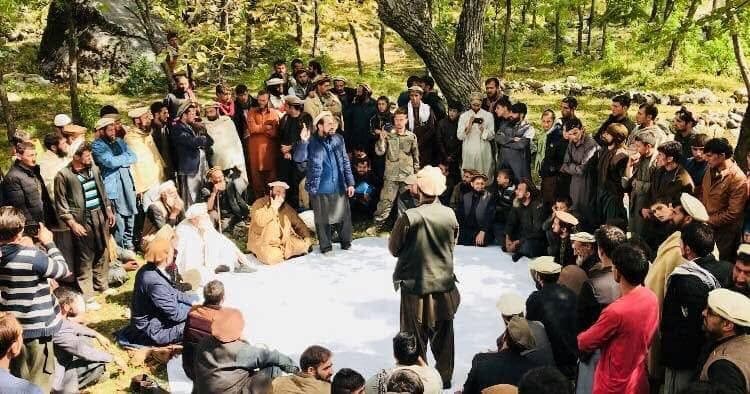
The history of Nuristan
From the Indo-Iranian past to the flood of 2026: the empires that stopped at the passes, the winter of 1895, the wars of this century and the years since, in order.
A short name and a long past
Nuristan's history is short as a name and very long as a place. The province was named in 1896; the people who live in it have been in these valleys since before the languages of Iran and India parted company. For most of that time the story was written by outsiders looking in, and it reads as a list of the empires that failed to get up the valleys. Since 1896 it has been the story of a mountain people finding their place inside Afghanistan, through two wars and now a run of hard years with the weather.
This page sets the record out in order. The fuller accounts of Kafiristan and of the flood of 2026 are on their own pages, linked as you go.
Kafiristan, to 1896
A thousand years as the unconverted country behind the passes.
Antiquity
An Indo-Iranian people apart
The Nuristani languages split from the rest of the Indo-Iranian family before Iranian and Indo-Aryan divided, which places the ancestors of today's Nuristanis in or near these mountains more than three thousand years ago. Their religion kept gods, Imra and Indr among them, whose names appear in the oldest Indian hymns.
320s BC
Alexander passes by
Alexander's army fought its way through the Kunar valley on the road to India. The Kafir valleys above it were not conquered. Whether some of his soldiers stayed and left descendants, as the valleys have long claimed, is still argued: the languages point to a people already here, and the record cannot settle it either way.
8th to 11th centuries
Islam reaches the lowlands
Arab and then Ghaznavid rule brought Islam to Kabul, Laghman and the Kunar. The high valleys were bypassed, and from then on their people were the kafirs, the unbelievers, to everyone around them. The name Kafiristan comes from this long standoff.
1398
Timur's raid
Timur turned aside on his march to India to attack the Kafirs of Kator in the Bashgal. His chroniclers record a hard campaign in the snow and a withdrawal. The valleys stayed unconverted.
Early 1500s
Babur notes the wine
Babur, founder of the Mughal dynasty, passed through Kunar and recorded the Kafirs and their strong wine, one of the few outside glimpses of the valleys before the nineteenth century.
1815
The first European account
Mountstuart Elphinstone's An Account of the Kingdom of Caubul, written from informants at the Afghan court, gave Europe its first description of Kafiristan and began a century of fascination with a lost people.
1888
Kipling's Kafiristan
Rudyard Kipling's The Man Who Would Be King sent two British adventurers to make themselves kings of the Kafirs. Kipling never went. The story fixed the Alexander legend in the English-speaking imagination.
1890 to 1891
Robertson in Kamdesh
George Scott Robertson, a British surgeon and political officer, lived a year among the Kom of Kamdesh. His book The Kafirs of the Hindu Kush, published in 1896, is the only detailed record of the old religion and society, made just before they ended.
1893
The Durand Line
The border agreed between Afghanistan and British India ran through the eastern Hindu Kush and left Kafiristan on the Afghan side. Its fate was decided in that treaty.
1895 to 1896
Conquest and conversion
Amir Abdur Rahman Khan's army entered the valleys in winter, when the passes were blocked, and took the country in about forty days by his own account. The population was converted to Islam, and in 1896 Kafiristan became Nuristan, the land of light.
The Afghan century, 1896 to 2001
A new faith, a new name, and a province that kept fighting for itself.
1896 onward
Mosques and a new name
Mosques were built in the valleys and boys were sent to Kabul to be educated as Muslims. The languages, the houses and the carving stayed; the gods, the wine and the feasts of merit went. Within a generation Nuristanis were known as devout Muslims, and the pakol had replaced the bare head.
1929
Nuristanis and the crown
Nuristani fighters were among the tribal forces that helped Muhammad Nadir Shah take Kabul in 1929, the beginning of a long association between the province and the Afghan army.
1978
First to rise
After the communist coup of April 1978, Nuristan was among the first regions of Afghanistan to take up arms against the new government. The valleys stayed beyond Kabul's reach for most of the war that followed.
1980s to 1990s
The Dawlat
Under Mawlawi Afzal, Kamdesh and the eastern valleys ran their own Islamic Revolutionary State, known as the Dawlat, with support from Saudi Arabia and Pakistan, until the Taliban absorbed it in the late 1990s.
1988 to 2004
A province of its own
Nuristan was created as a province in the late 1980s from valleys that had been governed as parts of Kunar and Laghman. It was enlarged in 1993, with its capital at Pashki in the Parun valley, and its eight districts were fixed when the map was redrawn in 2004.
This century
Twenty years of war, then quiet, then the weather.
2001 to 2009
The American war reaches the valleys
Coalition forces built combat outposts in Nuristan after 2001. At Wanat in Waygal district on 13 July 2008, nine American soldiers died in an assault by some two hundred fighters. At Kamdesh on 3 October 2009, eight Americans and seven Afghan soldiers were killed defending Combat Outpost Keating. Within weeks the United States withdrew from its four main bases in the province.
2010 to 2021
Beyond the state
For most of the following decade much of Nuristan lay outside government control, and the valleys were all but closed to outsiders. In June 2020 the government announced Nuristan National Park in the eastern districts. In August 2021 the Taliban took the province with the rest of the country.
2021 to today
Quieter, and open again
The province is quieter than it has been in decades, and the first visitors are returning with local guides. The mountains have not softened. Floods in Kamdesh in July 2021 killed 113 people, a landslide buried the village of Nakre in February 2024, and on 20 July 2026 a flash flood through Parun killed dozens and destroyed the capital's market.
Asked about Nuristan's history
When did Nuristan become a province?
In the late 1980s, from valleys that had been administered as parts of Kunar and Laghman. It was enlarged in 1993, with its capital at Pashki in the Parun valley, and its eight districts were fixed in 2004.
What was Nuristan called before 1896?
Kafiristan, the land of the unbelievers, the name its Muslim neighbours gave a region that kept its own religion. It was renamed Nuristan, the land of light, after the conquest and conversion of 1895 to 1896.
Why was Kafiristan renamed Nuristan?
Amir Abdur Rahman Khan renamed it after converting its people to Islam in 1896. The light in the name is the light of the faith.
What happened in Nuristan during the Soviet war?
Nuristan was among the first regions to rebel after the 1978 coup, and the eastern valleys ran their own Islamic state, the Dawlat, under Mawlawi Afzal for much of the 1980s and 1990s.
What happened at Wanat and Kamdesh?
Two of the costliest battles of the American war in Afghanistan. Nine American soldiers were killed at Wanat in Waygal district on 13 July 2008, and eight Americans and seven Afghan soldiers at Combat Outpost Keating in Kamdesh on 3 October 2009, after which the United States withdrew from its main bases in the province.
Where this comes from
- Encyclopaedia Iranica: Nuristan
- Wikipedia: Nuristan Province
- Wikipedia: Kafiristan
- George Scott Robertson, The Kafirs of the Hindu-Kush (1896), full text at the Internet Archive
- Wikipedia: Battle of Wanat
- Wikipedia: Battle of Kamdesh
- Wikipedia: Nuristan National Park
- Wikipedia: 2021 Nuristan floods
- Wikipedia: 2024 Nuristan landslide
Plan your Nuristan journey
Ready to plan a visit, source Nuristani products, or discuss an investment? Your message goes to Obaid, who is from Nuristan, and his team in Afghanistan and the UK. We reply to every message.