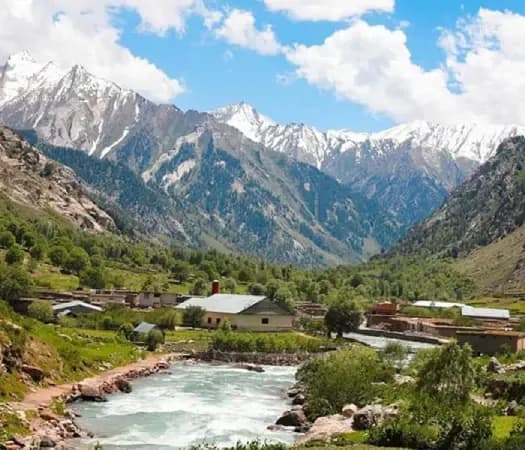
Parun
The provincial capital, high in the Parun valley at the roof of the province.
About Parun
Parun is the seat of Nuristan's provincial administration and the heart of one of its highest valleys. The town and its surrounding villages sit far up the Parun river, where the growing season is short, herds move to the high pastures in summer and the peaks above keep their snow through the year.
The valley is also a world of its own linguistically. The Prasun language spoken here stands apart even from the other Nuristani languages, alongside the local dialects that vary from village to village. That distinctiveness runs through the valley's customs and its old timber-and-stone architecture.
Six principal villages step down the valley: Ishtewi, Pronz, Dewa, Kushteki, Tsutsum and Pashki, which serves the provincial capital. The highest stands near 2,850 metres and the lowest around 2,500 to 2,600. Kushteki once held the great temple of Imra, called Mara in Prasun, the largest religious building of old Kafiristan, destroyed in the conversion of 1895 to 1896.
For visitors, Parun is the administrative and symbolic centre of the province, and a base from which the high country opens up. The usual approach is from Asadabad up the Pech valley through Wama; there is still no dependable direct road from much of the rest of the province, so journeys need planning and local knowledge.
- Role
- Provincial capital of Nuristan
- Setting
- High Parun valley, eastern Hindu Kush
- Population
- About 11,400 (2024 estimate, excluding Kantiwa)
- Villages
- Ishtewi, Pronz, Dewa, Kushteki, Tsutsum, Pashki
- Language
- Prasun, with local dialects
- Known for
- Snow peaks, summer pastures, seat of government
Other districts of Nuristan
Plan your Nuristan journey
Ready to plan a visit, source Nuristani products, or discuss an investment? Your message goes to Obaid, who is from Nuristan, and his team in Afghanistan and the UK. We reply to every message.