Nuristan kept an arched harp of a kind that disappeared from the plains of Asia long ago, and a way of singing in parts that one scholar calls without parallel on the continent. The waj and the other instruments, the songs of Waygal, the dances of the old religion, and where to hear the recordings.
Two things about the music of Nuristan have drawn scholars over the mountains. One is an instrument: a small harp with a curved neck, of a kind carved on Buddhist monuments two thousand years ago and played, by the twentieth century, nowhere else between the Caucasus and Burma. The other is a way of singing, in which two soloists and a choir hold notes a tone apart on purpose, and which the Danish musicologist who studied it called without parallel in Asia.
Both come from our own valley, Waygal, among others. This page describes the instruments, the songs and the dances as they were recorded between 1890 and 1970, what part they played in the old religion, and where the recordings can be heard today. Far less music is made in Nuristan now than then, and we say why as plainly as the record allows.
The short version
- The waj is a four-stringed arched harp, the last of its kind in the region.
- In Waygal it is played with the saringi, a two-stringed fiddle; Parun and Wama have a lute, the urba.
- Waygal song is sung in parts, by two soloists and a choir, with drum and clapping.
- The old dances were ring dances for the gods, called nat, held in a dance house.
- About 350 recordings made between 1953 and 1970 are kept in Denmark, and many are published.
The waj, the Nuristani harp
The waj is small enough to hold in the lap. Its body is a single piece of wood, long, narrow in the middle and hollowed like a boat, with a skin stretched over the top and laced on with thongs. A curved stick is pushed through the skin so that it rises in a bow over the body, and four strings run from the stick down to the body. They were once made from the tendons of a deer's back and are now nylon. The player tunes them by sliding the cords that tie them to the bow.
It is not plucked note by note like a European harp. The player sweeps a plectrum up and down across all four strings and uses the fingertips of the other hand to damp the ones not wanted, so that the music comes out as small clusters of notes. George Scott Robertson, who heard it at Kamdesh in 1890, saw it held between the knees. Photographs from 1953 show it on the lap, or with one end between the feet.
The name changes with the valley: waj or wadz in Waygal, wanz in Wama, and in Parun a word of its own. Most harps have four strings; one with five was found in Parun in 1948 and a six-stringed kind is reported from Kantiwa. Poets used it when making a song about a man's deeds, and there was a soft style of solo singing to the harp alone. By the 1970s it was played only in Waygal and the Ashkun country, though the older people remembered it in the Bashgal, Kantiwa and Parun.
What makes it remarkable is its family. Harps of this arched shape are carved on the stone reliefs of Gandhara and of ancient India, and then they disappear from the plains. Nuristan kept one. It is the only harp tradition to have survived anywhere between the Caucasus and Burma. The Metropolitan Museum in New York has two of them, and the National Museum in Kabul has one.
The other instruments
- The saringi, or sarani: a two-stringed fiddle about seventy centimetres long, cut from one piece of wood with a skin belly and played with a horsehair bow. It was recorded only in Waygal, always together with the harp and never alone.
- The urba: a short lute with four strings, plucked, from Pashki and Shtiwe in Parun and also known in Wama. It mostly accompanies singing.
- Flutes: short reed flutes with two finger-holes, played in pairs with the drums. Some villages have a shepherd's flute with five holes.
- Drums: a frame drum, called dab in Wama and Muldesh and bambuk in Waygal; a drum with two heads; and a small pair of metal kettledrums. Robertson saw tiny hourglass drums, each one valued at a cow.
The men who made and played the instruments were often the craftsmen, the bari. At a feast at Nisheigram in 1970 it was the bari who played the drums and flutes while the other men clapped and danced. In 1953 a craftsman of Berimdesh in Waygal named Amir Shah was photographed on a rooftop playing the fiddle beside a neighbour with the harp. Fifteen years later he was said to be the only man left who knew how to make the fiddle.
The singing of Waygal
Most of the songs recorded in Waygal are sung in parts. A lead singer begins, a second singer answers and supports him, and a choir joins, over a drum and the clapping of hands, in a rhythm of nine beats. The voices do not move in sweet harmony. They sit a tone apart and hold there, in thick, clashing chords that sound strange to an outsider and are entirely deliberate. Sixty-three of the hundred and six recordings from the valley are of this kind.
The same tune carries many different words. One set of recordings made in the valley in 1953 uses a single melody for two songs in praise of men, a lament, and a mother's farewell to her daughter. Other valleys sing differently. In Parun a soloist calls and the choir gives a longer answer; at Kushtoz in the Bashgal the men sing in unison. In the 1970s the scholars listed hymns to the old gods, by then known only to a few old men, songs of heroes and ancestors, love songs, and songs for herding and for churning butter.
The dances
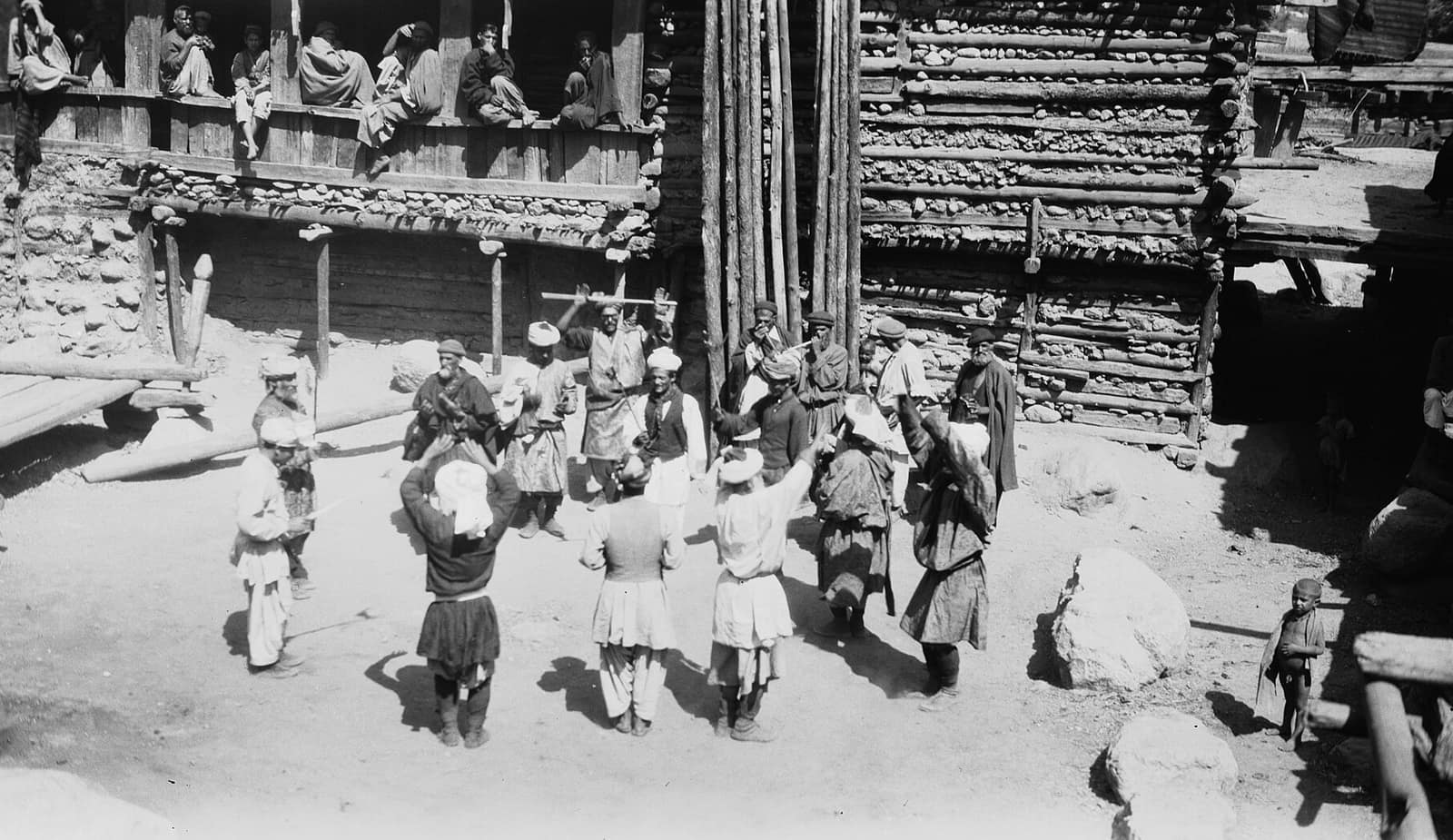
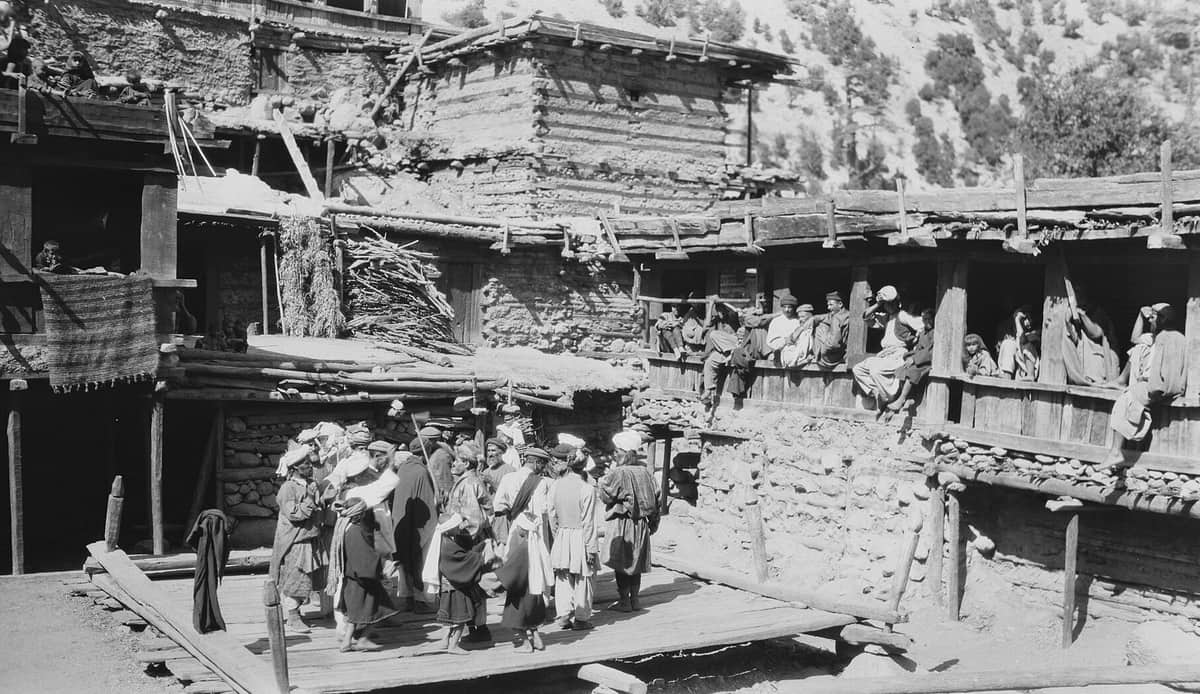
Robertson, at Kamdesh in 1890 and 1891, called dancing a religious exercise, a spectacle and an amusement at once. He counted six occasions for it: the dances of the headmen for the gods, dances for the honoured dead, the thanksgiving of men who had killed an enemy, the dance of the women while the men were away raiding, dances at a death, and dances when a wooden figure of the dead was set up.
The great dances were held in the dance house. A fire burned in the middle and the musicians sat on the east side. The priest stood inside a single ring of the headmen with the two other religious officers, and the ring went round: first three rounds for Gish, the god of war, then a round for each of the other gods in turn. The step was a quick shuffle and then a stamping advance, and the men twirled their dancing-axes as they went. The women danced in an outer ring, in the opposite direction, with very small steps. The word for a dance, and for dance music, is nat, and Robertson recorded the names of several: one danced on the wooden platform and one on the ground.
Music and the old religion
In the religion Nuristan followed until 1896, music was the worship. Robertson wrote that the gods were pleased in three ways only: by songs, by dancing, and by feasting with sacrifice. One of the three religious offices was the debilala, the man who chanted the praises of the gods and sang and danced beside the priest. At Kamdesh in March 1891 Robertson watched a composer of hymns chant a line and the whole crowd answer him together.
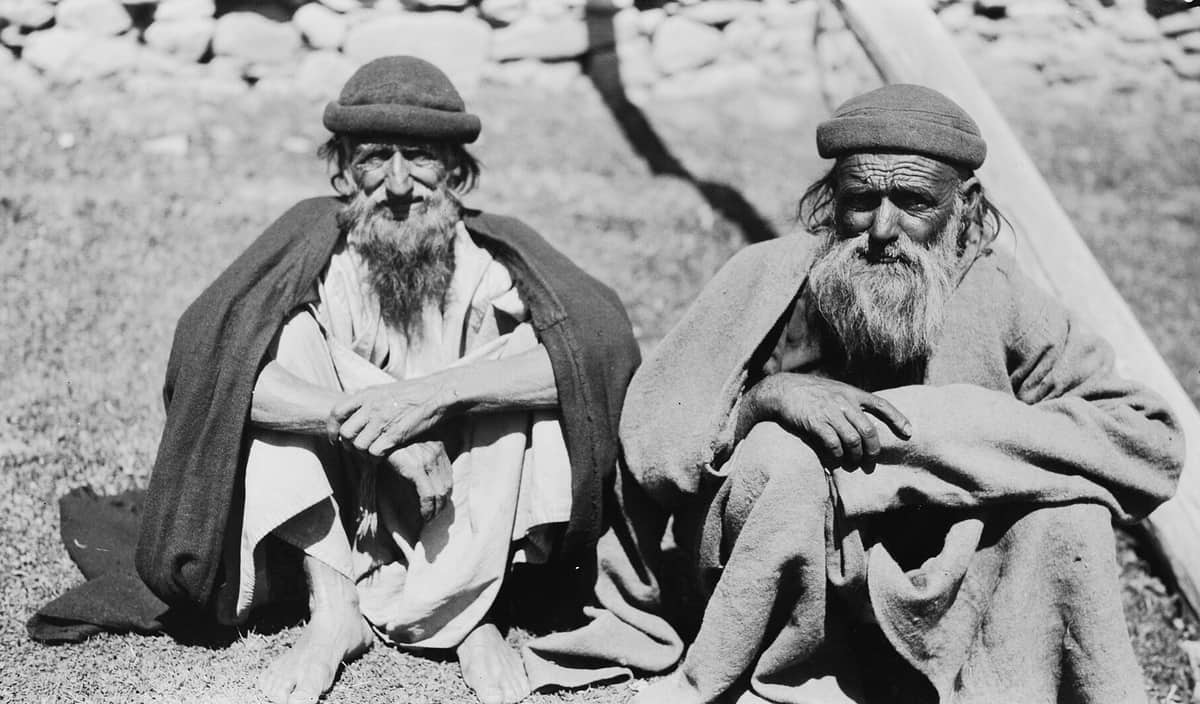
The phrase singing priest, which people search for, belongs to one man. In May 1929 the Norwegian linguist Georg Morgenstierne, working among Kati families in the Kalash valleys of Chitral, recorded and filmed an old man named Kareik, the last debilala, chanting the hymns. The photograph below is of him. In Parun, as late as October 1953, an old man of the Disni clan sang hymns to the goddess Disani and to Mara, the creator, for the Danish expedition, accompanying himself on the urba. Men in Kushteki told the same visitors that the harp, the lute, the flute and the drum had all been played in the temple.
After 1896, and now
The conversion did not end the music. When the Danish scholars Lennart Edelberg and Klaus Ferdinand carried tape recorders through the valleys between 1953 and 1970 they found the part-singing in full use, and the harp and the fiddle were still being played in Waygal at the end of that time. Songs about the coming of Islam were among those recorded in Waygal.
The decline came later. Max Klimburg, who knew the valleys from the 1970s onward, wrote that a stricter kind of religion had been gaining ground since the 1960s, and that by the early 2000s music and dance had been suppressed nearly everywhere. In Parun he found no singing, music or dancing left at all. Yet it has not vanished. In 2018 three bands of Nuristani musicians recorded and performed in Kabul, and the report on that project found the music little changed in some places and mixed with other Afghan instruments in others.
If you have recordings of songs from your valley, old or new, we would be glad to hear them and, with your leave, to add them to this page.
Where to hear it
- Music in Nuristan, by Christer Irgens-Møller (Jutland Archaeological Society, 2009): a book with three CDs, drawn from about 350 recordings made by Edelberg and Ferdinand and kept at the Moesgaard Museum in Denmark.
- The Pitt Rivers Museum, Oxford, has published a recording of waj music made by Lennart and Margo Edelberg on its SoundCloud page.
- Folk Music of Afghanistan, volume 2 (Lyrichord), includes a song from Nuristan and can be heard at the Internet Archive.
- Musik aus Afghanistan: Nuristan (Adevaphon, 1976), an Austrian record made from recordings of the late 1960s, includes a solo on the waj.
Questions people ask
What is Nuristani music like?
The best recorded is the part-singing of the Waygal valley: a lead singer, a second singer and a choir, with a drum and hand-clapping, in voices that deliberately rub against each other a tone apart. Other valleys sing in call and response or in unison. Instruments include a small harp, a fiddle, a lute, reed flutes and drums.
What is a waj?
The waj is the Nuristani arched harp: a boat-shaped wooden body covered with skin, a curved stick rising from it, and four strings between the two. It is strummed with a plectrum while the fingers of the other hand silence the strings that are not wanted. Harps of this shape appear in the ancient sculpture of Gandhara and survive nowhere else in the region.
What instruments are played in Nuristan?
The waj, a four-stringed arched harp; the saringi, a two-stringed fiddle that is played with it in Waygal; the urba, a four-stringed lute of Parun and Wama; pairs of short reed flutes; and frame drums, two-headed drums and small metal kettledrums.
Who were the singing priests of Nuristan?
In the old religion one of the three religious offices was the debilala, the man who chanted the praises of the gods at the dances. The phrase singing priest comes from the caption to a 1929 photograph of the last of them, a Kati man named Kareik, whom the linguist Georg Morgenstierne recorded in Chitral.
Do Nuristanis dance the attan?
The attan is a Pashtun dance, now danced all over Afghanistan. The dances recorded in Nuristan are its own: ring dances called nat, in which men circled a fire in the dance house with a shuffling and stamping step, sometimes carrying axes, while women moved in an outer ring in the opposite direction.
Where can I listen to Nuristani music?
The fullest collection is the three CDs published with Christer Irgens-Møller's book Music in Nuristan (2009), from recordings made between 1953 and 1970. The Pitt Rivers Museum in Oxford has put a recording of the waj online, and a track from Nuristan is on the Lyrichord record Folk Music of Afghanistan, volume 2.
Read on
- Nuristani religion: the gods the hymns were sung to
- Nuristani woodcarving, and the craftsmen who also made the instruments
- Kafiristan: the history of Nuristan before 1896
- Kalasha religion, where the dances and hymns are still performed
- Waygal, the valley of the harp and the part-songs
- The Nuristani languages, and recordings from the valleys
- Nuristani culture
Questions people ask
What is Nuristani music like?
The best recorded is the part-singing of the Waygal valley: a lead singer, a second singer and a choir, with a drum and hand-clapping, in voices that deliberately rub against each other a tone apart. Other valleys sing in call and response or in unison. Instruments include a small harp, a fiddle, a lute, reed flutes and drums.
What is a waj?
The waj is the Nuristani arched harp: a boat-shaped wooden body covered with skin, a curved stick rising from it, and four strings between the two. It is strummed with a plectrum while the fingers of the other hand silence the strings that are not wanted. Harps of this shape appear in the ancient sculpture of Gandhara and survive nowhere else in the region.
What instruments are played in Nuristan?
The waj, a four-stringed arched harp; the saringi, a two-stringed fiddle that is played with it in Waygal; the urba, a four-stringed lute of Parun and Wama; pairs of short reed flutes; and frame drums, two-headed drums and small metal kettledrums.
Who were the singing priests of Nuristan?
In the old religion one of the three religious offices was the debilala, the man who chanted the praises of the gods at the dances. The phrase singing priest comes from the caption to a 1929 photograph of the last of them, a Kati man named Kareik, whom the linguist Georg Morgenstierne recorded in Chitral.
Do Nuristanis dance the attan?
The attan is a Pashtun dance, now danced all over Afghanistan. The dances recorded in Nuristan are its own: ring dances called nat, in which men circled a fire in the dance house with a shuffling and stamping step, sometimes carrying axes, while women moved in an outer ring in the opposite direction.
Where can I listen to Nuristani music?
The fullest collection is the three CDs published with Christer Irgens-Møller's book Music in Nuristan (2009), from recordings made between 1953 and 1970. The Pitt Rivers Museum in Oxford has put a recording of the waj online, and a track from Nuristan is on the Lyrichord record Folk Music of Afghanistan, volume 2.
Sources
- Lennart Edelberg and Schuyler Jones, Nuristan (1979), with Thomas Alvad's chapter on the music and instruments
- Christer Irgens-Møller, on the traditional music of Nuristan (2005)
- George Scott Robertson, The Kafirs of the Hindu-Kush (1896), pages 615 to 632 on dancing and music
- Encyclopaedia Britannica: vaji, the Nuristani arched harp
- The Metropolitan Museum of Art: Waj, Nuristan, mid-twentieth century
- Mark Slobin on the musical instruments of Afghanistan (The Metropolitan Museum of Art)
- Max Klimburg, Nuristan, in the Encyclopaedia Iranica
- SIL International: report on Nuristani music, with the Kabul recordings of 2018
- Pitt Rivers Museum: Nuristani waj music, recorded by Lennart and Margo Edelberg
- Folk Music of Afghanistan, volume 2 (Lyrichord), at the Internet Archive
- Photograph of the ring dance at Kunisht, 1929: Georg Morgenstierne, National Library of Norway, public domain, via Wikimedia Commons
- Photograph of the dance on the plank floor, 1929: Georg Morgenstierne, public domain, via Wikimedia Commons
- Photograph of Kareik and Baghashai, 1929: Georg Morgenstierne, public domain, via Wikimedia Commons