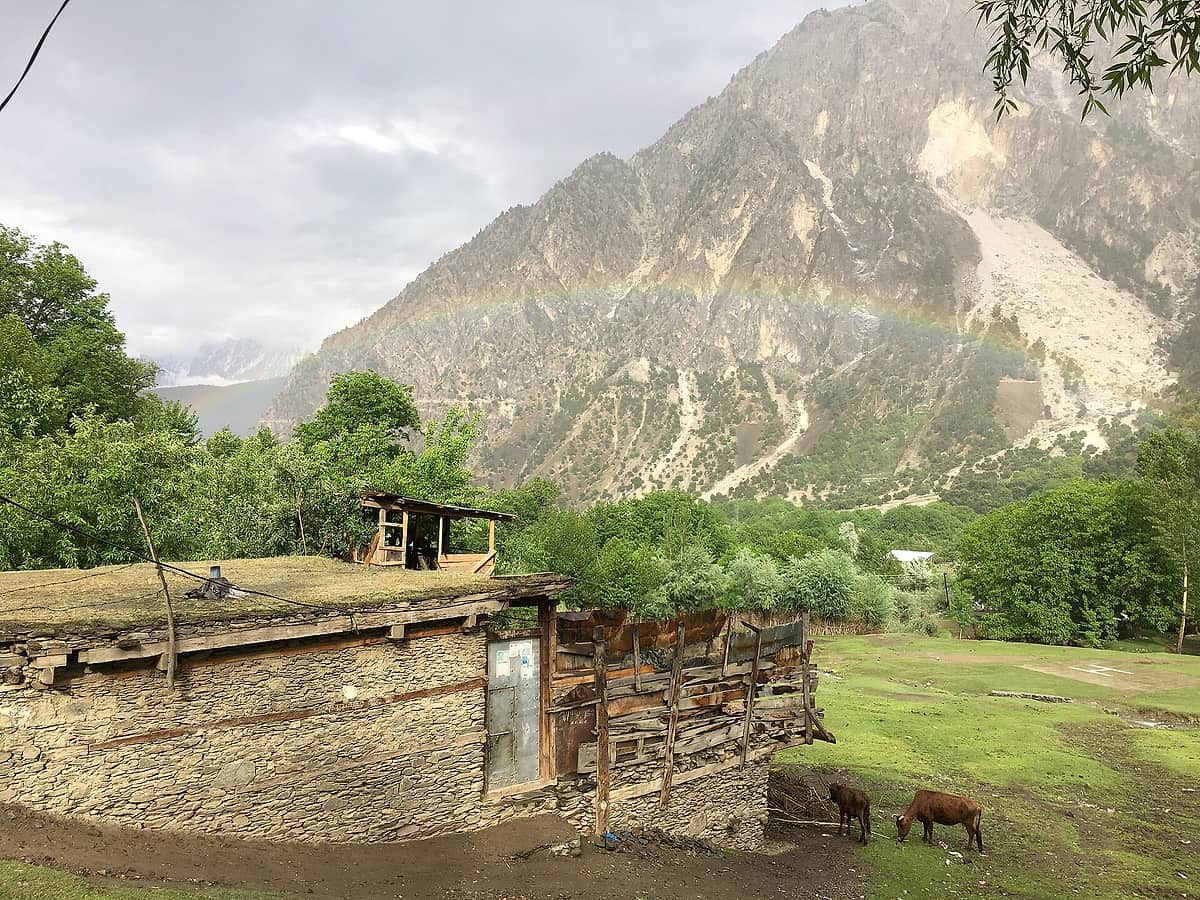
The Kalasha language
The Indo-Aryan language of the Kalash valleys in Chitral, and the Nuristani language of Waygal that shares its name in the books.
Kalasha, and the other Kalasha
Kalasha is the language of the Kalash, the people of three valleys in Chitral, in the far north-west of Pakistan. It is an Indo-Aryan language, one of the mountain languages loosely called Dardic, and its nearest relative is Khowar, the main language of Chitral. Pakistan's 2023 census counted 7,466 people who speak it as their mother tongue. Its first alphabet books were printed in 1994, and since 2001 it has been written in a Roman alphabet that its own teachers and elders chose.
There is a second Kalasha. In the Waygal valley of Nuristan, over the mountains in Afghanistan, the books give the same name to a different language, Kalasha-ala. People in Waygal call it Waygali-ala, and it is our mother tongue. It is a Nuristani language, not an Indo-Aryan one, and a speaker of one Kalasha cannot follow the other. This page is about the Kalasha of Chitral: how linguists classify it, who speaks it, how it came to be written, its dialects and how endangered it is. Then it sets the two Kalashas side by side, with a short word list, because the shared name causes real confusion, not least for anyone looking for a translator.
- Family
- Indo-Aryan, in the group called Dardic
- Nearest relative
- Khowar, the main language of Chitral
- Speakers
- 7,466 in Pakistan's 2023 census
- Where
- Bumburet, Rumbur and Birir, Lower Chitral
- Own name
- Kalasha-mun, or Kal'as'amondr
- Writing
- A Roman alphabet, chosen at the turn of 2001
- UNESCO
- Severely endangered (Atlas, 2010)
- Codes
- ISO 639-3 kls; Glottolog kala1372
Where Kalasha belongs
An Indo-Aryan language of the Chitral mountains, close to Khowar and older in its sounds than most of its relatives.
Kalasha is an Indo-Aryan language. Linguists usually put it with Khowar in a Chitral group of the languages called Dardic, the Indo-Aryan languages of the north-western mountains. Dardic names a region more than a family: Elena Bashir calls it a geographic cover term, and Richard Strand would drop it altogether. Glottolog, the catalogue of the world's languages, lists Kalasha directly under Indo-Aryan, because no shared innovations have been found that would make Kalasha and Khowar a branch of their own.
What interests linguists is how much Kalasha has kept. With Khowar it is probably the most conservative language spoken in Pakistan, holding on to old sounds, consonant clusters and many of the old case endings of Sanskrit. The word for village is grom, beside Sanskrit grāma, and Kalasha keeps the breathy consonants written bh, dh and gh, which most of its Dardic neighbours have lost. It is also known for its retroflex vowels, said with the tongue curled back, which it sets beside plain, long and nasal ones.
It is not a Nuristani language. Georg Morgenstierne, the Norwegian linguist who began work in these mountains in the 1920s, showed that the Nuristani languages next door form a third branch of Indo-Iranian, beside Indo-Aryan and Iranian, and that Kalasha and the other Dardic languages are Indo-Aryan. The two families share many features, and the early writers mixed them up. In 1880 Gottlieb Leitner published a study called The Bashgeli Kafirs and their language. The language in it was the Kalasha of Chitral, which is not spoken in the Bashgal at all.
Who has recorded it
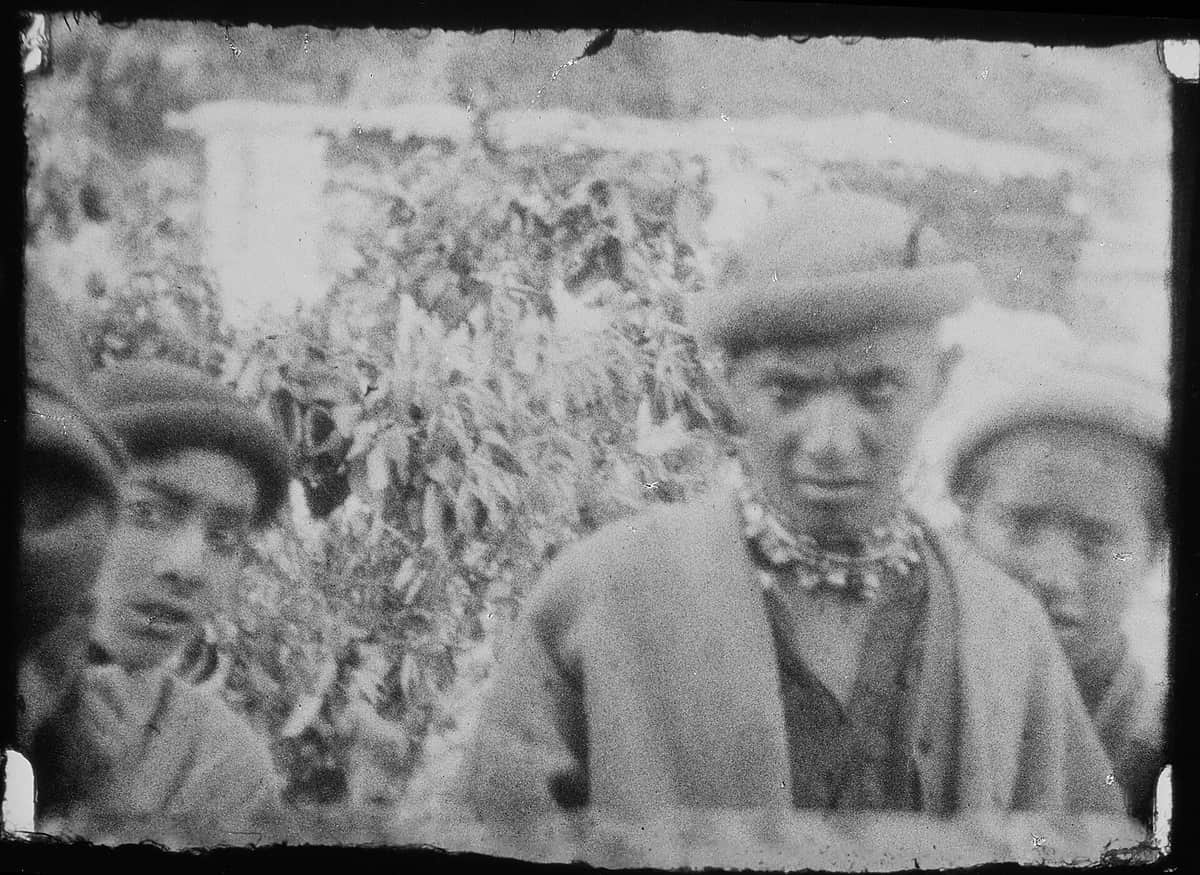
Morgenstierne took the photograph here in Rumbur in May 1929 and published his volume on the Kalasha language in 1973. Ronald Trail and Gregory Cooper published a Kalasha dictionary, with English and Urdu, in 1999.
Jan Heegård Petersen recorded Kalasha texts with his language consultants between 1995 and 1997 and again between 2004 and 2006, and published them with a grammar in 2015. In 2021 a description of the sounds of the Bumburet speech appeared in the Journal of the International Phonetic Association with the Kalasha linguist Taj Khan Kalash among its five authors.
Who speaks Kalasha
Kalasha is spoken in the Kalash valleys of Lower Chitral: Bumburet, Rumbur and Birir, which run west from the Chitral river up towards the Afghan border, and Urtsun to the south, where the speech has changed most.
Pakistan's census of 2023 counted 7,466 people whose mother tongue is Kalasha. That is more than the estimates linguists had worked with before it, which ran from three to five thousand.
The census counts speakers, not believers. For the Kalash population and their religion, see the Kalash people and the Kalash religion.
How Kalasha came to be written
Two scripts were prepared, and the Kalash chose between them. The Roman alphabet has been in use since 2001.
- 1982The Australian linguist Greg Cooper comes to the valleys and is soon joined by the American linguist Ron Trail. Together they work out the sounds, words and grammar of the language.
- 1994A first illustrated alphabet book and a pre-reader are printed in a Persian-style script based on Urdu, which the Kalasha speakers they worked with preferred at the time.
- 1999Trail and Cooper's Kalasha dictionary appears, with every word in both Roman and Arabic script.
- 2000Elsa Cooper and Taj Khan, then a Kalasha student, bring the Kalasha teachers together through the autumn. Injinier Khan, the first Kalasha teacher, has devised an alphabet of his own whose sounds match the linguists' analysis. The teachers decide on the Roman script.
- 2001At a conference in Islamabad over the New Year, 21 Kalasha teachers, students, elders and others weigh the Arabic and Roman spellings. On New Year's Eve they vote a second time, and the Roman alphabet is again the unanimous choice. The organisers date written Kalasha from 1 January 2001.
- 2003The alphabet book is reissued in the Roman script as Kal'as'a Alibe, sponsored by the Mesogaia Foundation in Athens, for the five Kalasha schools of the time.
- 2016A spelling workshop at the Kalasha Dur in Bumburet keeps the Roman alphabet and settles how to mark nasal sounds. Participants object to a proposal to replace the apostrophes with dots under the letters, because of the books printed since 2001.
- 2020A proposal to Unicode by a Chitrali linguist, backed by the Khowar Academy, asks for seven extra Arabic letters, for writing Kalasha in the Arabic script.
Apostrophes and dots
The school spelling marks some sounds with an apostrophe, so the name of the people and the language is written Kal'as'a. Linguists write the same sounds with a dot under the letter, as in Kalaṣa, which is why the word list further down this page looks different from a Kalash schoolbook.
The Arabic script has not gone away. The first books were in a Persian-style script, the 1999 dictionary gives both, and the original Persian-script alphabet and books are still available for any community that prefers them.
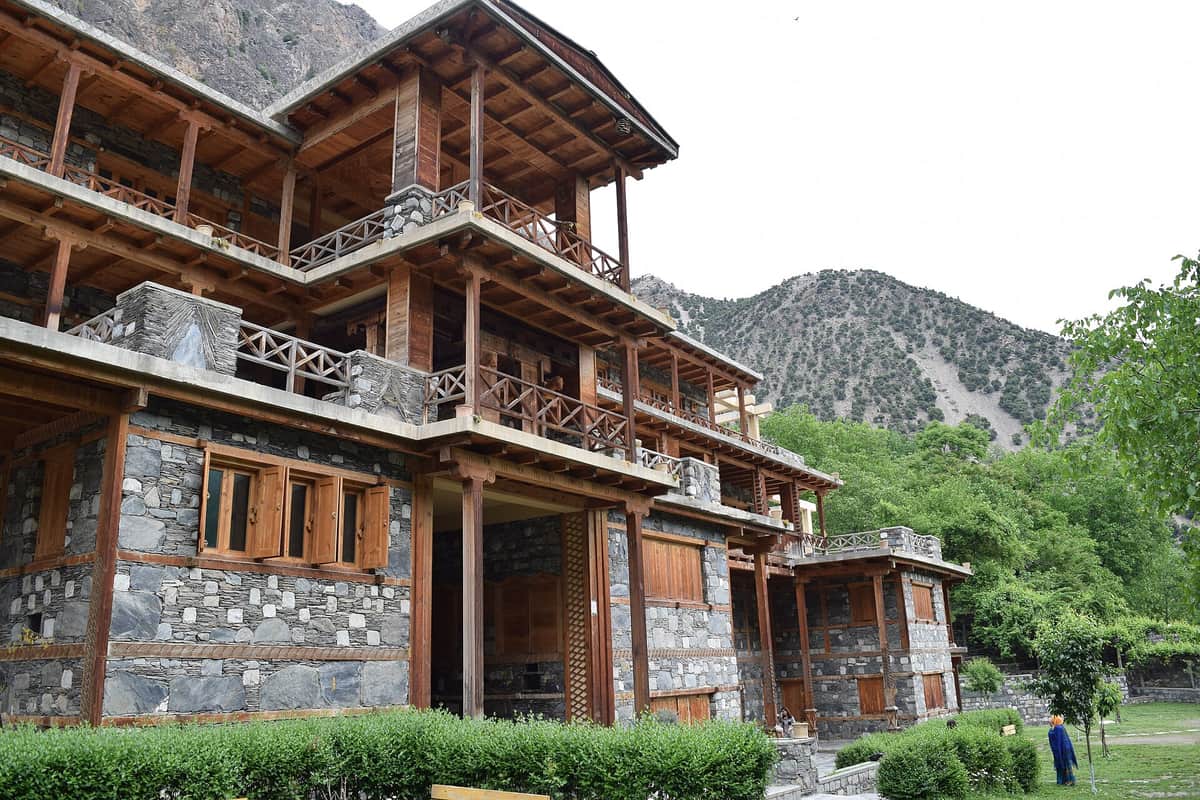
The Kalasha Dur, where the 2016 spelling workshop met. Dur means house in Kalasha.
Valley by valley
Kalasha changes a little from valley to valley. Glottolog divides it into a north-western Kalasha, in which Rumbur and Bumburet count as one variety and Birir as another, and a southern Kalasha, the speech of Urtsun. The 2021 description of the language's sounds is of the speech of Bumburet.
Even the word for language differs. In one form it is mon and in another mandr, which is why the language's own name appears both as Kalasha-mun and as Kal'as'amondr.
The southern speech has moved furthest. In the twentieth century the Kalash of Urtsun shifted to a form of Kalasha strongly influenced by Khowar, which is known as Urtsuniwar.
How endangered is Kalasha?
The assessments disagree. This is what each one says, with its date.
How endangered Kalasha is depends on who is assessing it. The census figure is higher than the old estimates, and the cataloguers record that the younger generation still learns the language, from family or at school. They also record a community moving towards other languages of the area, especially Khowar and Pashto, through religious conversion and migration.
Conversion is the pressure people in the valleys name. A Kalash speaker told the Express Tribune in 2018 that once people convert, they do not teach their children Kalasha. The same report found that the school at the Kalash cultural centre was the only one in the area teaching the language.
| Source | What it says |
|---|---|
| Pakistan census, 2023 | 7,466 people with Kalasha as their mother tongue |
| Linguists' estimate before the census | 3,000 to 5,000 speakers |
| UNESCO Atlas of the World's Languages in Danger, third edition, 2010 | Severely endangered |
| Endangered Languages Catalogue, as cited by Glottolog 5.3 | Threatened: the young still learn it, but the community is shifting towards Khowar and Pashto |
| Glottolog 5.3, on its own scale | Shifting |
| Ethnologue, as reported in 2021 | Vigorous |
The other Kalasha: Kalasha-ala (Waygali-ala) of Waygal
We come from the Waygal valley, and this is our language. It shares a name with the Kalasha of Chitral in the books, and nothing closer than that.
In the Waygal valley of southern Nuristan, over the mountains in Afghanistan, there is another Kalasha. Linguists call its language Kalasha-ala, or Nuristani Kalasha, and older books call it Waigali. In Waygal we call it Waygali-ala. Ala means language, and mon means language in Kalasha, so Kalasha-ala and Kalasha-mun both say the same thing, the Kalasha language, each in its own tongue.
They are different languages. Kalasha-ala is Nuristani, in the southern group of that family with Ashkun and Tregami, while the Kalasha of Chitral is Indo-Aryan. Richard Strand divides Kalasha-ala into the speech of the Väi of the upper valley, around Waygal village, and that of the Čima-Nišei of the lower valley, around Nishigram. A speaker of one Kalasha cannot follow the other, although people in Waygal hear the kinship when the Kalash speak.
Why the same name? The word Kalasha is older and wider than either language. Wolfgang Lentz, who was in Nuristan with a German expedition in 1935, heard it used for the people and language of the Waygal valley and, more loosely, for neighbouring tribes as well, and thought it had no connection with the Kalash of Chitral. Richard Strand thinks a group of Kalasha from Waygal crossed into lower Chitral in the fifteenth century, set up a ruling line there and gave the people their name. Samiullah Taza, a native speaker of Kalasha-ala, counts the Kalasha as one of the large tribes of the Nuristani nation, taking in the people of Waygal, of the Ashkun country and of Wama, and counts the Kalash of Chitral as historically part of it.
Because the books use one name for two languages, the confusion is practical as well as scholarly. Some linguists have tried to keep them apart by the word for language, Kalasha-mon for Chitral and Kalasha-ala for Waygal; others write Nuristani Kalasha and Indo-Aryan Kalasha. When someone asks for a Kalasha translator, the first question is which Kalasha they mean.
| Kalasha of Chitral | Kalasha-ala of Waygal | |
|---|---|---|
| Family | Indo-Aryan, in the Dardic group, nearest to Khowar | Nuristani, in the southern group with Ashkun and Tregami |
| Where | Bumburet, Rumbur and Birir, Lower Chitral, Pakistan | The Waygal valley, Nuristan, Afghanistan |
| Own name | Kalasha-mun or Kal'as'amondr: mon means language | Waygali-ala in Waygal, Kalasha-ala in the books: ala means language |
| Speakers | 7,466 in Pakistan's 2023 census | About ten thousand or more, on published estimates |
| Writing | A Roman alphabet since 2001 | No agreed alphabet; Samiullah Taza's dictionary, with Pashto and Dari, appeared in Kabul in 2017 |
| UNESCO | Severely endangered | Definitely endangered |
| Codes | ISO 639-3 kls; Glottolog kala1372 | ISO 639-3 wbk; Glottolog waig1243 |
The two Kalashas, word by word
Twenty-two everyday words in the two languages. The first numbers look alike; most of the other words do not.
| English | Kalasha of Chitral | Waygali-ala, Nishigram |
|---|---|---|
| one | ek | ev |
| two | du | dü |
| three | tre | tre |
| four | čaw | čatâ |
| five | ponǰ | pu˜č |
| water | uk | âv |
| sun | súri | sö |
| moon | mastrúk | mâs |
| mountain | dénta | dâ |
| snow | kírik, oš | zim |
| house | dur | amâ |
| village | grom | deš |
| man | púruṣ, moč | mâč |
| woman | istríža | meši |
| child | súda | kṛo |
| father | dáda | tâti |
| mother | áya | iei |
| dog | šọ̃́a | ću˜ |
| hand | bazá | dost |
| heart | hị́a | zö |
| name | nom | nâm |
| language | mon | alâ |
The Kalasha words are as Wiktionary gives them, in the Latin transcription of the National Institute of Pakistan Studies, in which a dot under a consonant marks a retroflex sound. The Waygali-ala words are Richard Strand's, recorded at Nishigram in the lower valley, as on our page of Nuristani words; the speech of Waygal village differs in places.
Kalasha column: Wiktionary, Appendix:Kalasha Swadesh list and entries, licensed CC BY-SA 4.0. The column may be reused under the same licence. Licence terms.
Translating Kalasha
We are native speakers of Waygali-ala, the Kalasha-ala of Waygal, and that is the Kalasha we translate and interpret: documents, voice messages and recordings, and interpreting in person anywhere in the UK or by telephone and video. We do not speak the Kalasha of Chitral. For that language you need a speaker from Bumburet, Rumbur or Birir.
If you have a recording and are not sure which Kalasha it is, send it to us and we will tell you whether it is ours.
Asked about the Kalasha language
Can you translate Kalasha?
Only the Kalasha of Waygal. We are native speakers of Waygali-ala, the Nuristani language the books call Kalasha-ala, and we translate documents and recordings in it and interpret in person anywhere in the UK, or by telephone and video. We do not speak the Indo-Aryan Kalasha of the Kalash valleys in Chitral, and a Waygali speaker cannot follow it, so for that language you need a speaker from Bumburet, Rumbur or Birir. If you are not sure which Kalasha you have, send us a short recording and we will tell you whether it is ours.
Is Kalasha related to Khowar?
Yes. Both are Indo-Aryan languages of Chitral, and linguists usually group them together in the Dardic languages; the two are probably the most conservative languages spoken in Pakistan. Khowar is the main language of Chitral, and it is one of the languages Kalasha speakers are shifting towards. Glottolog does not treat the two as a proven branch of their own, because no shared innovations have been found.
What alphabet is Kalasha written in?
A Roman alphabet. It was chosen by a unanimous vote of 21 Kalasha teachers, students, elders and others at a conference in Islamabad at the turn of 2001, and the first Roman-script alphabet book, Kal'as'a Alibe, was printed in 2003. Some sounds are marked with an apostrophe, as in Kal'as'a. The first books, in 1994, used a Persian-style script based on Urdu, and those books are still available for anyone who prefers that script.
Is Kalasha an endangered language?
UNESCO's atlas of 2010 lists it as severely endangered and the Endangered Languages Catalogue as threatened, while Ethnologue has called it vigorous. Children still learn it from family or at school, but the community is shifting towards Khowar and Pashto, mainly through conversion and migration. Pakistan's 2023 census counted 7,466 people with Kalasha as their mother tongue.
What does Kalashamon mean?
The Kalasha language. Mon means language in Kalasha, and in some speech the word is mandr, which is why the name is also written Kal'as'amondr. The Nuristani language of Waygal makes its book name the same way with its own word for language, ala: Kalasha-ala.
How do you say hello in Kalasha?
Ishpata. Wiktionary records it, spelt išpáta, as a Kalasha greeting, and the Express Tribune, reporting from the valleys in 2018, explained it as welcome.
On this site
- The Kalash people: who they are and where they come from
- Kalasha religion: the gods, the festivals and the rules
- Chitral and the Kalash valleys, over the passes
- The Nuristani languages, valley by valley
- Words and numbers in the Nuristani languages
- Waygali-ala translation and interpreting
- Waygal, the valley of the other Kalasha
- Pakistan Bureau of Statistics: National Census Report 2023 (mother tongue tables)
- Wikipedia: Kalasha language (classification, conservative features, vowels, Urtsuniwar, the local name)
- Wikipedia: Dardic languages (the Chitral group, and Dardic as a geographic term)
- Glottolog 5.3: Chitral Kalasha (kala1372), classification, varieties and endangerment
- Kochetov, Arsenault, Heegård Petersen, Kalas and Kalash, Kalasha (Bumburet variety), Journal of the International Phonetic Association, 2021 (abstract)
- Claus Peter Zoller, review of Jan Heegård Petersen, Kalasha Texts, with Introductory Grammar (Norsk Lingvistisk Tidsskrift, 2016)
- Jakob Halfmann, Terminological proposals for the Nuristani languages (Himalayan Linguistics, 2021), on Leitner, Lentz, Taza and the two Kalashas
- Kalasha.org: the beginning of the Kalasha alphabet (1982)
- Kalasha.org: the first alphabet book and pre-reader (1994)
- Kalasha.org: the change to a Roman script (2000)
- Kalasha.org: the orthography conference and Kal'as'a Alibe (2001 to 2003)
- Pamir Times: five-day workshop on the Kalasha language concluded (24 April 2016)
- Forum for Language Initiatives: orthography workshop at the Kalasha Dur, Bumburet (26 April 2016)
- Unicode document L2/20-160: proposal to include Kalasha language alphabets (May 2020)
- Express Tribune: the heritage of Kalash, and whether it will survive (Rina Saeed Khan, 9 December 2018)
- Wikipedia: List of endangered languages in Asia (UNESCO Atlas status, third edition, 2010)
- Wiktionary: Appendix, Kalasha Swadesh list (CC BY-SA 4.0)
- Wiktionary: Appendix, Kalasha pronunciation (the transcription used in the word list)
- Richard Strand: the Kalasha of Nuristan, their dialects and their name
- Richard Strand: Nishei-alâ lexicon (the Waygali-ala words)
- Wikipedia: Nuristani Kalasha language (speakers, dialects, UNESCO status)
Photographs
- A house in Bumburet: photograph by Numan Ali, CC BY-SA 4.0, via Wikimedia Commons
- Kalasha youths at the Shing-mou altar, Rumbur, 1929: Georg Morgenstierne, National Library of Norway, public domain, via Wikimedia Commons
- The Kalasha Dur, Bumburet: photograph by Zeeshan-ul-hassan Usmani, CC BY-SA 4.0, via Wikimedia Commons
The site's own photographs are of Nuristan; these are used under their licences until we have our own from Chitral.
Plan your Nuristan journey
Ready to plan a visit, source Nuristani products, or discuss an investment? Your message goes to Obaid, who is from Nuristan, and his team in Afghanistan and the UK. We reply to every message.