Some Afghans have blue or green eyes and fair or red hair, and in Nuristan people ask about it more than anything else. How common it really is, what the measurements show, where the genes come from, and why the story about Alexander the Great has never been settled.
Some Afghans have blue or green eyes, and some have fair or red hair. It surprises people who expect everyone in Afghanistan to look alike, and it is the question we are asked most often about Nuristan, where it is a little more common than elsewhere. The short answer is that the genes for light eyes and hair are far older than any nation and are scattered thinly from Ireland to the Himalayas, and that small mountain communities tend to hold on to what they have.
The longer answer is on this page: how common it actually is, what the people who measured it found, where the traits come from, and what can and cannot be said about Alexander the Great. We have kept to what the evidence supports. A great deal of nonsense has been written on this subject, some of it for ugly reasons, and we say where.
The short answer
- Most Afghans, and most Nuristanis, have dark hair and brown eyes. Light colouring is a minority everywhere in the country.
- It is found in many groups: Nuristanis, Pashtuns, Tajiks and the peoples of Badakhshan and the Pamirs.
- The gene variants behind it are thousands of years old and are shared across Europe, Central Asia and northern South Asia.
- Isolated valleys keep rare traits at a higher rate, which is why the Hindu Kush has a reputation for them.
- No study has shown that it comes from Alexander's Greeks, and almost no Nuristanis have been tested.
How common is it really?
Less common than the photographs on the internet suggest, and nobody has counted properly in modern times. The only large body of measurements comes from a Soviet and Afghan survey led by the anthropologist G. F. Debets in the 1960s, which recorded the eye and hair colour of men in dozens of places using printed colour scales. It is sixty years old, its samples were small, and it looked only at men, but it is the best there is.
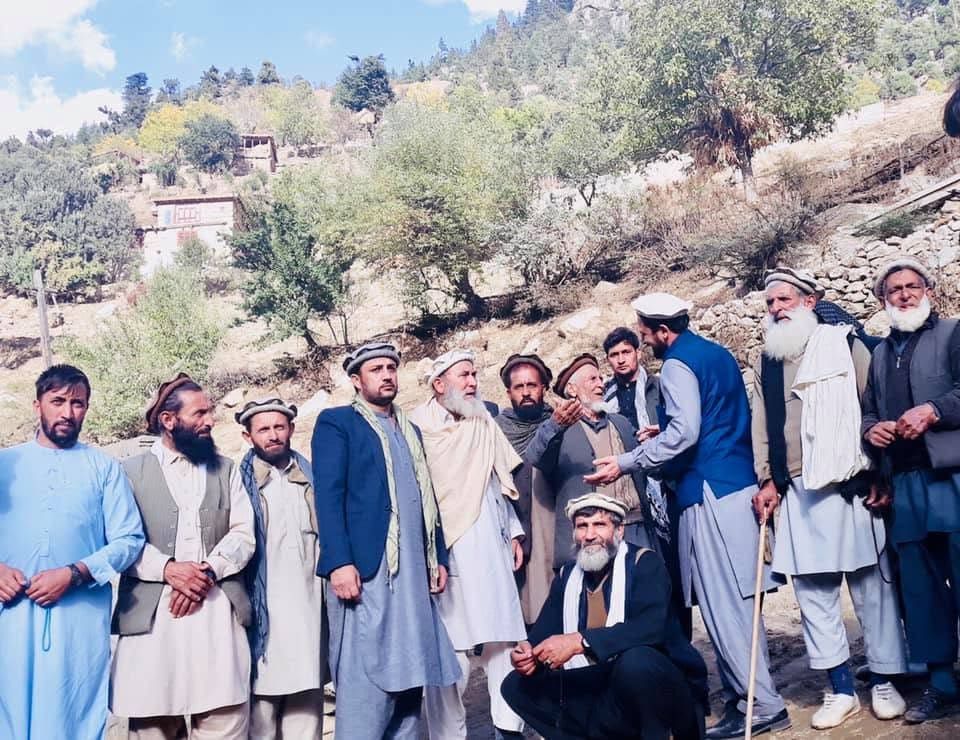
- Kati Nuristanis around Kamdesh: 2 per cent with light eyes and 80 per cent with dark, out of 113 men.
- Ashkun Nuristanis of Wama: 12 per cent with light eyes, about a third mixed and just over half dark, out of 63 men. This was the lightest group in the whole survey.
- Pashtuns, in eighteen local samples: between 0 and 5 per cent with light eyes.
- Tajiks, in twelve samples: between 0 and 5 per cent, with the fewest dark eyes at Jurm in Badakhshan.
- The Pamir peoples of the far north-east: between 1 and 4 per cent.
- Hazaras, in five samples: between 0 and 1 per cent.
Debets's own conclusion was that Nuristanis are slightly lighter than Pashtuns on average, but that black hair and brown eyes predominate among them too, and that his sample from the lower Bashgal was no lighter than the Pashtuns next door. One much-quoted reference work says that about a third of Nuristanis are fair, but it gives no measurements, and the figures above do not support it. A study of nearly nine hundred Pashtuns in northern Pakistan in 2023 found blue eyes in about one in eighteen, though it was a test of DNA prediction and was not designed as a count.
What the early travellers wrote
The reputation is two hundred years old, and it began with men who had never been to Kafiristan. Mountstuart Elphinstone, writing in 1815, was told in Peshawar that the Kafirs were famous for their beauty and their European complexion. Alexander Burnes, in the 1830s, saw one Kafir boy of about ten in Kabul, with bluish eyes, and wrote about him. Charles Masson saw six or seven youths, noticed fair skin and lighter hair, and was careful to say that everything he knew was hearsay.
The one who actually lived there told a calmer story. George Scott Robertson spent a year at Kamdesh in 1890 and 1891. He found the Kafirs on the whole less fair than the upper classes of Chitral and many people of Badakhshan, with a skin colour like that of the average Punjabi. He noticed that the children of Parun were often fair-haired and light-eyed when small and darkened as they grew. Red-haired and very fair people, he wrote, were fewer than one in a hundred.
Where blue eyes and fair hair come from
Blue eyes are caused by a small change in a stretch of DNA that controls a pigment gene called OCA2. Blue-eyed people from Denmark, Turkey and Jordan have been found to carry the same version, which points to a single origin a very long time ago: it was already common among the hunter-gatherers of Europe after the last Ice Age. Red hair comes mostly from variants of another gene, MC1R. Fair hair has several causes, and it has arisen more than once: the blond hair of the Solomon Islanders in the Pacific comes from a different gene altogether, so fair hair is no proof of European descent.
These variants never belonged to Europe alone. The best-studied variant for lighter skin has a frequency of about a half across South Asia and nearly nine-tenths in the north-west of the subcontinent, inherited from the same ancient source as in Europeans. Herders of the Bronze Age steppe whose remains have been tested carried the variants for light eyes and hair, and steppe ancestry of that kind, which spread south in the second millennium BC, makes up as much as thirty per cent of the ancestry of some South Asian groups today.
So the raw material is present, thinly, across the whole region. What changes from place to place is how much of it survives. In a city of a million, a rare variant stays rare. In a valley of a few thousand people who have married among themselves for centuries, chance alone can make it several times more common, or lose it altogether. Debets put the Nuristanis' slightly lighter colouring down to exactly this, drift in an isolated population, and not to any northern European element. The Kalash across the border, a people of a few thousand, show the same effect in their DNA.
Is it Alexander?
The story that the fair people of the Hindu Kush descend from the soldiers of Alexander the Great, who crossed these mountains in the 320s BC, is very old. Marco Polo heard it in the thirteenth century about the kings of Badakhshan, and it has been told since of the rulers of Hunza, Nagar and Skardu, and of the Kafirs. In Nuristan it is told with conviction today.
The written record is mixed. Elphinstone raised the idea and then rejected it because the Kafir languages are not Greek. Burnes reported that the Kafirs he met had no such tradition. Robertson recorded the Kom of Kamdesh tracing themselves to the Quraysh of Arabia. Yet a Kafir delegation of 1891 did claim descent from Alexander, though the scholar who records it thinks the claim was made for political effect.
The genetic record is thin. A study of the Y chromosomes of 952 men in Pakistan found two Pashtun men with a lineage matching Greek and Macedonian ones, and nothing of the kind among the Kalash. Studies of Afghan men have found that the lineages sometimes thought to be Greek group with those of the Middle East and Iran. Two teams of geneticists still disagree about whether the Kalash show traces of mixing from about Alexander's time. And for Nuristan itself there is almost nothing: the one Afghan study to include Nuristanis had five men, of whom only two gave Nuristan as their fathers' home. Evidence of Greek ancestry has not been found, and it has not really been looked for among us. We leave the question open.
The search for Aryans
Not all the interest has been innocent. In 1935 a German expedition travelled through Nuristan and measured some 250 people. The Nazi government had a racial interest in the trip, and its anthropologist sorted the Nuristanis into types, one of them tall, blond and blue-eyed. The idea of a lost European tribe in the Hindu Kush has trailed after us ever since.
The word at the centre of it has been badly misused. Aryan is properly a term for languages: the Iranian and Indo-Aryan languages, whose ancient speakers used the word of themselves. The Nuristani languages form a third branch of the same family. That makes Nuristanis the heirs of a very old language, which is something to be proud of, and it says nothing at all about the colour of anyone's hair.
Not only Nuristan
The most famous pair of light eyes in Afghanistan belonged to a Pashtun. Sharbat Gula, the girl with sea-green eyes photographed by Steve McCurry in a refugee camp in 1984, appeared on the cover of National Geographic in June 1985 and became the best-known Afghan face in the world. Debets photographed a blue-eyed blond and a blue-eyed redhead among the Tajiks of Panjshir, while noting that the popular belief in fair Panjshiris was much exaggerated. Light eyes turn up in every part of the country.
How it looks from inside the valleys
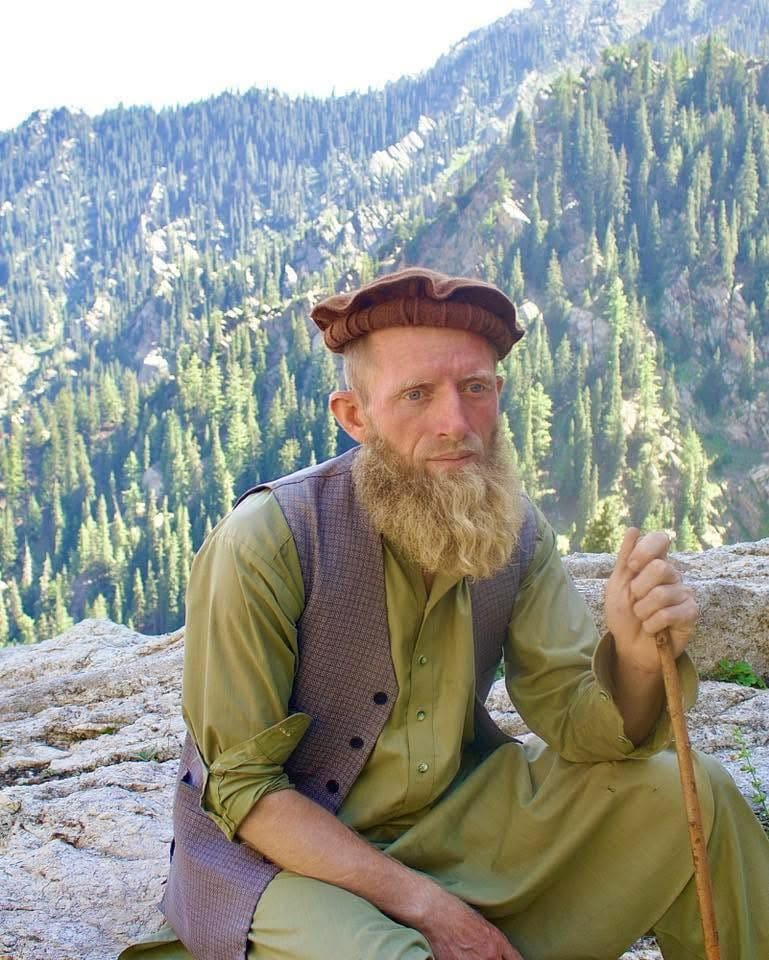
We grew up in Nuristan, and none of this was remarkable there. In most families everyone is dark. In some there is a child with fair hair that darkens by the time they are grown, as Robertson noticed in Parun, or a man with a red beard and grey eyes. Nobody thinks of it as foreign. The man in the photograph at the top of this page is an elder of the high valleys, and he looks like what he is, a Nuristani.
What we would ask of visitors and of people writing about us is to hold two facts together. Some Nuristanis are fair, and that is real. And Nuristanis are Afghans of the Hindu Kush, with a history of our own that does not need a European ancestor to be worth knowing.
Questions people ask
Why do some Afghans have blonde hair and blue eyes?
Because the gene variants that produce light eyes and hair are very old and are found, at low frequency, right across Europe, Central Asia and the north of South Asia. In small mountain communities that marry among themselves, such as the valleys of Nuristan, an uncommon trait can stay more common than it is in the cities and plains.
What percentage of Afghans have blue eyes?
There is no national figure. The only large survey, carried out by Soviet and Afghan anthropologists in the 1960s, found light eyes in between 0 and 5 per cent of men in most Pashtun and Tajik groups, with a larger share having mixed or hazel shades. Dark brown eyes are by far the most common.
Which Afghan tribe has blue eyes?
No single one. Light eyes turn up among Nuristanis, Pashtuns, Tajiks and the peoples of Badakhshan and the Pamirs. In the 1960s survey the highest share was among the Ashkun Nuristanis of Wama, at 12 per cent of 63 men, and even there most people had dark eyes.
Are Nuristani people white?
Nuristanis are Afghans of the eastern Hindu Kush, and they come in every shade. George Scott Robertson, who lived among them in 1890 and 1891, compared their usual skin colour to that of the average Punjabi and said very fair or red-haired people were fewer than one in a hundred. Some families are much fairer than that, and most are not.
Why do some Nuristanis have red hair?
Red hair comes from variants of a gene called MC1R and usually has to be inherited from both parents, which is why it is rare everywhere. It has been recorded in Nuristan, in Hunza and elsewhere in these mountains for as long as travellers have written about them.
Are Nuristanis descended from Alexander the Great?
It has not been shown, and it has not been properly tested. The story is centuries old in this region and is still told in the valleys. Genetic studies of Afghans have found little sign of Greek ancestry, but almost no Nuristanis have ever been sampled, so the question remains open.
What are the typical eye colours in Afghanistan?
Dark brown is much the most common in every group that has been measured. Mixed shades, hazel and greenish, come next, and clear blue or grey eyes are a small minority, a few per cent at most in the groups surveyed.
Read on
- Who are the Nuristani people? Origins, genetics and daily life
- The Kalash people and what their DNA studies found
- The Nuristani languages, a branch of their own
- Kafiristan: the history of Nuristan before 1896
- Is The Man Who Would Be King a true story?
- Nuristani clothing and how people dress
- The gallery: our own photographs of Nuristan
Questions people ask
Why do some Afghans have blonde hair and blue eyes?
Because the gene variants that produce light eyes and hair are very old and are found, at low frequency, right across Europe, Central Asia and the north of South Asia. In small mountain communities that marry among themselves, such as the valleys of Nuristan, an uncommon trait can stay more common than it is in the cities and plains.
What percentage of Afghans have blue eyes?
There is no national figure. The only large survey, carried out by Soviet and Afghan anthropologists in the 1960s, found light eyes in between 0 and 5 per cent of men in most Pashtun and Tajik groups, with a larger share having mixed or hazel shades. Dark brown eyes are by far the most common.
Which Afghan tribe has blue eyes?
No single one. Light eyes turn up among Nuristanis, Pashtuns, Tajiks and the peoples of Badakhshan and the Pamirs. In the 1960s survey the highest share was among the Ashkun Nuristanis of Wama, at 12 per cent of 63 men, and even there most people had dark eyes.
Are Nuristani people white?
Nuristanis are Afghans of the eastern Hindu Kush, and they come in every shade. George Scott Robertson, who lived among them in 1890 and 1891, compared their usual skin colour to that of the average Punjabi and said very fair or red-haired people were fewer than one in a hundred. Some families are much fairer than that, and most are not.
Why do some Nuristanis have red hair?
Red hair comes from variants of a gene called MC1R and usually has to be inherited from both parents, which is why it is rare everywhere. It has been recorded in Nuristan, in Hunza and elsewhere in these mountains for as long as travellers have written about them.
Are Nuristanis descended from Alexander the Great?
It has not been shown, and it has not been properly tested. The story is centuries old in this region and is still told in the valleys. Genetic studies of Afghans have found little sign of Greek ancestry, but almost no Nuristanis have ever been sampled, so the question remains open.
What are the typical eye colours in Afghanistan?
Dark brown is much the most common in every group that has been measured. Mixed shades, hazel and greenish, come next, and clear blue or grey eyes are a small minority, a few per cent at most in the groups surveyed.
Sources
- G. F. Debets, Physical Anthropology of Afghanistan (Peabody Museum, 1970), the survey tables for eye and hair colour
- George Scott Robertson, The Kafirs of the Hindu-Kush (1896)
- Encyclopaedia Iranica: Afghanistan, ethnography (the one-third figure, given without measurements)
- Eye colour prediction in Pashtuns of Malakand Division, Pakistan (2023)
- Eiberg and others, Blue eye color in humans (Human Genetics, 2008)
- Basu Mallick and others, The light skin allele of SLC24A5 in South Asians and Europeans shares identity by descent (PLoS Genetics, 2013)
- Kenny and others, Melanesian blond hair is caused by an amino acid change in TYRP1 (Science, 2012)
- Keyser and others, Ancient DNA and the south Siberian Kurgan people (Human Genetics, 2009)
- Narasimhan and others, The formation of human populations in South and Central Asia (Science, 2019)
- Haber and others, Afghanistan's ethnic groups share a Y-chromosomal heritage (PLoS ONE, 2012)
- Firasat and others, Y-chromosomal evidence for a limited Greek contribution to the Pathan population of Pakistan (2007)
- Ayub and others, The Kalash Genetic Isolate (American Journal of Human Genetics, 2015)
- Augusto Cacopardo, Are the Kalasha really of Greek origin? (Acta Orientalia, 2011), on the history of the Alexander legend
- Afghanistan Analysts Network: the German Hindu Kush expedition of 1935
- Encyclopaedia Iranica: Aryans (the word as a linguistic term)
- National Geographic: the Afghan Girl found (2002)