For a thousand years the valleys were Kafiristan, a land of carved wooden gods, wine and great feasts that outlasted every empire around it. Who the Kafirs were, what they believed, how it ended in the winter of 1895, and what survives.
Until 1896 the province now called Nuristan did not exist, and neither did the name. The valleys of the eastern Hindu Kush were Kafiristan, the land of the kafirs, the unbelievers: a name given by the Muslim peoples around them to a mountain country that had kept its own gods long after everyone else in the region had converted. The people themselves never used it. They called themselves by tribe and valley: Kata, Kom, Mumo, Wai, Ashkun, Vasi. What follows is their story, as far as the record lets us tell it.
A name given by outsiders
Kafir is the Arabic word for one who does not believe, and Kafiristan was how the Afghans, the Chitralis and every Persian-writing chronicler referred to the region from the medieval period onward. The neighbours also divided the Kafirs by dress. The tribes of the Bashgal valley in the east, the Kata and the Kom, wore black goat-hair robes and were called the Siah-posh, the black-robed. The Wai of Waygal, the Ashkun of the Pech and the Vasi of Parun wore lighter clothing and were the Safed-posh, the white-robed. Inside the valleys the distinction mattered less than the tribe, the village and the clan.
Who were the Kafirs?
They were, and are, an Indo-Iranian people whose languages branched off from the rest of the family before Iranian and Indo-Aryan went their separate ways. That places them in these mountains a very long time ago. The most likely account is that they descend from peoples who were already living in the Hindu Kush when Islam arrived in the surrounding lowlands between the eighth and eleventh centuries, and who held out because the terrain let them.
A more romantic story says they descend from the soldiers of Alexander the Great, who crossed the Hindu Kush in the 320s BC. Travellers recorded the claim in the nineteenth century and Rudyard Kipling built a novella on it. There is no evidence for it in the languages, in the archaeology or in genetics. The Kafirs were in these valleys long before Alexander came through.
The old religion
What the Kafirs believed is known mostly through one man, the British surgeon and political officer George Scott Robertson, who lived in Kamdesh through 1890 and 1891 and published The Kafirs of the Hindu Kush in 1896, the year the religion ended. Every later account leans on his.
It was a religion of many gods. Imra, called Mara by the Vasi of Parun, was the creator, and his temple at Kushteki in the Parun valley was the largest religious building in the country. Gish was the god of war, and the favourite of the fighting tribes of the Bashgal. There were Moni, Bagisht the god of waters, the goddess Disani, and a god called Indr whose name connects the Kafir pantheon to the Vedic hymns of ancient India: not Hinduism, but a shared Indo-Iranian inheritance thousands of years old.
Worship was outdoors and in wood. Shrines held carved boards and figures. Goats and cattle were sacrificed at stone altars and their blood offered to the gods. Grapes grew on the lower terraces, and wine was made from them and drunk at feasts, which astonished Muslim visitors; Babur, writing in the early 1500s, noted the strong wine of the Kafirs. Priests, seers and chanting at the great festivals of the year tied the villages to their gods.
Rank, feasts and the honoured dead
Kafir society ran on merit earned in public. A man rose by giving feasts: enormous distributions of meat, bread, cheese and wine to the whole village that could take years to afford. Each feast brought a rank, and each rank brought the right to wear certain marks, sit in certain places and speak in the council. The system rewarded generosity with prestige, and it explains the intensity of the hospitality that Nuristanis are still known for.
The dead were honoured the same way. A year or so after a man or woman of standing died, a wooden effigy was carved and set up outside the village, seated on a stool or riding a horse, and the family gave a feast to mark it. Rows of these figures once stood on the hillsides of every valley. The conquest swept most of them away, but some survived into the National Museum in Kabul, where they were damaged in 2001 and have been repaired since, and others are in museums abroad.
Outsiders at the gate
Kafiristan was often attacked and never held. The chronicles of Timur record a campaign against the Kafirs of Kator in 1398, on his way to India, which took heads and left the valleys unconverted. Later Afghan rulers raided the fringes, and the Kafirs raided back, so that a state of low war with the Muslim villages of the Kunar valley ran on for centuries. By the nineteenth century the Kafirs had become a curiosity to the British in India, who saw in them a lost people to be explored. Robertson's year among the Kom of Kamdesh was the result, and he was the last outsider to see Kafiristan as it was.
The winter of 1895
The Durand Line agreement of 1893 drew the border between Afghanistan and British India through the eastern Hindu Kush and left Kafiristan on the Afghan side. Amir Abdur Rahman Khan, who was building a centralised Afghan state, moved quickly. In the winter of 1895 to 1896 his army entered the valleys from several directions at once, when snow blocked the escape routes and the Kafirs could not scatter to the high pastures. By his own account the country fell in forty days. Resistance was fiercest in the Bashgal. Afterwards the population was converted, mosques were built, boys were taken to Kabul to be educated as Muslims, and in 1896 the Amir renamed the land Nuristan, the land of light, and its people Nuristanis, the enlightened.
Some families fled east over the passes into Chitral, where their descendants still speak Kati. And across those same passes the Kalash of Chitral, on the British side of the line, kept their religion. They keep it today in three small valleys, the last living cousins of the faith that once filled Kafiristan.
Kipling's Kafiristan
Many people first meet the name in fiction. Rudyard Kipling's novella The Man Who Would Be King, published in 1888, sends two British adventurers over the mountains to make themselves kings of the Kafirs, who take them for descendants of Alexander. Kipling never went near the place. John Huston filmed the story in 1975 with Sean Connery and Michael Caine, and shot it in Morocco. It is a fine story about empire and hubris, and it has almost nothing to do with the real Kafiristan, which had become Nuristan before the book was a decade old.
What survives
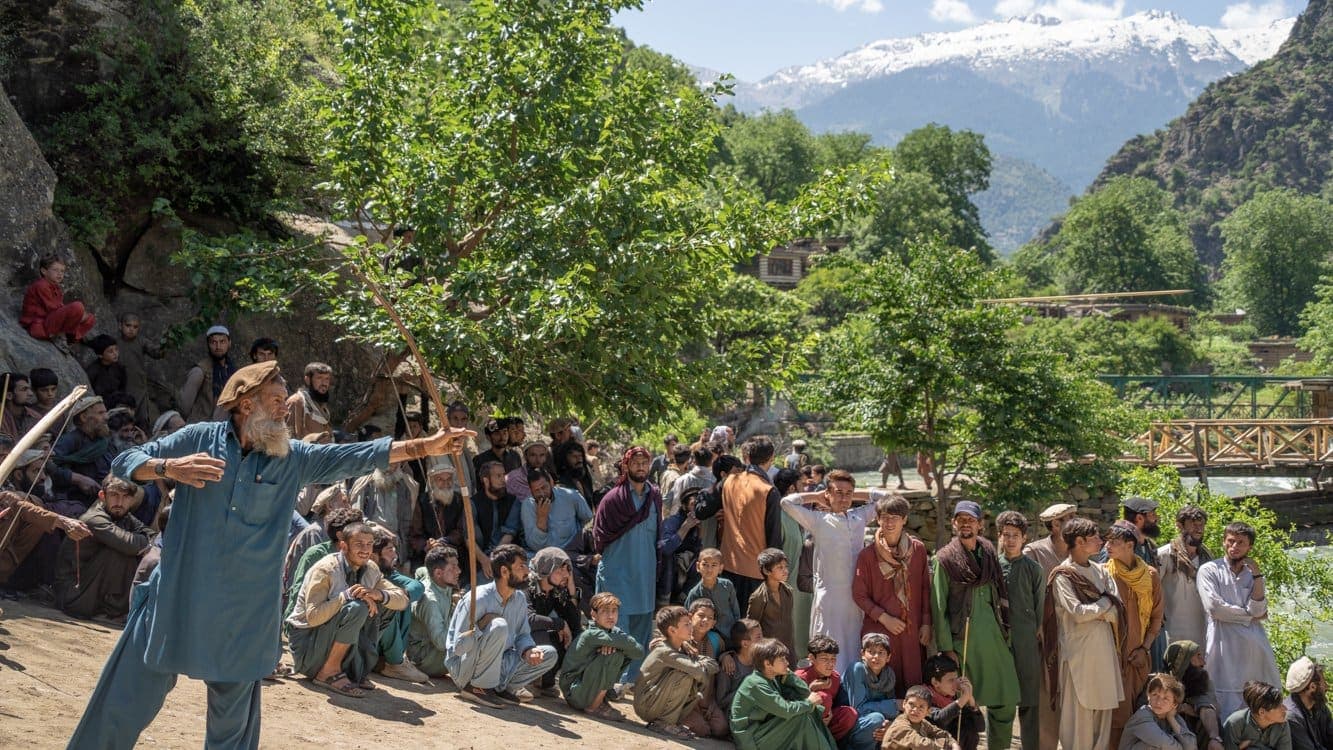
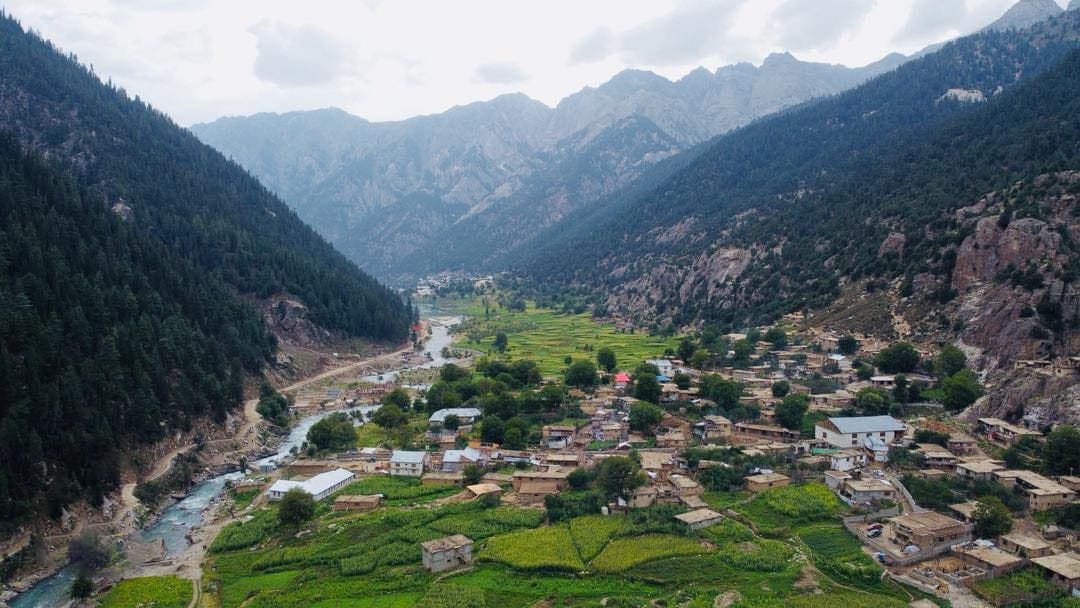
The conversion changed belief. It did not erase a culture. The languages are still spoken. The houses still climb the mountainside in tiers with carved cedar columns, and the carvers still cut the same horns, chevrons and rosettes that decorated the shrines. Feasting and hospitality still confer standing. The archery, the dances at weddings and festivals, the stools, the bows and the sense of being a people apart all come from the older world. Nuristanis today are Sunni Muslims, and devout ones, and they are also the heirs of Kafiristan. Nobody in the valleys finds that strange.
Questions people ask
When did Nuristan convert to Islam?
In the winter of 1895 to 1896, after Amir Abdur Rahman Khan's conquest. The name Nuristan dates from 1896.
Are Nuristanis Muslims?
Yes. Nuristanis have been Sunni Muslims for more than a century and are known for their piety. The Kalash of Chitral in Pakistan, who are related, still follow their old religion.
Where was Kafiristan?
The region covered today's Nuristan province, roughly the basins of the Alingar, Pech and Bashgal rivers in eastern Afghanistan, with related peoples over the passes in Chitral.
Are Nuristani people descended from Alexander the Great?
No. The story is old and much repeated, but the languages show the Nuristanis were in the Hindu Kush long before Alexander, and there is no genetic evidence for a Greek origin.
Sources