Nuristan's villages climb the mountainside in steps, each flat roof serving as the yard of the house above, framed in cedar and held together by carved columns. How the houses are built, why they stand where they do, and what the carving means.
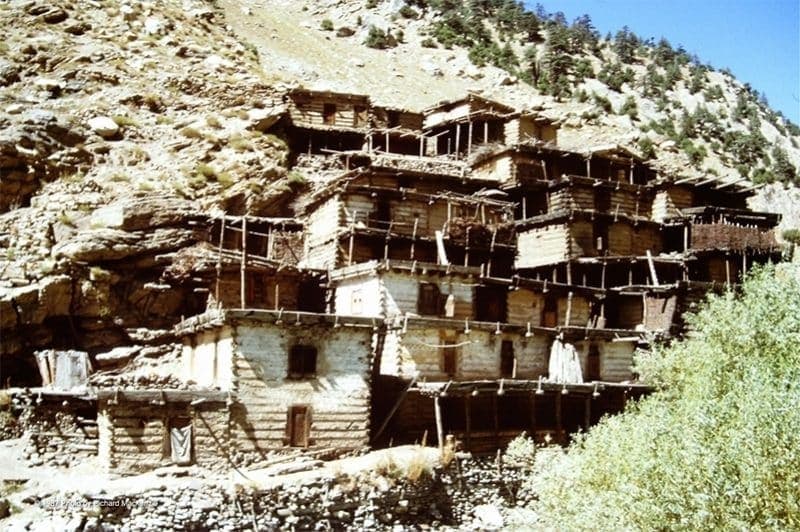
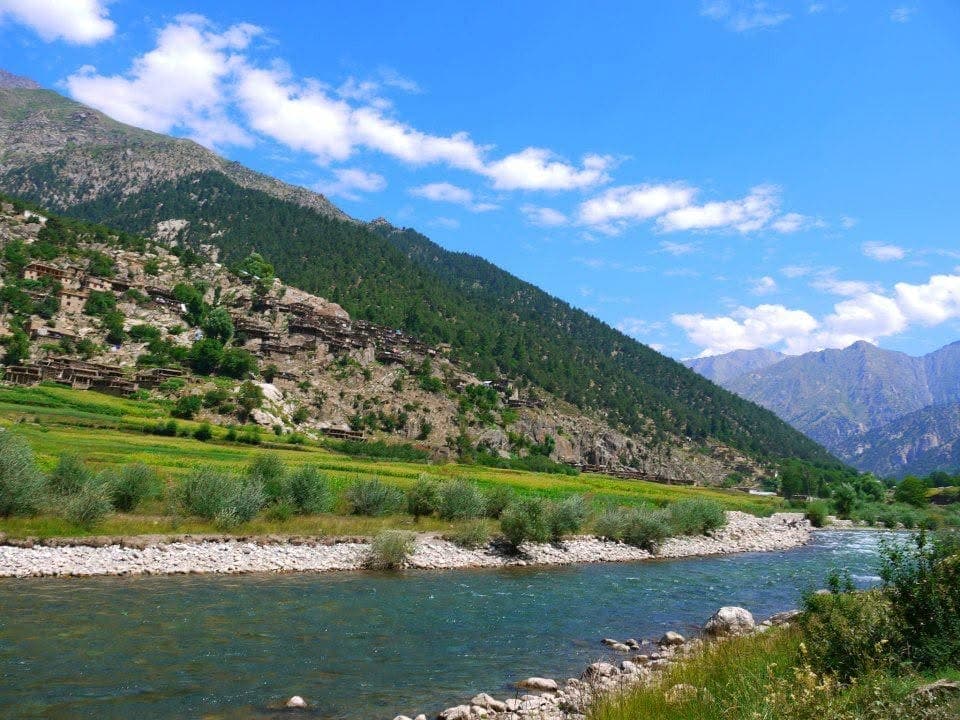
Seen from the river, a Nuristani village looks like a single building. Houses climb the slope in tiers, each one set on the roof of the one below, so that the whole settlement reads as a staircase of timber, stone and carved wood rising towards the forest. No one else in Afghanistan builds like this. The form is a direct answer to the land: steep valleys, scarce flat ground, long winters, cedar in abundance and a long memory of raids.
Why the villages stand high
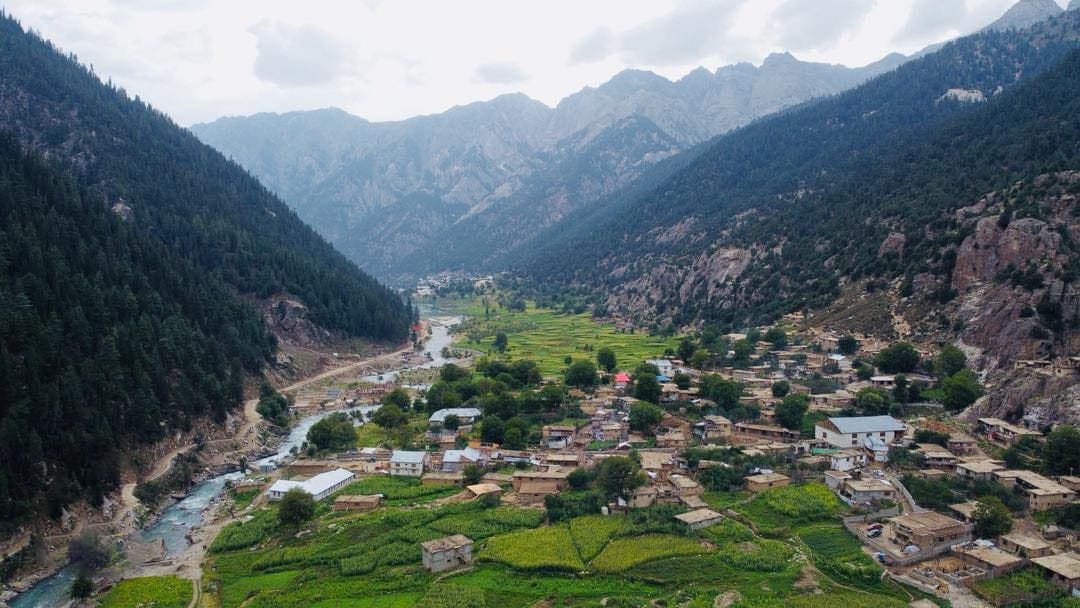
The first rule of Nuristani building is not to waste the valley floor. Every flat patch beside the river is terraced for maize, wheat and beans, and the walnut and mulberry trees stand there too. Houses go on the steep, stony ground above, where nothing will grow. Building high also gave the village sun through the winter, a view of anyone approaching and, not least, safety from the river. Old villages sit well above the flood line, which is why floods like the one that struck Parun in July 2026 do their worst damage to the modern bazaars and offices built on the flat ground by the water.
Timber and stone
The material is the forest. Deodar cedar, the great tree of the eastern Hindu Kush, gives long, straight, rot-resistant beams; pine and holly oak fill in. Walls are built of dry stone laced with horizontal timbers at intervals, a method found from here across the Himalaya that lets a wall flex and settle in an earthquake instead of cracking. The roof is a deck of beams overlaid with split timber, brushwood and a thick layer of packed earth, rolled flat after rain. That roof is the next family's terrace: a place to dry walnuts and apricots, to sit in the evening and to walk from one house to the next. The village's streets are its roofs.
Inside the house
The heart of the traditional house is a single large room with a hearth in the middle of the floor and a smoke hole in the roof above it. Four carved wooden columns stand around the hearth, carrying the main beams. Sleeping platforms and storage run along the walls, and a veranda across the front, often with its own carved posts and balustrade, opens onto the view. Below, a lower storey holds animals in winter and stores of grain, cheese and firewood. The low, hand-turned wooden stool is the furniture.
The carving
Carving is where Nuristani building becomes art. The four hearth columns, the door frames, the veranda posts and the window surrounds are cut with deep, confident geometric patterns: chevrons, diamonds and lozenges, rosettes, ropes and interlace, and above all the horns of the markhor and the ibex, curling in pairs. In Kafiristan these motifs decorated shrines and effigies as well as houses, and they carried meaning: the horns of the wild goat that was sacred, the diamond as an eye and a protection. The meaning faded after 1896. The motifs did not. The carved diamond that marks the pages of this website comes from them.
The carvers were, and are, ordinary village craftsmen who learnt from their fathers. Waygal and Kamdesh are known for them, and the same hands make the carved boxes, stools and panels sold as Nuristani woodcraft today.
Mosques
When the valleys became Muslim, the carpenters who had built the shrines built the mosques, and they built them the same way: timber frames, verandas, and rows of carved wooden columns inside. Some of the finest carving in Nuristan is in its mosques, on columns, mihrabs and ceilings, and the habit of decorating a place of worship in wood carried straight across the conversion.
Change
Down on the valley floor, where the road arrives, the province is building in concrete block and corrugated tin. Timber is scarcer than it was, after decades of logging, and a concrete house is quick. The old villages still stand above, and people still live in them, but the skills that made them are held by fewer people each generation. If the old houses are to survive, the carvers and the cedar forests have to survive with them.
Sources