Nuristan carves its houses, its mosques and its chairs in cedar and walnut, in patterns older than anyone can date. What the horns, wheels and knots meant, who was allowed to sit in a carved chair, what happened to the wooden figures of the dead, and who the carvers were.
A Nuristani village is a carved thing. The pillars that hold up the verandah, the door and the panels beside it, the posts around the hearth, the front of the mosque, the chair an elder sits in: all of it is cedar or walnut cut with horns, wheels, knots and plaits, in a style found nowhere else in Afghanistan.
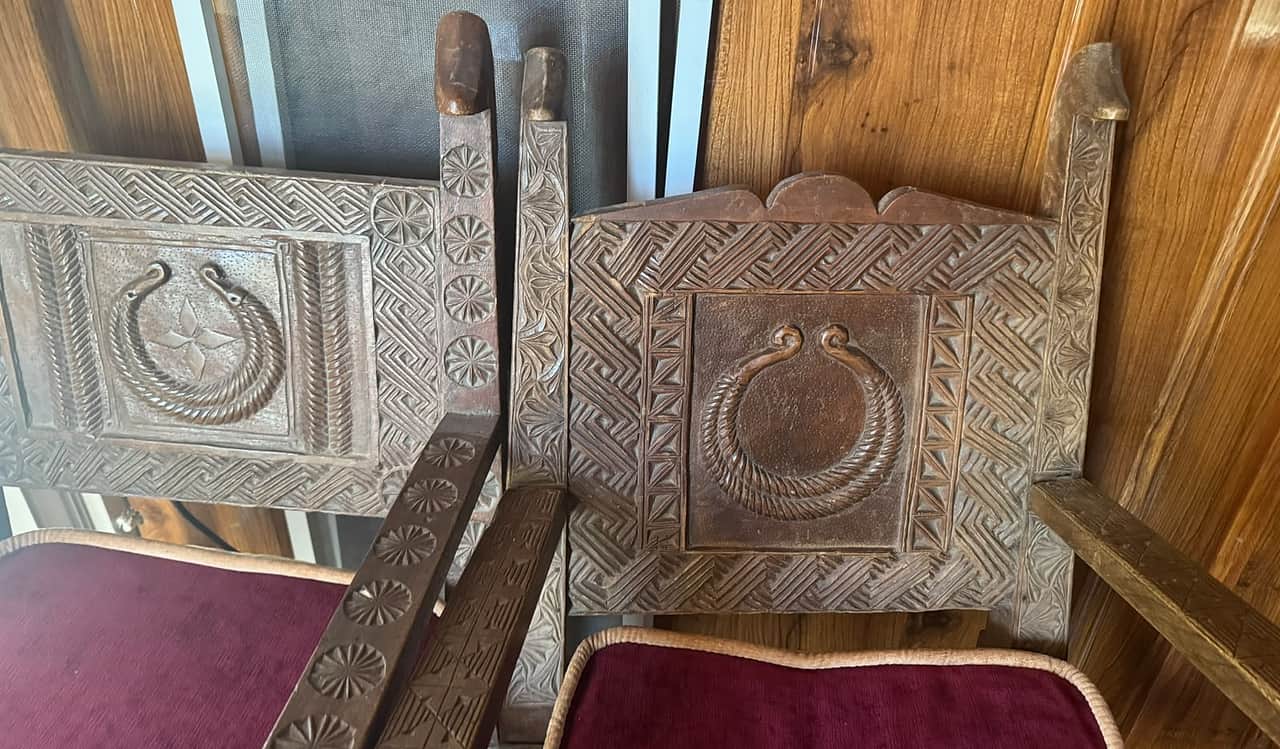
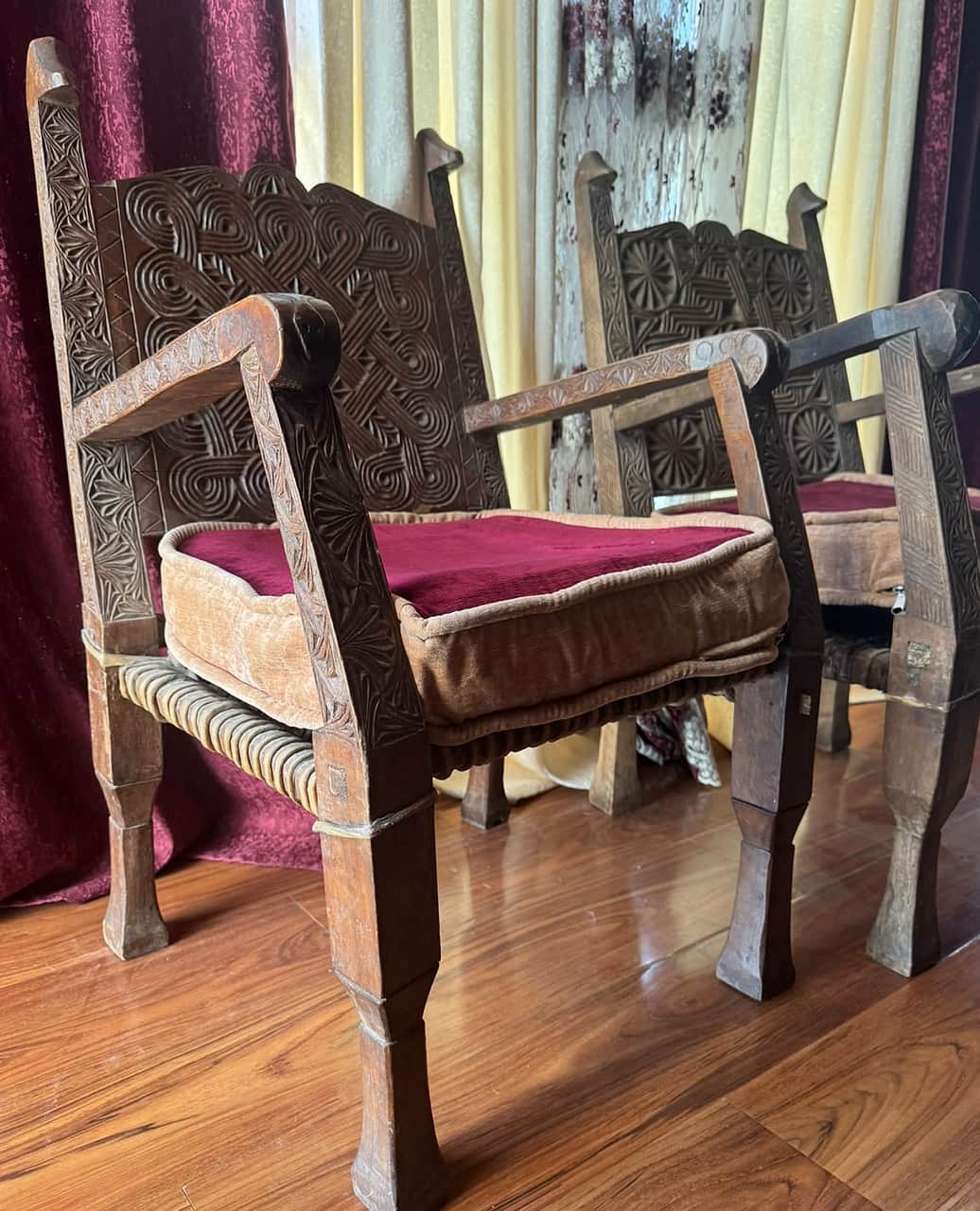
We are from Waygal, a valley known for its carvers, and the chairs in the photographs are ours. This page sets out what is carved and why, what the patterns once meant, who the craftsmen were, and where the craft stands now. For the meanings we have followed the scholars who recorded them from the last generation that remembered, and where their informants disagreed we give every version.
The short version
- The woods are deodar cedar for buildings and walnut for vessels and furniture.
- The patterns are geometric, cut in shallow relief with an adze and a knife.
- Before 1896 most motifs were marks of rank, earned by giving feasts.
- The carving was done by a hereditary class of craftsmen, the bari, who were not free.
- The old figures of gods and ancestors were burned or carried off after the conquest; a few survive in Kabul and Paris.
- The craft is alive, in Parun, Waygal and Kamdesh and among Nuristani carvers in Kabul.
What is carved
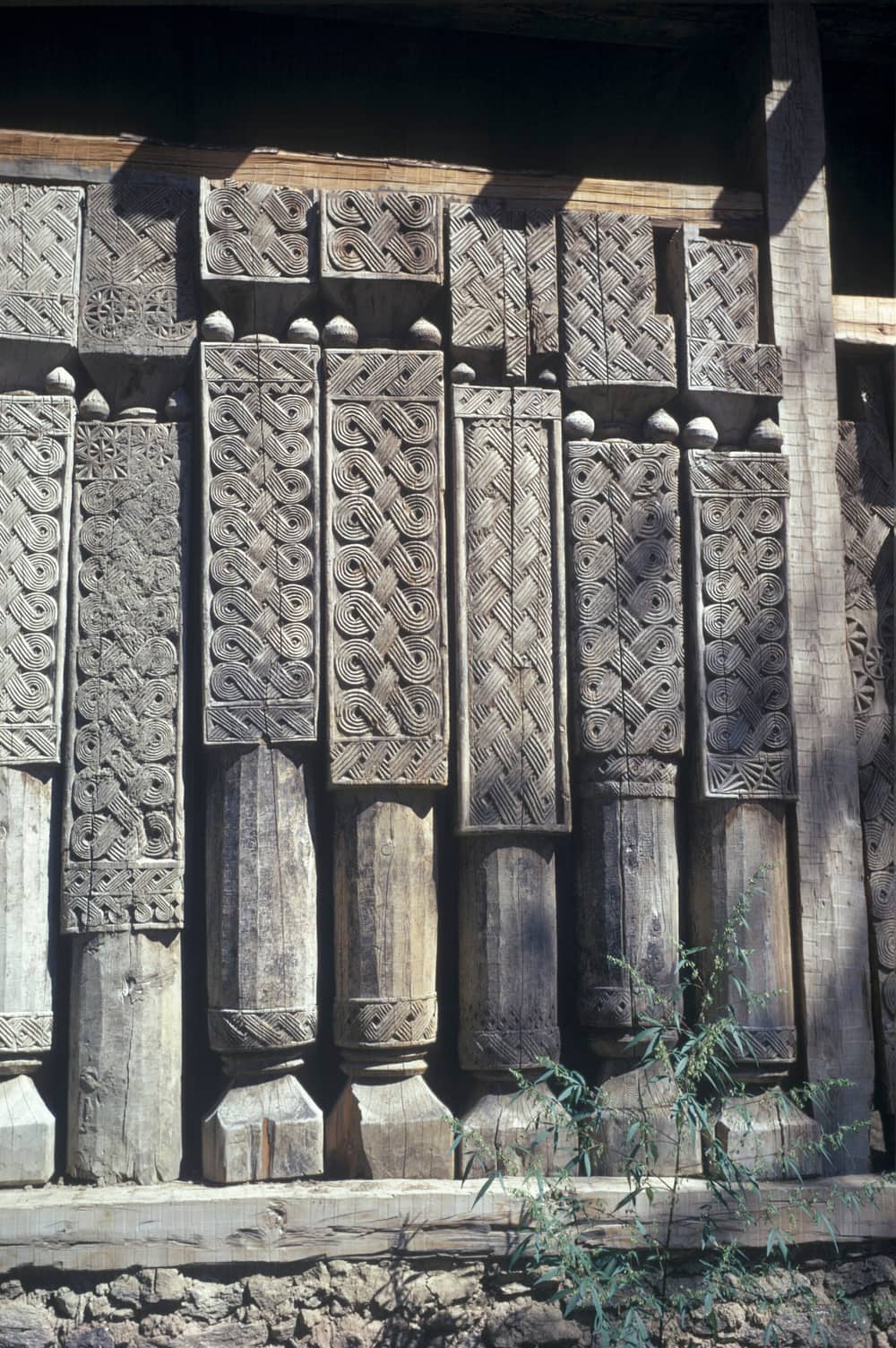
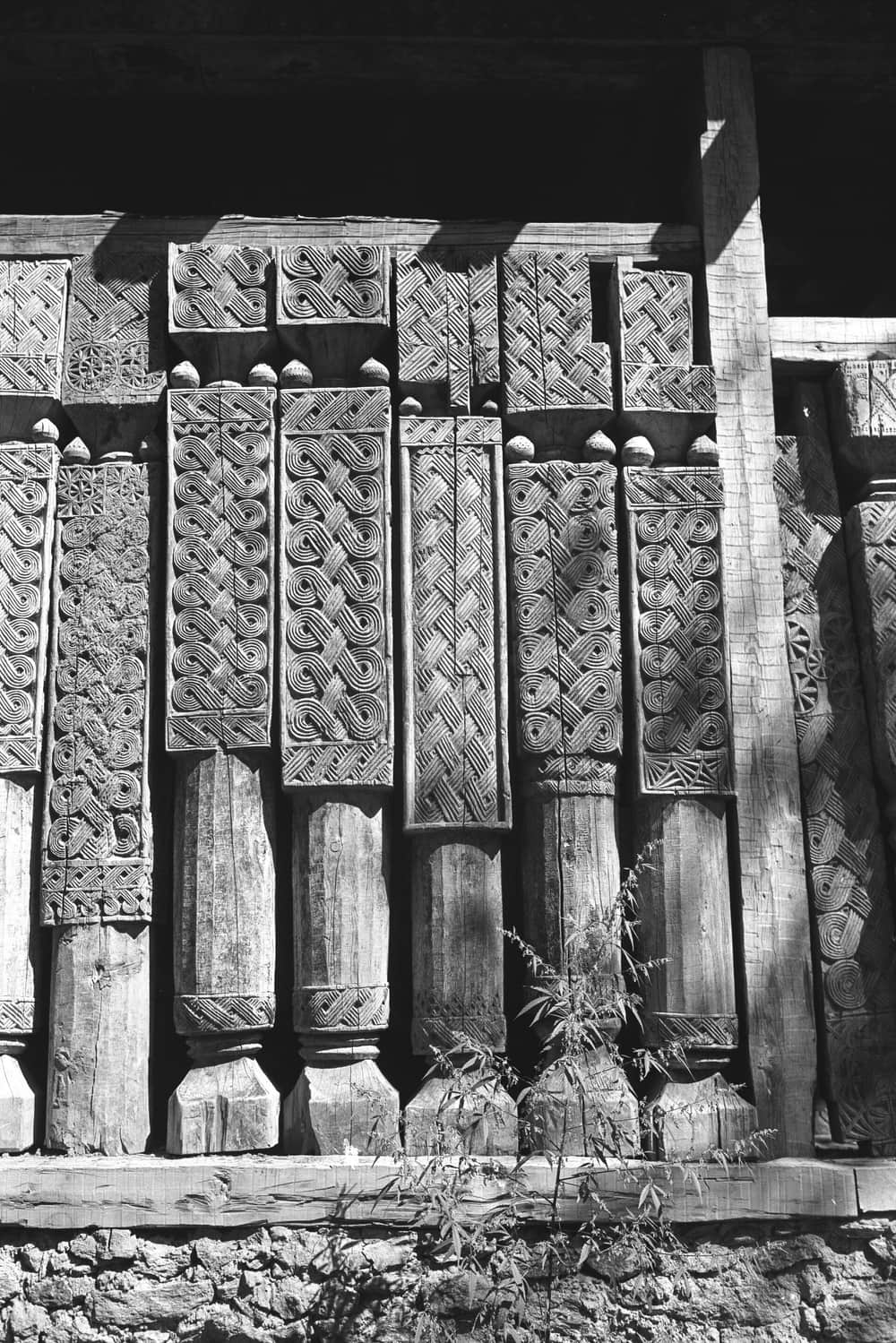
In a house, the carving is concentrated where people look: on the door and the panels on either side of it, on the upper halves of the four pillars around the hearth, and on the posts of the verandah. In Waygal the main room is always square, with those four pillars at its centre. In the Bashgal the houses have an enclosed verandah fronted by broad plank-like columns, each one a field for the carver.
The grandest buildings of old Kafiristan were the clan houses and the temples. George Scott Robertson, who saw the temple of Imra at Kushteki in Parun in 1891, described a building fifty or sixty feet square with a portico of carved pillars, rows of rams' heads and crossing horns, and eight figures of the god in relief, each about seven feet high. It was destroyed five years later. When the valleys became Muslim the same craftsmen built the mosques, in the same style and often with the same patterns, leaving out the figures. The mosque at Kamdesh, photographed in 1968, is carved like the houses around it.
The patterns and what they meant
Nuristani carving is geometric. There are no flowers and, since 1896, no figures. The patterns are built from a small stock of forms, and in the old society most of them said something about the man who owned the house.
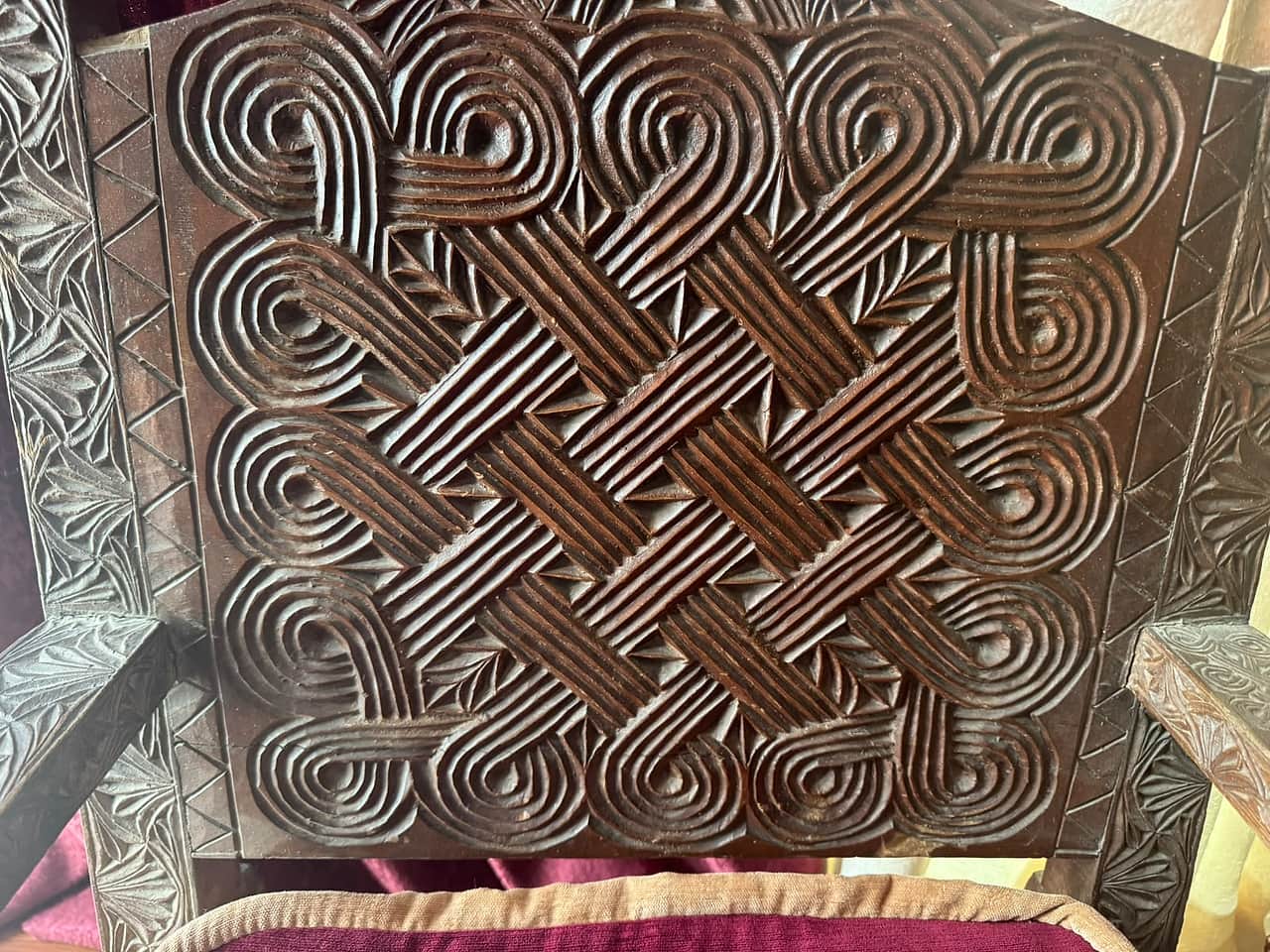
The horns come first. The horns of the goat and the ram stood for strength, and a man earned the right to have them carved on his door, its panels and his hearth pillars by feeding the village at great feasts. The Danish scholar Lennart Edelberg recorded names for the forms, one for horns entangled and one for horns forked, and was told that notches cut along them counted the feasts a man had given and his deeds as a fighter. At Keshtagrom, in the Kamdesh country, the plaited pattern that runs up the pillars was itself called by a word meaning ram's horns.
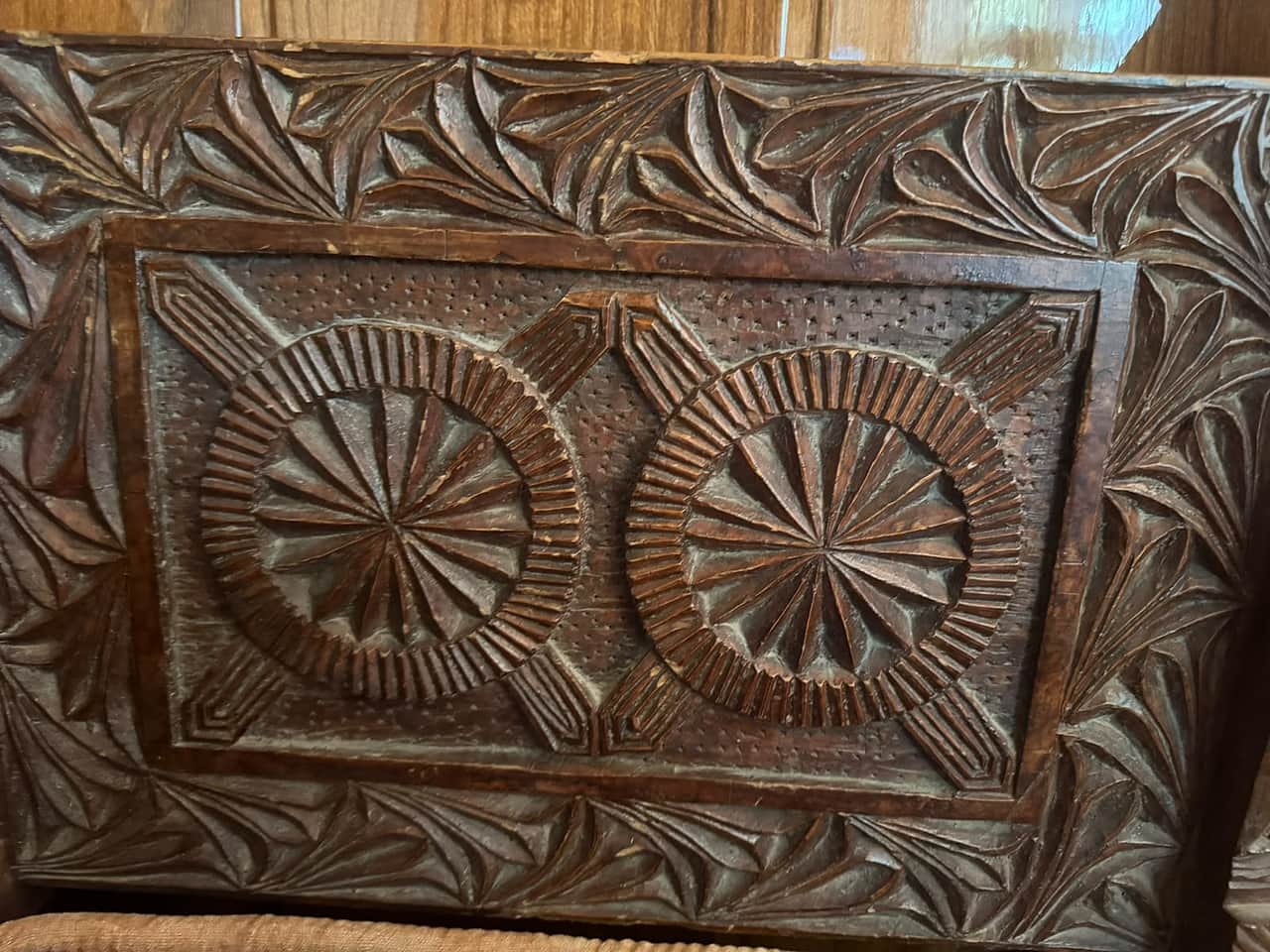
The wheel, or rosette, is the motif people ask about most, and there is no single answer. Edelberg was told at one door that the round designs stood for feasts of merit. Some of his informants said the circles on the pillars were silver cups, the cups of wine drunk at those feasts. The Turquoise Mountain institute in Kabul, which has documented the craft, records that the spokes count enemies killed. The readings differ, and each may once have been true in one valley or another.
In Waygal and among the Ashkun, human heads, horned headdresses and shields were carved to mark a great man's house, and among the Ashkun and the western Kati pairs of embracing figures stood on the posts of the benches of honour. After the conversion the figures stopped. The knots, the plaits, the horns and the wheels went on, and they are what a Nuristani carver cuts today. For the chevrons, zigzags and diamonds that fill the borders we have found no recorded meaning, and we will not invent one.
The chair
Kafiristan was a country of chairs in a region where everyone else sat on the floor, and travellers remarked on it from the start. But a chair was not furniture in the ordinary sense. In the Bashgal, to sit on a stool out of doors was a mark of rank. In Waygal the horn chair, with its tall carved back, was a seat of honour that a man earned only after giving many feasts to the public. Parun had a form of its own.
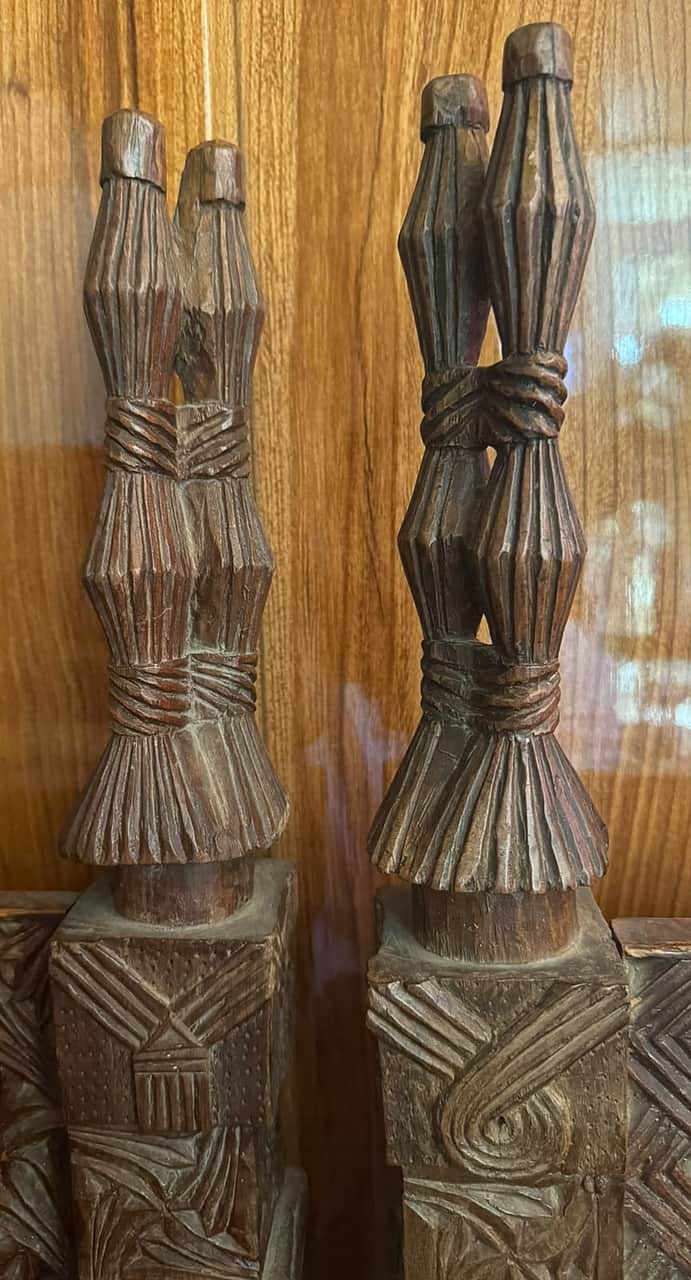
The feasts of merit ended in 1896 and the chair lost its rules. It kept its shape: a low woven seat, heavy arms, a back carved with knots or horns, and posts ending in finials. It is now the best known of all Nuristani things, made for anyone who orders one.
The figures of the dead
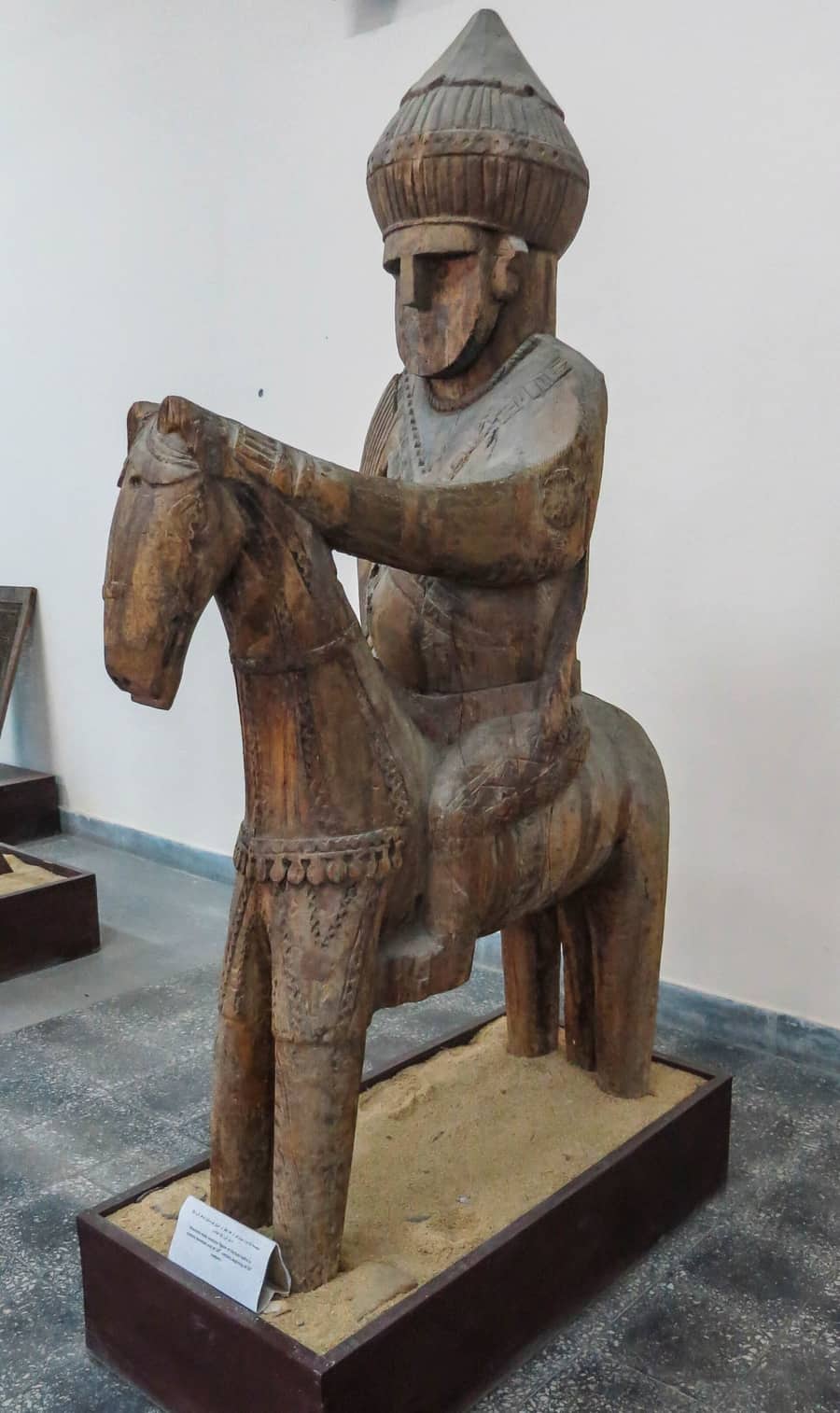
The most striking carvings of old Kafiristan are the ones that no longer stand in it. Among the Kati of the Bashgal, a year after a man or woman of standing died, the family had a life-size wooden figure made and set up outside the village: standing, seated on a chair or, for a man, mounted on a horse. Robertson recorded the price of one as three cows. Waygal and the Ashkun raised carved posts to their heroes instead, and Parun made figures only of gods.
After the conquest of 1895 to 1896 the figures were burned or taken as trophies. How many reached Kabul is not agreed: the accounts say nineteen, about thirty, thirty-two and a hundred. Fourteen ended up in the Kabul Museum, and in 1925 King Amanullah gave four to France, two of which are in the Musée Guimet in Paris. In March 2001 the figures in Kabul were hacked to pieces. They were put back together in 2004 by an Austrian-funded team under the scholar Max Klimburg, and seventeen went on show that December.
The men who carved: the bari
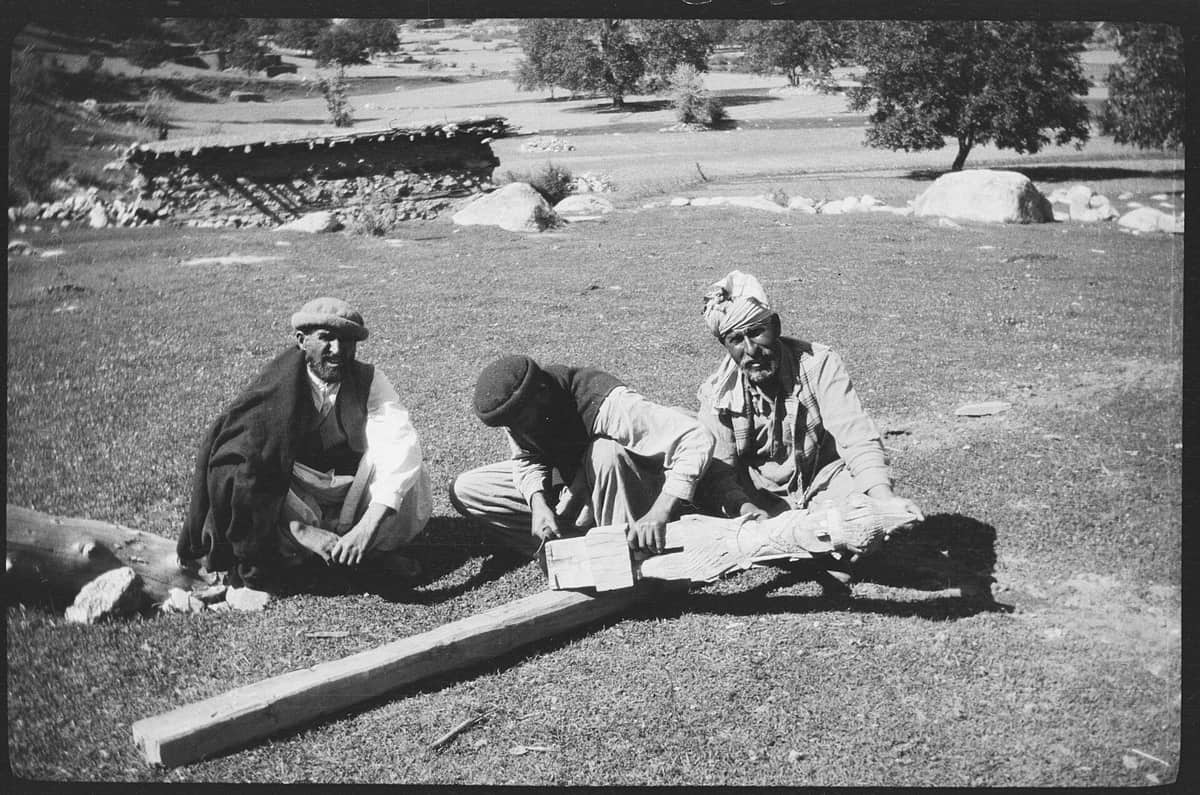
None of this was made by the men whose rank it advertised. In old Nuristan, landowning families did no craft work at all. The carpenters, carvers, smiths, potters and weavers were a separate, hereditary class called the bari, and they were not free. In Waygal they and the labourers below them were about a tenth of the people. They could not marry into the landowning families or eat with them, they had no rights to pasture, and before 1896 they could be sold. A bari could carve the horns of rank on another man's door and was forbidden to carve them on his own.
By local account their bondage ended around 1922, under King Amanullah. Many left the valleys afterwards for work outside or for the army. Edelberg wrote down the words of a bari named Abdullah Wakil: "things in Nuristan will never be good until we are all bari". Parun was the exception to the system. The bari were kept out of it, and the farmers of Parun did their own carving, including the figures of gods that other valleys bought from them.
It is not a comfortable part of our history, and the carving cannot be understood without it.
Wood and tools
Buildings are cedar: the deodar, which grows between about 2,500 and 3,100 metres. Edelberg noted that a tree was ringed before it was felled, to draw the resin up into the wood. Bowls, cups and the wide dishes on three legs are walnut, and in Parun also poplar and willow. Holly oak and pine go into tools and fittings.
The tools are few. A carpenter's kit recorded at Keshtagrom in 1964 was an axe, three adzes, a chisel, a whetstone, a handsaw that the scholar never once saw used, and a knife ground down from an old file, which was the carving tool. The adze gives the flaked surface of the old timbers. Chests and frames are held with pegged tenons and no nails. A carver in Parun told a reporter in 2019 that he still works with a single chisel and no machine.
Valley by valley
- Waygal and the Ashkun country: motifs that belonged to particular men and recorded their rank, and chairs with a double back.
- The Bashgal, among the Kati and the Kom: large, dense, interwoven patterns covering whole columns, not tied to one man's rank.
- Parun: religious carving above all, with figures of gods that have broad shield-like heads on short bodies.
The craft today
The carving did not stop in 1896, and it has not stopped since. A survey in 2022 recorded woodworking in Parun, Waygal, Kamdesh and Bargi Matal. In Parun a master named Sharafuddin, then 67, was running a workshop that employed a dozen men in 2019. In Kabul the Turquoise Mountain institute, which trains Afghan craftsmen, began documenting Nuristani carving in 2017, and women in Kabul have taken up carving Nuristani patterns too.
The threats are the forest and the market. Cedar is harder to get every year as the forest is cut for timber, and old carved pieces have been leaving the valleys for decades: a pair of carved columns was smuggled out and offered by European dealers as long ago as 1974. A chair ordered from a living carver keeps the craft in work, which is a better way to own a piece of it than buying an old pillar taken from a house.
Where to see it
- The National Museum of Afghanistan, Kabul: the restored figures from Kafiristan.
- The Musée Guimet, Paris: a horseman and a seated woman, given by King Amanullah.
- The Moesgaard Museum, near Aarhus in Denmark: a reconstructed room from the Waygal and Wama valleys.
- The Weltmuseum, Vienna: a small collection made by Max Klimburg in the 1970s.
- The National Army Museum, London: a grave figure of about 1880.
- And in Nuristan itself, on the houses and mosques, where it was meant to be seen.
Questions people ask
What is Nuristani woodcarving?
The carving tradition of Nuristan in eastern Afghanistan: geometric patterns cut in shallow relief into the cedar pillars, doors and panels of houses and mosques, and into walnut chairs, chests and bowls. Before 1896 it also included wooden figures of gods and ancestors.
What do the patterns in Nuristani carving mean?
Most of them were marks of rank. Goat and ram horns stood for strength, and a man earned the right to have them carved on his door and house pillars by giving feasts to his village. The round wheel or rosette has been explained as a feast given, as an enemy killed and as a silver cup, depending on who was asked.
What wood is used in Nuristani carving?
Deodar cedar for buildings, pillars and doors, and walnut for bowls, vessels and furniture. Holly oak and pine are used for tools and fittings. Traditional pieces are joined with pegs and tenons and no nails.
Who are the bari?
The hereditary craftsmen of old Nuristan: the carpenters, woodcarvers, smiths, potters and weavers. They were a separate and unfree class, about a tenth of the people in Waygal, and could be sold as slaves before 1896. Their status was abolished in the 1920s.
What is a Nuristani chair?
A low wooden armchair with a carved back, a woven seat and tall posts. In the old society the horn chair of Waygal was a seat of honour that a man earned by giving public feasts. Today the chairs are made for anyone and are the best-known Nuristani craft.
Where can I see Nuristani woodcarving?
The National Museum of Afghanistan in Kabul has the restored wooden figures from Kafiristan, the Musée Guimet in Paris has two, and the Moesgaard Museum in Denmark has a reconstructed room from the Waygal and Wama valleys. New work is made in workshops in Parun and by Nuristani carvers in Kabul.
Read on
- Nuristani architecture: the tiered timber villages
- Nuristani products, including carved chairs and woodwork
- Nuristani religion: the gods the old carvings showed
- Kafiristan: rank, feasts and the honoured dead
- Waygal, the valley of the carvers
- Nuristan National Park and the cedar forest
- The Kalash people, whose carvers work in the same tradition
Questions people ask
What is Nuristani woodcarving?
The carving tradition of Nuristan in eastern Afghanistan: geometric patterns cut in shallow relief into the cedar pillars, doors and panels of houses and mosques, and into walnut chairs, chests and bowls. Before 1896 it also included wooden figures of gods and ancestors.
What do the patterns in Nuristani carving mean?
Most of them were marks of rank. Goat and ram horns stood for strength, and a man earned the right to have them carved on his door and house pillars by giving feasts to his village. The round wheel or rosette has been explained as a feast given, as an enemy killed and as a silver cup, depending on who was asked.
What wood is used in Nuristani carving?
Deodar cedar for buildings, pillars and doors, and walnut for bowls, vessels and furniture. Holly oak and pine are used for tools and fittings. Traditional pieces are joined with pegs and tenons and no nails.
Who are the bari?
The hereditary craftsmen of old Nuristan: the carpenters, woodcarvers, smiths, potters and weavers. They were a separate and unfree class, about a tenth of the people in Waygal, and could be sold as slaves before 1896. Their status was abolished in the 1920s.
What is a Nuristani chair?
A low wooden armchair with a carved back, a woven seat and tall posts. In the old society the horn chair of Waygal was a seat of honour that a man earned by giving public feasts. Today the chairs are made for anyone and are the best-known Nuristani craft.
Where can I see Nuristani woodcarving?
The National Museum of Afghanistan in Kabul has the restored wooden figures from Kafiristan, the Musée Guimet in Paris has two, and the Moesgaard Museum in Denmark has a reconstructed room from the Waygal and Wama valleys. New work is made in workshops in Parun and by Nuristani carvers in Kabul.
Sources
- Lennart Edelberg, Nuristani Buildings (Jutland Archaeological Society, 1984)
- Lennart Edelberg and Schuyler Jones, Nuristan (1979)
- Max Klimburg, Nuristan, in the Encyclopaedia Iranica (art, effigies and regional styles)
- George Scott Robertson, The Kafirs of the Hindu-Kush (1896)
- Kuml, the yearbook of the Jutland Archaeological Society: on rank, horn carving and the craftsmen of Waygal
- Max Klimburg, The Arts and Culture of Parun (Arts Asiatiques, 2002)
- Daniel Foliard on the Kafir figures taken to Kabul and Paris (Revue française de civilisation britannique, 2024)
- The Art Newspaper: the restored Nuristani figures go on show in Kabul (January 2005)
- Turquoise Mountain: Nuristan, shedding light on an inaccessible craft
- Radio Free Europe: the woodcarvers of Parun (2019)
- Culture in Crisis: preliminary assessment of cultural heritage in Nuristan (2022)
- Richard Strand: the Kom and their craftsmen
- Photograph of the Kamdesh mosque wall, 1968: Herbert Maeder, CC BY-SA 4.0, via Wikimedia Commons
- Photograph of the mosque pillars, 1969: Herbert Maeder, CC BY-SA 4.0, via Wikimedia Commons
- Photograph of the horseman in the National Museum of Afghanistan: Ninara, CC BY 2.0, via Wikimedia Commons
- Photograph of the carver at Brumotul, 1929: Georg Morgenstierne, National Library of Norway, public domain, via Wikimedia Commons