Super negin
The longest, thickest all-red threads, cut above the pale style so that no yellow remains. The grade asked for by buyers who want the look as well as the strength, and the dearest.
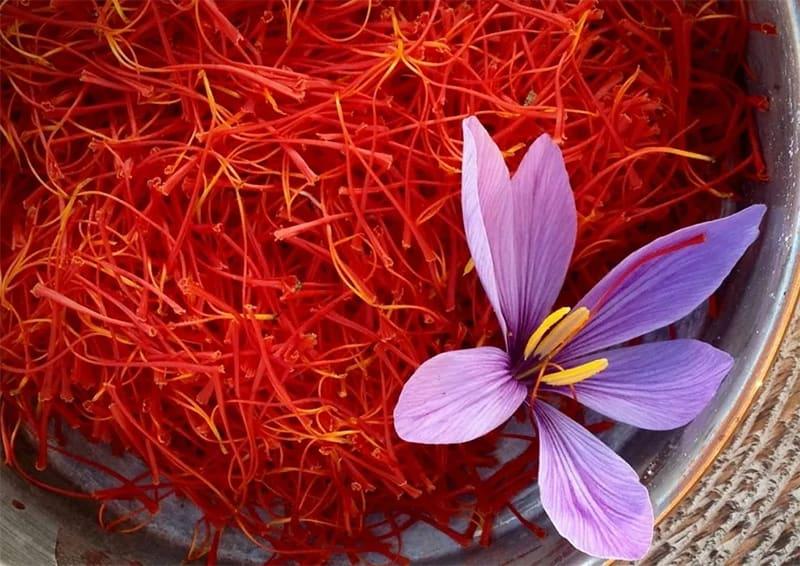
Saffron from the fields of Herat, in super negin, negin, sargol and pushal, sourced to order from the growers and sold under its own origin.
Afghan saffron comes from the west of the country, above all from the fields around Herat, where the crocus flowers for a few weeks each autumn and is picked at dawn, mostly by women, before the stigmas are drawn out by hand and dried. Judges at the International Taste Institute in Brussels have placed Herat saffron first among the world's saffrons year after year, and buyers who know it ask for it by name.
We supply Afghan saffron wholesale as the exporter in Afghanistan. We are from Nuristan, in the east, where saffron does not grow, so we say plainly what we do: we source it to order from growers in Herat, by grade, and sell it under its own origin. This page is for spice importers, wholesalers, food manufacturers and restaurants buying by the hundred grams or the kilogram.
Saffron is the dried stigma of a crocus, three red threads to a flower. About 150,000 flowers go into a kilogram, and picking that many takes some forty hours before the slower work of separating the threads begins. That labour is the price of saffron everywhere, and it is why the spice suits Afghanistan: it needs little water, it is light enough to fly, and it pays a farming family far more per field than wheat.
Afghanistan began growing saffron at scale in the early 2000s, in Herat, on the same latitude and in much the same climate as the saffron country of eastern Iran across the border. Herat still grows the great majority of it. The harvest of 2025 was expected to reach about 40 tonnes, short of the 70 hoped for after a dry year, and in the first nine months of that year the country exported a little over 22 tonnes worth about 30 million US dollars.
Its reputation rests on taste panels. The International Taste Institute in Brussels, which puts foods in front of chefs and sommeliers, has ranked Herat saffron the best it has tasted nine or ten years running, depending on which report you read, most recently in January 2026. An award is one panel's judgement. A laboratory report is the proof a buyer should ask for, and good Afghan saffron passes it comfortably.
The longest, thickest all-red threads, cut above the pale style so that no yellow remains. The grade asked for by buyers who want the look as well as the strength, and the dearest.
All-red threads, a little shorter and less uniform than super negin, with the same strength in the dish. The usual choice for good kitchens and retail jars.
The red tips only, shorter threads with some broken pieces. Strong colour at a lower price, favoured by food manufacturers and caterers.
The red thread with a little of the yellow style left on. Cheaper by weight, and some buyers like it because the style shows the thread is whole and genuine.
These four names are the trade's, used in Afghanistan and Iran alike, and they describe how the thread is cut. They are not a laboratory measure. The measure is ISO 3632, which tests a sample for colouring strength (crocin), flavour (picrocrocin) and aroma (safranal) and sorts saffron into categories. Category I, the highest, has required a colouring strength of at least 200 and a flavour reading of at least 70. Ask for the report with the lot, and check which edition of the standard it was tested to.
If you buy to a written standard, send it. Tell us the grade, the quantity and the tests you need, and we source the lot to that standard, send photographs, and send a sample by courier if you want one. We do not grind saffron, because powder is where adulteration hides; we sell threads.
Published benchmarks with their dates, given as ranges because the price is never one figure. We quote per lot.
| Item | Price or figure | Source |
|---|---|---|
| Afghan saffron, sampled export prices, October 2026 | About 1,250 to 1,400 US dollars a kilogram | Tridge, read 16 November 2026 |
| Saffron in the Herat market, 2024 to 2025 | About 1,200 to 1,800 US dollars a kilogram (80,000 to 120,000 afghanis) | Khate Nakhost, 14 December 2025 |
| Saffron, world wholesale price, 2024 | About 1,150 to 1,950 US dollars a kilogram | Tridge |
| Afghanistan's saffron exports, first nine months of 2025 | A little over 22 tonnes, worth about 30 million US dollars | Khate Nakhost, 14 December 2025 |
Saffron is priced by the kilogram in the trade and by the gram in the shop, and there is never one price. It moves with the grade, the size of the crop, the laboratory figures and the exchange rate, and it rose sharply after the short harvest of 2025. We quote per grade for the quantity you want, with our terms written on the quote.
For the fuller picture, read how Afghan saffron compares with Iranian, Kashmiri and Spanish, and what it costs.
Afghan saffron enters the United Kingdom and the European Union under ordinary food law. Afghanistan is not on the lists of countries whose produce faces increased official controls at the border, in Great Britain's version of the regulation revised to January 2026 or in the European Union's of July 2025. Afghanistan has duty-free access to Britain under the Developing Countries Trading Scheme and to the Union under Everything But Arms, so saffron, under tariff heading 0910, carries no duty.
The paperwork is a commercial invoice and packing list and a certificate of origin from the Afghanistan Chamber of Commerce and Investment, with a phytosanitary certificate where your country asks for one and the laboratory report if you have asked for it. We supply as the exporter in Afghanistan; the buyer, or an importer of your choosing, is the importer of record, registered as a food business in your country, and declares the goods on arrival.
Saffron is the easiest Afghan product to ship. A kilogram fits in a small box, so trial lots go by insured courier and larger lots by air cargo from Kabul, packed in sealed tins or foil away from light and damp.
Tell us the grade, the quantity and the timing you want, and the country you import into.
We source the lot from growers in Herat and send photographs, plus a sample by courier if you want one.
A written quote per kilogram per grade, with our terms, the documents included, and the shipping and insurance set out.
A laboratory report to ISO 3632 at your request, at cost.
Payment in whatever way suits you, always made before shipment.
Export documents, courier or air cargo from Kabul, and your importer clears the goods. An acceptance window is agreed before shipment.
We do not call Afghan saffron organic unless a recognised control body has certified the lot, and none has certified ours. We do not sell powder, we do not sell last year's crop as new, and we make no health claims for saffron. We are not growers: we buy from them, and we say which district a lot came from.
From the west of Afghanistan, above all Herat province, where the great majority of the country's crop is grown. It is harvested by hand in autumn, and the threads are separated and dried in the villages.
Yes. The International Taste Institute in Brussels has ranked Herat saffron first among the saffrons it tasted nine or ten years running, by Afghan press reports, and well-made Afghan saffron meets the top category of the ISO 3632 laboratory standard. Ask for the laboratory report with any lot.
Super negin, negin, sargol and pushal, to order. Super negin is the longest all-red thread and the dearest; pushal keeps a little of the yellow style and costs least.
It changes with the grade and the crop. As a guide, sampled export prices for Afghan saffron were about 1,250 to 1,400 US dollars a kilogram in October 2026, and the Herat market ran from about 1,200 to 1,800 dollars a kilogram across 2024 and 2025. We quote per lot.
Yes, at your request and at cost. The standard is ISO 3632, which measures colouring strength, flavour and aroma. Tell us which laboratory and which edition of the standard you accept.
Yes. Afghanistan is not on the lists of countries whose produce faces increased border controls in Britain or the European Union, and saffron from Afghanistan carries no import duty under either preference scheme. The importer must be a registered food business.
None fixed. Saffron is sold from a hundred grams upwards, and a first order can be a small trial lot sent by courier.
No. We are from Nuristan, in eastern Afghanistan, where saffron does not grow. We source it from growers in Herat and sell it under its own origin.
Related: wholesale from Afghanistan, pine nuts wholesale, dried morels wholesale, wholesale gemstones.
Tell us the product, the quantity and the country you import into. Your message goes to Obaid and his team in Afghanistan and the UK, and we reply to every message with what we can supply.