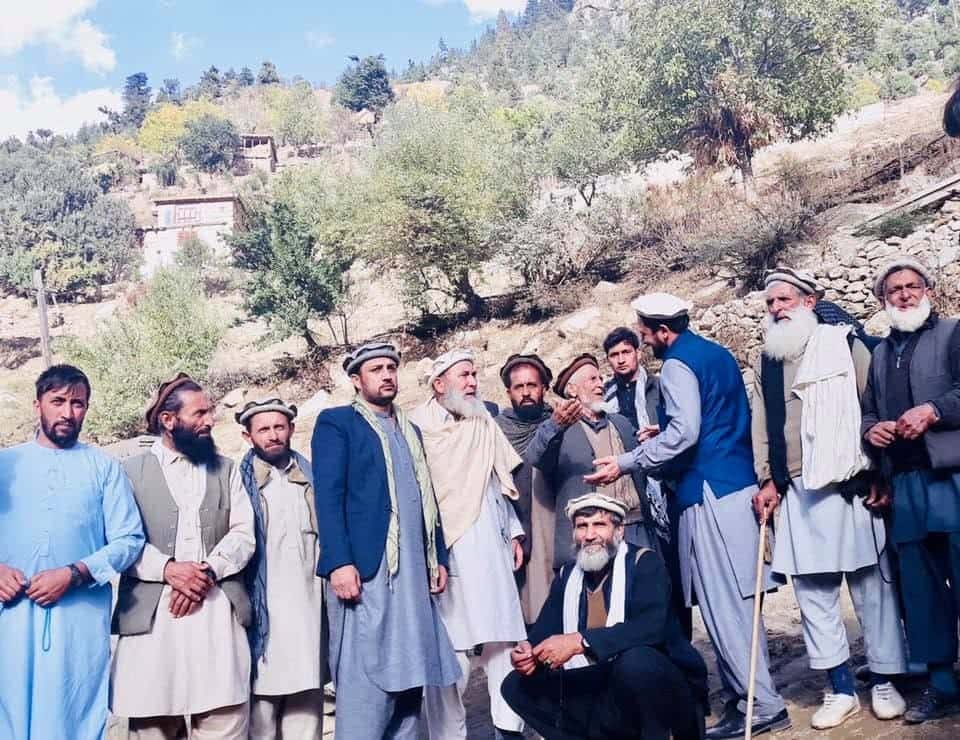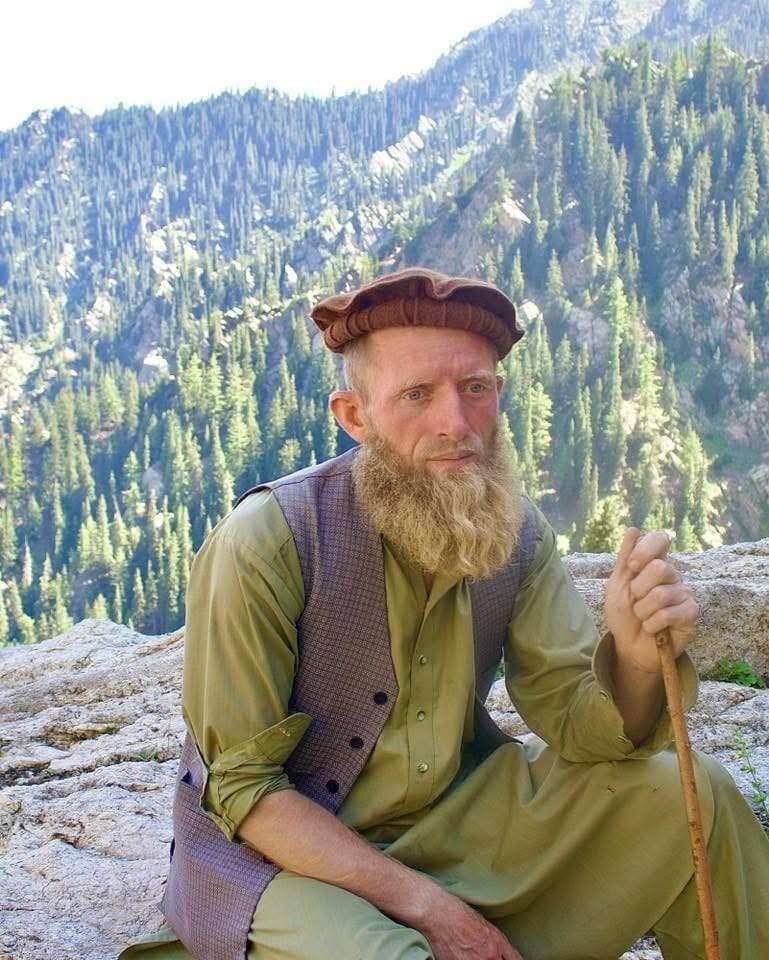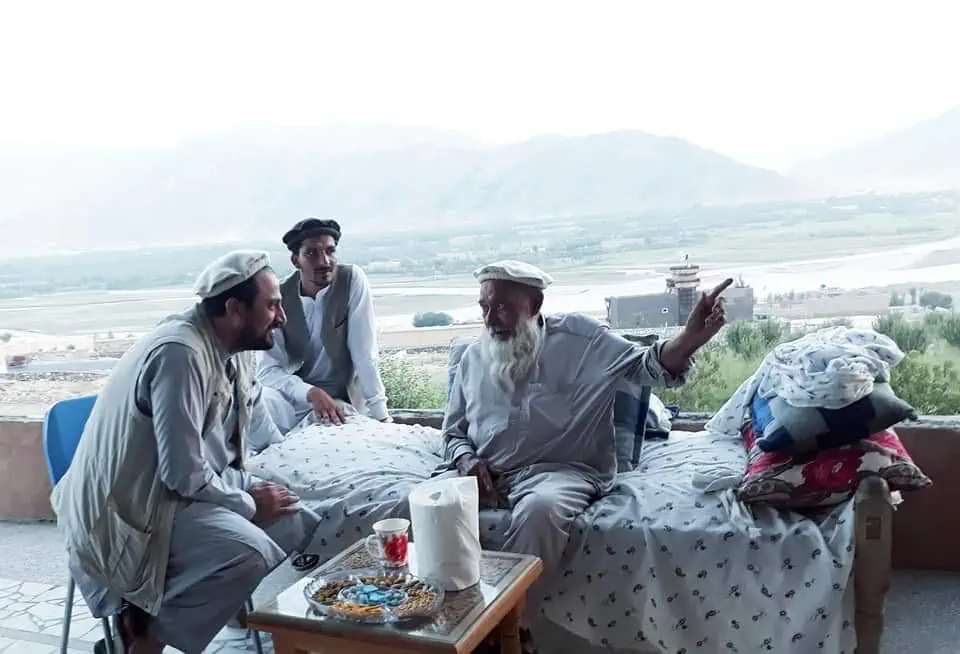
About one Pashtun in eighteen has blue eyes and roughly one in eight has green or hazel, which is uncommon but not mysterious. We are Nuristanis and the same question is asked about us, usually with the same bad answers attached. Here is what has actually been measured, what the genetics shows, and where the stories about Greeks and lost tribes came from.
We are Nuristanis, and the question asked about Pashtuns is the one asked about us. Why are some of them fair. Where did the blue eyes come from. Were there Greeks. We have written about the Afghanistan-wide version of that question already, and this page is about the Pashtuns in particular, because they are the largest people in the country, our neighbours on three sides, and the ones the internet asks about most.
There is a reason to be careful with it. The same question has been asked for two hundred years by people who wanted a particular answer, and the answers they produced did real harm. So this page sticks to what has been measured, says who measured it and when, and says plainly where the evidence stops.
The short answer
- Most Pashtuns have brown eyes and dark hair. In the one study that counted, about 82 per cent had brown eyes.
- About 5.6 per cent had blue eyes and 12.8 per cent green or hazel, so the in-between shades are more than twice as common as clear blue.
- A Soviet survey of nineteen Pashtun samples in the 1960s found the same pattern by a completely different method: truly light eyes close to nil everywhere, and what varied between groups was the share of mixed eyes.
- The variant behind blue eyes is a single old change in one regulatory switch, shared by every blue-eyed person on earth. It is present at low frequency right across this region.
- Pashtun skin is on average slightly lighter than that of Baloch and Punjabi neighbours, measured with an instrument rather than by eye.
- No study has shown Greek descent beyond two individual men, and the famous study said to prove Israelite descent was never published.
What has actually been counted
Only one study has ever photographed and classified Pashtun eyes. In 2023 a team led by Muhammad Adil Rahat published work on 893 people in the Malakand division of northern Pakistan, in the districts of Swat, Buner, Shangla, Malakand, Upper Dir, Lower Dir and Chitral. Each person's eyes were photographed in a light box and sorted by trained observers into brown, intermediate and blue. The result was 81.6 per cent brown, 12.8 per cent intermediate and 5.6 per cent blue.
Two honest caveats go with those numbers. The sample is described as the local Pakhtoon population, but the paper records no per-person check of ethnicity and notes that Kohistanis and Gujjars also live in the area, so it is a Pashtun-majority sample rather than a verified Pashtun one. And no study of this kind has ever been done in Afghanistan, where most Pashtuns live. There is no Afghan figure to quote.
The same study tried to predict those eye colours from DNA, using the system forensic laboratories use, and the result is the most useful thing in it. Blue and brown were predicted correctly almost every time. Green and hazel were a coin toss: the system kept calling them blue or brown. That is because the prediction systems were built on European populations, where the in-between shades are less common. It is the scientific reason that talking about Pashtun eye colour in numbers is harder than it looks, and why the greenish middle of the range, which is where most light-eyed Pashtuns actually sit, is the least well understood part of it.
The survey nobody reads, and what it found
Long before DNA there was a survey, and it is the only large body of measurements from Afghanistan itself. Between 1964 and 1968 the Soviet anthropologist Georgy Debets and colleagues from Kabul University recorded the eye and hair colour of men across the country using printed colour standards. His tables include nineteen Pashtun samples, from Kunar, Nangarhar, Laghman, Wardak, Khost, Ghazni, Zabul, Uruzgan, Kandahar, Spin Boldak, Farah, Herat and among the Durrani and Ghilzai.
Across those nineteen samples the share with dark eyes runs from 55 per cent, among the Pashtuns of Wardak and the Ghilzai, to 86 per cent, among the Pashtuns of Kunar. That sounds like a lot of variation until you work through the means he also printed. In the lightest-eyed sample, where 55 per cent scored dark, the rest average out as almost entirely mixed, with the truly light category close to zero. The same holds for every other sample. What changes from one Pashtun group to another is not how many have blue eyes, it is how many have the greenish and hazel shades in between.
That is exactly what the Malakand study found with photographs and a light box fifty-three years later: 5.6 per cent clearly light, 12.8 per cent in between. Two completely different methods, two generations apart, on different sides of the Durand Line, agreeing about the shape of the thing. It is the firmest finding on this page.
What the geneticists have found
Blue eyes are, in effect, one variant in one genetic switch. A Danish team established in 2008 that a change in a regulatory region of a gene called HERC2, which turns down a neighbouring pigment gene, is almost perfectly associated with blue eyes, and that blue-eyed people in Denmark, Turkey and Jordan carried the same version of it. Wherever blue eyes turn up in the world, it is the same old variant, inherited in a near-recessive way, which is why two brown-eyed parents can have a blue-eyed child. A blue-eyed Pashtun and a blue-eyed Dane share one distant ancestral change and nothing else of consequence.
How common is that variant among Pashtuns? A Danish and Pakistani team measured it in 2021 in 103 Pashtuns from Khyber Pakhtunkhwa alongside 107 Baloch and 89 Punjabis. The blue-associated version was carried on about 16.5 per cent of Pashtun chromosomes, against about 6.7 per cent among the Punjabis and 6.5 among the Baloch. Other datasets put the Pashtun figure between roughly 16 and 22 per cent. For comparison, it sits above 60 per cent in Europe as a whole and near 77 per cent in north-western Europe, and near zero in East Asia. So Pashtuns carry it two to three times as often as their immediate neighbours and a quarter as often as Europeans. That is the entire size of the thing being explained.
The same study measured skin pigmentation with an instrument rather than by eye, on the upper arm, lower arm and forehead, and found the Pashtun group significantly lighter than the Baloch and Punjabi groups at every site. It is a real average difference, and it is an average: the ranges overlap heavily and no one person is described by it.
The steppe was not blue-eyed
Here is the finding that quietly disposes of most of the mythology. The popular picture has fair, blue-eyed horsemen riding down from the steppe into Iran and India in the Bronze Age and leaving their colouring behind. Ancient DNA says otherwise. A 2014 study recovered pigmentation data from skeletons of the Pontic-Caspian steppe, the very population in that picture, and found the blue-eye variant on only about 16 per cent of their chromosomes, against about 65 per cent among people living in the same region today. Blue eyes were commonest much earlier, among the hunter-gatherers of Europe, and rose in Europe afterwards, by selection, over the last five thousand years.
Pashtuns do carry a share of steppe ancestry, as most people of northern South Asia do. But if the steppe people themselves carried the blue-eye variant at about 16 per cent, then steppe ancestry predicts a modest elevation in Pashtuns over their southern neighbours, which is precisely what is observed, and nothing more dramatic. The arithmetic works out to the ordinary answer.
The rest of the explanation is the one that also explains Nuristan. In a population of millions a variant at one in six chromosomes shows up here and there. In a valley of a few thousand people who marry among themselves, chance alone can push a trait several times above or below the regional average, which is why light eyes cluster in particular families and villages. Marriage within the family or the clan, common across this whole region, does not create such variants; it makes a near-recessive one surface more often where it is already present. That is why the honest answer to why does that family have green eyes is usually about that family, not about their nation.
The Greeks
The story that the fair people of these mountains descend from Alexander's soldiers is attached to many peoples here: to the kings of Badakhshan, to the rulers of Hunza, Nagar, Skardu and Chitral, to the mountain Tajiks, to the Kalash, to the Nuristanis and to the Pashtuns. It is old, and in most cases it can be shown to be younger than Islam in the region, which places it a thousand years and more after Alexander.
For Pashtuns there is one real piece of evidence, and it is small. A 2007 study of 952 men, including 77 Greeks, found two Pashtun individuals carrying a lineage common in Greece; one of them shared a detailed sixteen-marker profile with three Greek men and the other differed by a single mutation. The authors called this a strong indication of a European, possibly Greek, origin for those particular chromosomes, while concluding in the same paper that a large Greek contribution to any Pakistani population is excluded. A larger survey of 190 Afghan Pashtun men in 2012 did not find that lineage at all. Two men is not a people. An earlier study using different markers found a small Greek-like signal among Pashtuns and Burusho that it judged probably older than Alexander's invasion.
What is better documented is how the idea arrived. The British mission to Kabul in 1809 went looking, in Mountstuart Elphinstone's own words, for our Macedonian neighbours, having read of a tribe in Bajaur that claimed descent from Alexander's army. They were told of a people in the mountains to the north who were celebrated for their beauty and their European complexion, drank wine from silver cups, used chairs and tables and spoke a language nobody around them understood. Elphinstone published that in 1815, and then demolished it himself: the languages of those mountains, he wrote, have a near connection with Sanskrit, and this derivation of their language seems fatal to the descent of the Kafirs from the Greeks.
He also corrected something still misread today. The two divisions of the Kafirs were called the black and the white not for their skin but for their clothes, one wearing black goatskin vests and the other white cotton.
The theory went on circulating anyway. Seventy-five years later Surgeon-Major Henry Bellew was identifying Greek descendants among the Pashtun tribes by the sound of their names, and writing of one group near Kabul that they were sometimes quite as fair as Englishmen; at least, he added, I have seen two such. That sentence is the whole evidential basis of a chapter. Bellew was also clear about why the work mattered to him: the study of these different peoples, he wrote in 1880, is of the first importance in view to their ere long becoming subjects of the British Empire.
The children of Israel
Many Pashtun families hold that their ancestors were of the Bani Israel, the children of Israel, carried into captivity and settling eastward through Persia into Ghor. Bellew relayed the tradition in 1880, and it is far older than he is, recorded in Pashtun genealogies for centuries. It is held with conviction, and it belongs to the people who hold it.
What can be said is that the genetic studies which have looked for it have not found it. And the study most often cited as proving it, announced to newspapers in 2010 and much repeated since, was never published; the names usually attached to it in later accounts belong to other researchers' work. A tradition of descent says something true about how a people understand themselves and where they place their history. It is a different kind of claim from a laboratory result, and the honest thing is not to pretend either one settles the other.
Sharbat Gula, who had green eyes
The most famous light-eyed face in Afghanistan belongs to a Pashtun woman, and almost everything popularly said about it is slightly wrong. Sharbat Gula was photographed by Steve McCurry in 1984 at the Nasir Bagh refugee camp near Peshawar, as a schoolgirl of about twelve, and the portrait ran on the cover of National Geographic in June 1985. She was born about 1972 in Nangarhar province; her parents were killed in a bombing when she was about six.
Her eyes are green, not blue. Every account that describes them, including the reporting of her later life, calls them green, and green is precisely the intermediate shade that the genetics handles worst and that the Malakand study found to be more than twice as common as blue. When a National Geographic team went to Afghanistan in 2002 to find her, several women claimed to be her, and she was identified by the pattern of her irises rather than their colour.
What happened afterwards is worth knowing too, because it is rarely attached to the image. In 2016 she was arrested in Peshawar for living in Pakistan on forged papers, convicted, fined 110,000 rupees, held for fifteen days and deported to Afghanistan at Torkham. Afghanistan is only my birthplace, she said then, but Pakistan was my homeland. In November 2021, after the Taliban took Kabul, she was evacuated to Italy at her own request and granted refugee status. It has also been alleged that the original photographs were taken without her permission. We have not reproduced the image on this page. A girl in a refugee camp became the most recognised Afghan face in the world and had very little say in any of it, and the least that can be done is to write about her as a person with a life rather than as a pair of eyes.
A word about the word Aryan
This subject cannot be discussed in English without the word turning up, so it is worth being exact. Aryan is properly a term for languages: the Iranian and Indo-Aryan languages, whose ancient speakers used the word of themselves, and to which Pashto belongs, as do Persian and Hindi. The Nuristani languages form a third branch of the same family. In the nineteenth century the word was lifted out of linguistics and reinterpreted as a racial category, and the United States Holocaust Memorial Museum's own account of the term says exactly that: a linguistic category reinterpreted incorrectly as referring to ethnicity or race, then adapted and radicalised into a belief in an Aryan race.
The professional bodies have been blunt about where that leads. The American Society of Human Genetics stated in 2018 that genetics demonstrates that humans cannot be divided into biologically distinct subcategories, and that it exposes the concept of racial purity as scientifically meaningless. The American Association of Biological Anthropologists stated in 2019 that race does not provide an accurate representation of human biological variation and that no group of people is, or ever has been, biologically homogeneous or pure. Someone with grey eyes in Swat and someone with brown eyes in Kandahar differ in a handful of variants out of many thousands, and in nothing else that matters.
What it looks like from here
Our own province sits at the top of the same valleys, and the same survey measured us. Debets found the Nuristanis of Kamdesh with 80 per cent dark eyes, which puts them inside the Pashtun range and darker-eyed than nine of his nineteen Pashtun samples, and he wrote that their pigmentation is not lighter than that of the Pashtun. He was arguing against the claim that European migrants stood among the ancestors of the Afghan people, and he preferred the explanation an earlier scientist had offered, that such peculiarities arose under the influence of isolation. A Soviet physical anthropologist, working inside the framework that produced these stories, using his own tables to take them apart.
There is one more thing Elphinstone saw in 1815 that is worth ending on. Among the eastern and the western Afghans alike, he wrote, men as swarthy as Indians, and others as fair as Europeans, are to be met with in the same neighbourhood. That has always been the reality here. Every valley holds every shade, and the interesting questions about Pashtuns, and about us, are about language, history, poetry, hospitality and how people have survived in these mountains. The colour of anyone's eyes is the least of it.
Read on
- Why some Afghans have blue eyes and blonde hair, the Afghanistan-wide answer
- Nuristani genetics and DNA: what the studies actually found
- Who are the Nuristani people?
- Kunar and Nuristan: the valleys next door
- The Kalash people, and what their DNA studies found
- Is The Man Who Would Be King a true story?
- The Nuristani languages: a branch of their own
Questions people ask
What percentage of Pashtuns have blue eyes?
The one published study measured 893 people in the Malakand division of northern Pakistan in 2023 and found 5.6 per cent with blue eyes, 12.8 per cent with green or hazel, and 81.6 per cent with brown. That is about one in eighteen for blue and one in eight for the in-between shades. No comparable study has ever been done in Afghanistan.
Why do some Pashtuns have green or grey eyes?
Because green, hazel and grey sit in the middle of a scale set mainly by how much pigment is in the iris, and the variants that lighten the eyes are present at low frequency across this whole region. Among Pashtuns the in-between shades are more than twice as common as clear blue. They are also the shades that genetic prediction systems get wrong most often, because those systems were built on European data.
Which Pashtun tribes have light eyes?
No tribe owns the trait. Mountstuart Elphinstone noticed fair complexions, grey eyes and red beards among the Yusufzai in 1809, and a 2026 study of 146 Pashtuns from six tribes, Yousafzai, Afridi, Khalil, Khattak, Momand and Wazir, found very little genetic difference between them in pigmentation. Light eyes run in particular families and villages rather than in tribes.
Do Pashtuns have blonde or red hair?
A few do, and it has been noticed for two centuries. Elphinstone wrote in 1815 that Afghan hair and beards were generally black, sometimes brown and rarely red. The Soviet survey of the 1960s recorded most hair as black or dark brown in every Afghan group it measured, with fully fair or reddish hair under one in twenty. A 2026 study found that the gene most associated with hair colour among Pashtuns is SLC45A2.
Are Pashtuns descended from Alexander the Great's soldiers?
It has not been shown, and the genetics is genuinely divided. A 2007 study found two Pashtun men carrying a lineage common in Greece, one of whom shared a detailed profile with three Greek men, and called it a strong indication of a possibly Greek origin for those chromosomes, while concluding that a large Greek contribution to any Pakistani population is excluded. A larger study of 190 Afghan Pashtun men in 2012 did not find that lineage at all. The story is old and widespread, it is told of many peoples in these mountains, and it remains unproven.
Are Pashtuns one of the lost tribes of Israel?
It is a tradition many Pashtun families hold, recorded by British writers as early as 1880, and every genetic study that has tested it has found no evidence for it. The study most often cited as proving it, announced to the press in 2010, was never published. Traditions of descent carry real meaning about who a people believe themselves to be, and that is separate from what a chromosome shows.
Are Pashtuns lighter-skinned than other Pakistanis?
On average, slightly, and it has been measured rather than guessed. A 2021 study instrument-measured skin pigmentation in 299 people from three Pakistani groups and found the Pashtun group significantly lighter than the Baloch and Punjabi groups at every site tested. The difference is an average, not a description of any individual, and skin colour varies widely within every one of those groups.
Do blue eyes mean Aryan ancestry?
No. Aryan is a term for a family of languages whose ancient speakers used the word of themselves, and it was wrongly turned into a racial category in the nineteenth century. Ancient DNA has shown that the blue-eye variant was carried by only about sixteen per cent of people on the Bronze Age steppe, the population usually pictured as blond and blue-eyed, and that it was commonest much earlier among the hunter-gatherers of Europe. Eye colour tracks a handful of variants and nothing else about a person.
What colour were Sharbat Gula's eyes?
Green. The Afghan girl photographed in a Peshawar refugee camp in 1984 and put on the cover of National Geographic in June 1985 is described in the reporting as green-eyed, not blue. She is Pashtun, born about 1972 in Nangarhar, and when the magazine traced her in 2002 she was identified by the pattern of her irises rather than their colour.
Sources
- Rahat and others, Phenotypic classification of eye colour and developmental validation of the IrisPlex system on population living in Malakand Division, Pakistan (Biomedicines, 2023): 893 people, brown 81.6, intermediate 12.8 and blue 5.6 per cent
- Shan and others, Analysis of skin pigmentation and genetic ancestry in three subpopulations from Pakistan: Punjabi, Pashtun, and Baloch (Genes, 2021): the measured skin comparison and the HERC2 frequencies
- Saif and others, Genetic analysis of 22 pigmentation-associated SNPs in the Pashtun population of Khyber Pakhtunkhwa (Legal Medicine, 2026): 146 people across six named tribes, with little pigmentation difference between them
- G. F. Debets, Physical Anthropology of Afghanistan (Peabody Museum, 1970), translated by Eugene V. Prostov: the nineteen Pashtun samples, the Nuristani comparison and his own conclusions
- Eiberg and others, Blue eye color in humans may be caused by a perfectly associated founder mutation in a regulatory element located within the HERC2 gene (Human Genetics, 2008)
- Sturm and others, A single SNP in an evolutionary conserved region within intron 86 of the HERC2 gene determines human blue-brown eye color (American Journal of Human Genetics, 2008)
- Wilde and others, Direct evidence for positive selection of skin, hair, and eye pigmentation in Europeans during the last 5,000 years (PNAS, 2014): the blue-eye variant at about 16 per cent on the Bronze Age steppe
- Mathieson and others, Genome-wide patterns of selection in 230 ancient Eurasians (Nature, 2015)
- Firasat and others, Y-chromosomal evidence for a limited Greek contribution to the Pathan population of Pakistan (European Journal of Human Genetics, 2007)
- Lacau and others, Afghanistan from a Y-chromosome perspective (European Journal of Human Genetics, 2012): 190 Afghan Pashtun men
- Mansoor and others, Investigation of the Greek ancestry of populations from northern Pakistan (Human Genetics, 2004)
- Mountstuart Elphinstone, An Account of the Kingdom of Caubul (1839 edition), volume I on Afghan complexion, volume II on the Yusufzai and appendix C on Kafiristan and the Greek theory
- H. W. Bellew, The Races of Afghanistan (1880), for the Bani Israel tradition and the purpose of the enquiry
- H. W. Bellew, An Inquiry into the Ethnography of Afghanistan (1891), for the Greek-descent method and the two fair men near Kabul
- Augusto S. Cacopardo, Are the Kalasha really of Greek origin? The legend of Alexander the Great and the pre-Islamic world of the Hindu Kush (Acta Orientalia, 2011)
- United States Holocaust Memorial Museum, Holocaust Encyclopedia: Aryan, on the word's history as a linguistic term
- American Society of Human Genetics, ASHG denounces attempts to link genetics and racial supremacy (American Journal of Human Genetics, 2018)
- American Association of Biological Anthropologists, Statement on race and racism (2019)
- National Geographic, A life revealed (April 2002), on finding Sharbat Gula and the iris identification
- Al Jazeera, Pakistan deports green-eyed Afghan girl Sharbat Gula (9 November 2016), with her own words
- ANSA, McCurry's Afghan Girl arrives in Rome (25 November 2021)
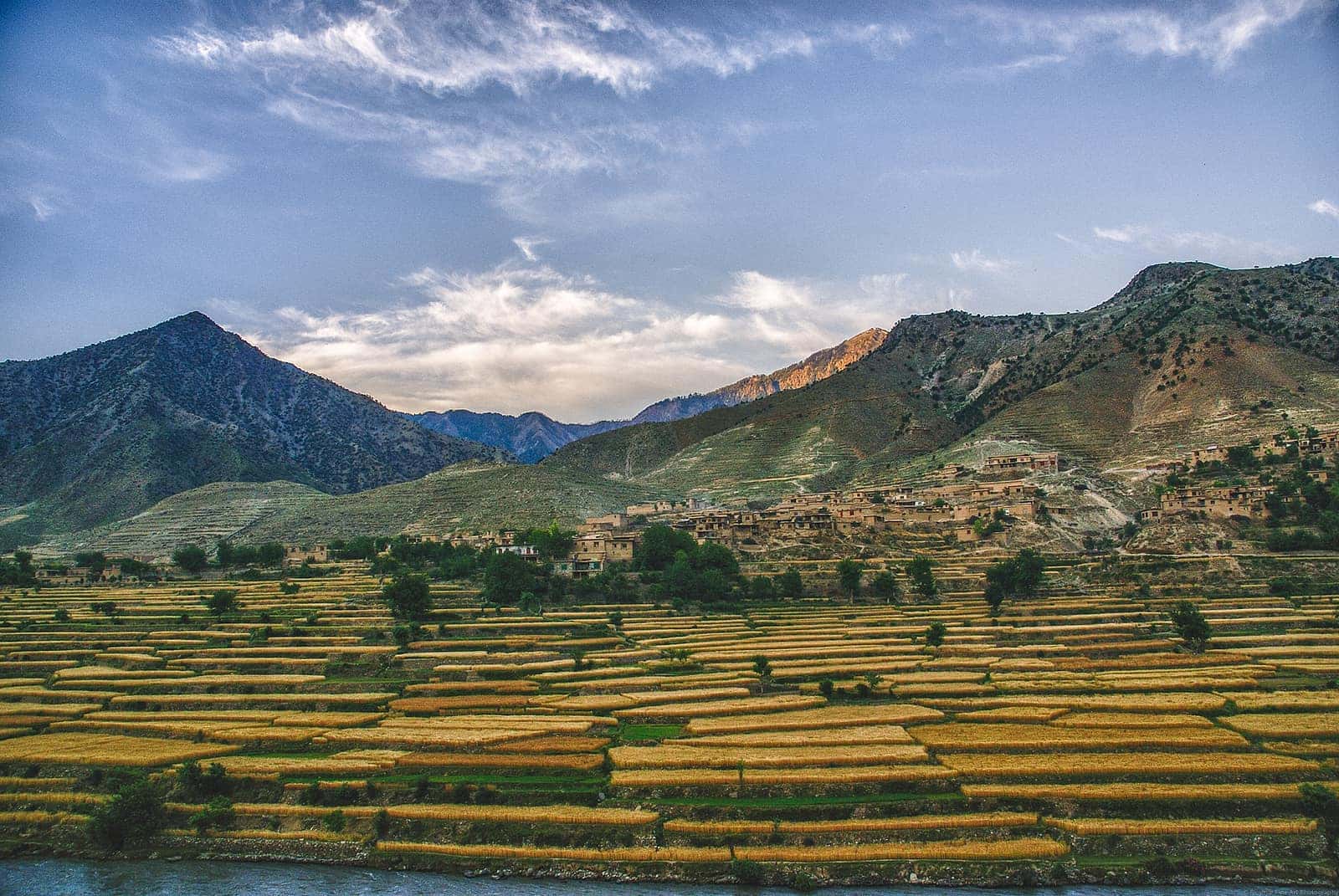
- Photograph of the Kunar valley at Nari: R9 Studios FL, CC BY 2.0, via Wikimedia Commons. The photograph at the top of this page is our own