Kati, the language of the Kata and the Kom
Kamkata-viri to the linguists, Katë in the newest grammar, Bashgali in the old books, and simply our language to the people who speak it: the largest Nuristani language, from the Kantiwa valley across the Bashgal to Chitral.
What Kati is, and why it has so many names
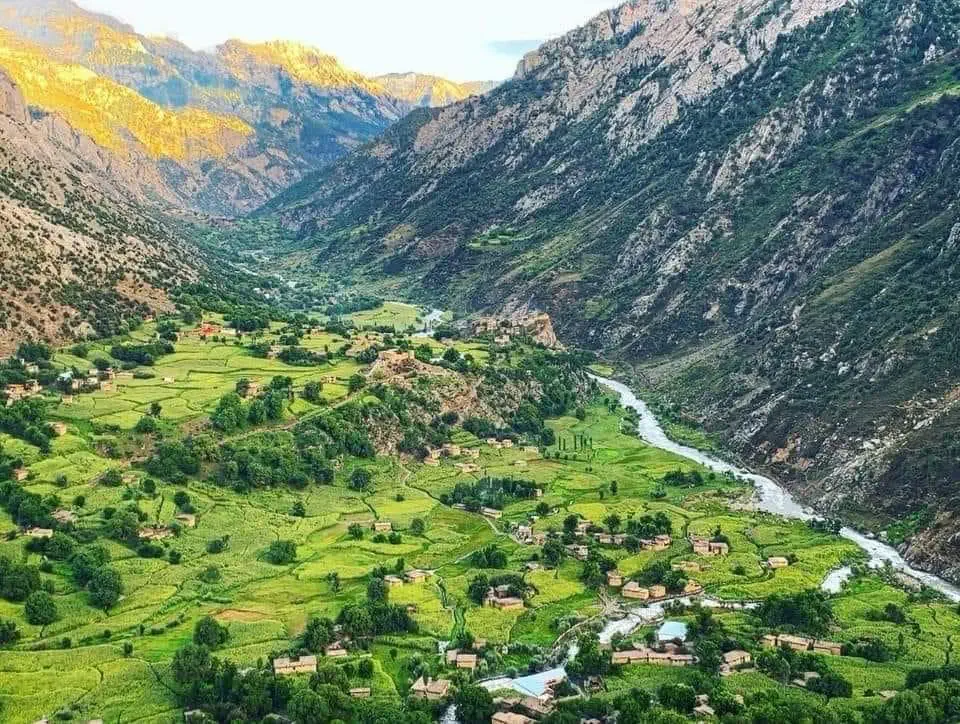
Kati is the largest of the five Nuristani languages, spoken across the whole breadth of the province and a little beyond it: in the Kantiwa valley, the ancestral home of the Kata, in Ramgal and Kulam at the head of the Alingar in the west, along the whole Bashgal valley in the east from Bargi Matal down through Kamdesh to the Kunar, in a handful of villages across the border in Chitral, and in two villages of the upper Munjan valley in Badakhshan, the only Nuristani settlement north of the main Hindu Kush. The best current estimate, worked out by the linguist Jakob Halfmann in 2024 from district populations, is 80,000 to 90,000 speakers.
There is no name that all its speakers use for the whole language. Most say imu veri or yimo viri, our language. The Kata call theirs Kata-vari, the Kom of Kamdesh Kamviri, the Mumo Mumviri. The old British books called it Bashgali, from the Khowar name of the Bashgal valley, which Kati speakers in Chitral find insulting. Georg Morgenstierne introduced Kati in 1926 by mishearing the Persian form Katë-i, and that is what the ISO code and most references use. Richard Strand coined Kamkata-viri, the Kom-and-Kata language, from a proposal by the Kom scholar Qazi Ghulamullah, and this site has used it. Halfmann's grammar of 2024 settles on Katë. All of them mean the same speech.
- Own names
- Kata-vari, Kamviri, Mumviri; imu veri, our language
- Family
- Nuristani branch of Indo-Iranian
- Where
- Kantiwa, Ramgal, Kulam, the Bashgal valley, Kunar, Chitral, upper Munjan
- Speakers
- 80,000 to 90,000 (Halfmann, 2024)
- Dialects
- Western, north-eastern and south-eastern, in a continuum
- Codes
- ISO 639-3 bsh and xvi; Glottolog kati1270
- UNESCO status
- Definitely endangered (2010); Ethnologue says vigorous
- Grammar
- Halfmann, 2024, 684 pages, open access
From the Alingar to the Kunar, and over the border
Halfmann describes the language as spoken in adjacent sections of five valley systems. In the west, Ramgal at the top of the Alingar, with more than twenty villages, and Kulam, a side valley lower down, cut off from Ramgal by Pashai-speaking country; both are in Mandol district. In the centre, Kantiwa, the Pech tributary the Kata count as their ancestral home, from which they spread in about the seventeenth century, with the villages of Kantiwa, Aspit and Mum. In the east, the whole Bashgal valley, which the maps call the Landai Sin, from Bargi Matal and the Kata villages of the upper valley down through Kamdesh and the Kom country to where it meets the Kunar, and on into the upper ends of a few Kunar side valleys such as Dungal. And across the Durand Line in Chitral, in Gobor at the head of the Lutkuh valley, in Shekhandeh above the Kalash villages of Rumbur and Bumburet, and in Langurbats and Badugal along the main Chitral river.
Not every village that was Kati-speaking still is. Strand records that Persian from the Panjshir has replaced Kata-vari in four villages of Ramgal, and that Pashto has displaced Kamviri in six Kom villages on the Kunar side. Two villages at the top of the Munjan valley in Badakhshan, Naw and Ferazen, still speak it, perhaps two hundred people, the one Nuristani outpost north of the watershed. And there are Kati speakers in Kabul, Jalalabad, Peshawar and Chitral town, and in the diaspora abroad.
The Chitral community deserves a word. Its families moved from Nuristan in the late nineteenth century, around the time of the conquest, and now number about six thousand eight hundred by Pakistan's 2018 census of the relevant villages, though the community itself claims ten thousand. They call their language Shekhani or Kataviri there, and since 2021 they have been the most active of all Kati speakers in writing it down.
From twenty thousand to ninety thousand
The counts have climbed with the population. The German expedition of 1935 reckoned about twenty thousand Kati speakers; the Afghan civil registers of 1975 about twenty-two thousand; Strand in 1997 put all the Kata, Kom, Mumo and Kshto together at forty to sixty thousand. Ethnologue's figure, as Wikipedia reports it, is a hundred and fifty thousand, which is almost certainly too high.
Halfmann's 2024 estimate is the careful one: about 79,600 inside Nuristan from the official district figures of 2020 and 2021, about 230 in Munjan and 6,803 in Chitral, so around 86,600 in the home area and something between 80,000 and 90,000 all told. That makes Kati the largest Nuristani language by a wide margin, more than all the others put together.
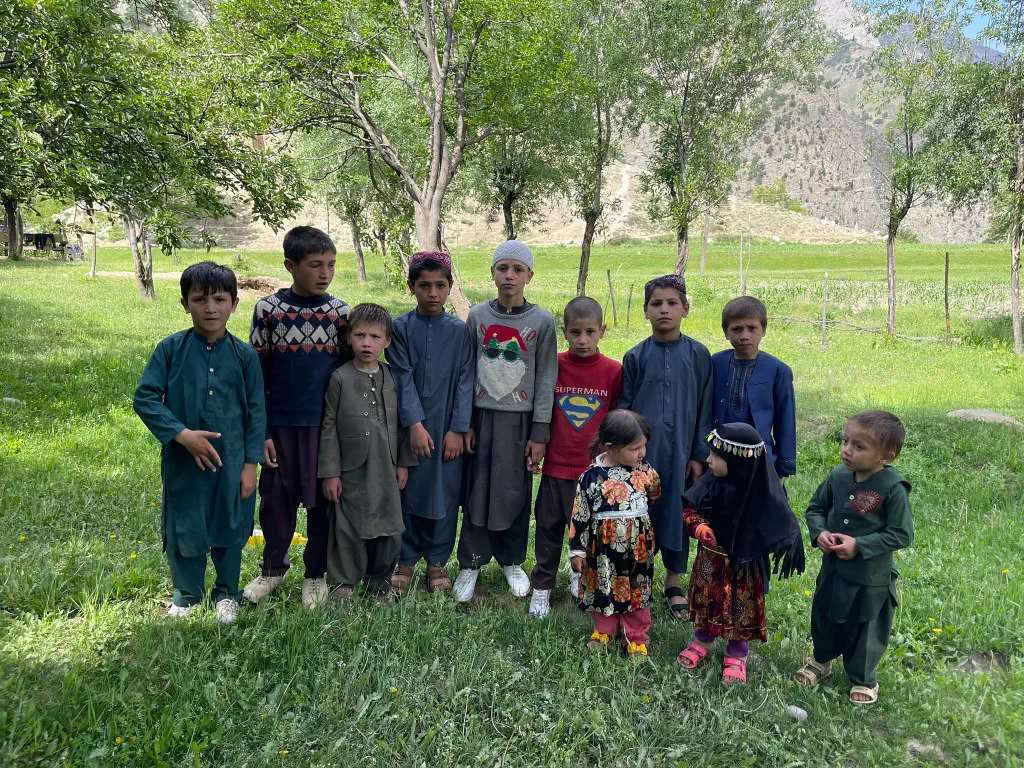
Children in Kantiwa, where the Kata trace their origin. Our own photograph, from our family in the valley.
Kata-vari, Kamviri, and a continuum between them
For a long time the question was whether the Kata and the Kom speak one language or two. The Soviet linguist Aleksandr Grjunberg, whose Kati grammar of 1980 was built on the western dialect of Kulam, treated Kati and Kamviri as separate languages, and the ISO standard still carries two codes, bsh for Kati and xvi for Kamviri. Strand, who has worked among the Kom since 1967, has always called them one language with a major dialect division. Halfmann's fieldwork settled it: the dialects form a continuum from one end of the country to the other, mutual understanding stays high, and he writes that there is no good reason to hold on to the idea of two languages. Grjunberg's own recordings have western speakers conversing with south-eastern ones, and Afghan television's Nuristani programmes put speakers of different dialects together each speaking their own.
Strand's map of the dialects follows the peoples: Kata-vari, western in Kantiwa and Ramgal and eastern in the upper Bashgal; Kamviri, the speech of the Kom and the Kshto, with the Jashi and the Binio; and Mumviri, which he describes as a Kata-vari base with Kamviri sounds. Halfmann draws the lines by geography instead and finds three dialect areas. The western, in Ramgal, Kulam and Kantiwa, is the most varied internally, has lost nasal vowels and marks the progressive with an n. The north-eastern, in the upper Bashgal around Bargi Matal and in the Chitral enclaves of Gobor and Shekhandeh, has long vowels where the others have a v and marks the progressive with a t. The south-eastern, in the lower Bashgal around Kamdesh, on the Kunar side and in Badugal and Langurbats in Chitral, softens consonants between vowels and voices them after nasals; the Mumo dialect belongs here. The old labels still fit: Kata-vari is the western plus the north-eastern, and Kamviri with Mumviri is the south-eastern.
The differences are of the kind that mark where someone is from without stopping a conversation. Bread is anji in the north-east and buri in the south-east; a boy is mere above and ari below; the writing verb is shtro in the west, sturo in the north-east and stro in the south-east.
A Nuristani language, and a debated place inside the family
Kati is one of the five Nuristani languages, which form their own branch of the Indo-Iranian family beside Iranian and Indo-Aryan. Morgenstierne made the case in 1926 and sealed it in 1945 with a paper on how the family treats an old Indo-European consonant, and Strand's account in the Encyclopaedia Iranica sets it out: where Nuristani has a dental ts, Iranian has s and Indo-Aryan sh, so that ten is duts in Kamviri, dasa in Avestan and Sanskrit. Halfmann's 2025 book argues the branch separated early from the Iranian side and only later came under the heavy Indo-Aryan influence that makes Kati, Waygali-ala, Ashkun and Tregami look in many respects like New Indo-Aryan languages.
Where Kati sits inside the family is less settled. Strand groups it with Prasun in a northern cluster, on shared sound changes, while noting that Prasun was cut off from the developments the core languages share. Glottolog, following the comparative work of Irén Hegedűs, puts Kati with Ashkun instead, in a node it calls Ashkun-Kate, and gives Prasun a branch of its own. Strand's own 2023 paper withdraws the northern group, pointing out that eighteen per cent of Prasun's vocabulary is borrowed from Kati, which was the common language of the province and made the two look closer than they are. The honest summary is that Kati is central to the family, and that its nearest relative is still being argued over.
Dental affricates, seven cases and a sense of direction
What marks Kati out, from Strand's descriptions of Kamviri and Halfmann's grammar.
The sounds that strike a listener first are the retroflex ones, made with the tongue tip curled back: t, d, s, z, n and the flap r in that series, plus a retroflex approximant like an English r without the lip-rounding, and in Kati a nasalised version of it that counts as a separate sound. Morgenstierne wrote in 1929 that this r and its nasal twin dominate the pronunciation of Kati. Beside them are the dental affricates ts and dz that are the family's fingerprint, and in Kamviri a voiceless retroflex lateral that sounds like tl said in one breath. Vowels can be long or short and nasal or plain in the north-east, and Kamviri adds ü. Kati has a movable word accent that can change meaning, which Strand marks in his transcriptions, but no tones; Halfmann could find none.
Nouns have two genders, masculine and feminine, with no rule to predict which, and up to seven cases depending on the dialect: direct, oblique, genitive, instrumental, locative, ablative and vocative, though no single noun shows them all and the ending goes only on the last word of the phrase. Words for relatives must carry a marker for whose relative they are: bro is my brother, brosha your brother, bros his or hers. Pronouns distinguish a third person you can see from one you cannot. In the past tense the doer of a transitive verb takes the oblique case, the pattern called split ergativity, which Kati shares with Waygali-ala and Ashkun and which Prasun and Tregami lack. The verb comes last.
- Kati points in pairs. Strand describes four sets of directional words: hither and thither relative to the speaker, up and down relative to the earth, in and out relative to a barrier, and upstream and downstream relative to the river. Kabul is up from Nuristan, because the road climbs steeply just before the city.
- The verb has a suffix for what the speaker witnessed, a particle, mem in Kamviri and mma in Kata-vari, for what is hearsay, and a form for the surprise of finding something out: Strand's example translates as now I see that I was stupid.
- Counting goes in twenties. Twenty is vitsi in Kamviri, forty two twenties, a hundred five twenties, and the old word for four hundred, twenty twenties, was azor, the Persian word for a thousand, which now means a thousand.
From a colonel in Chitral to a grammar of 684 pages
The first book on the language was written by Colonel John Davidson of the Indian Army, who spent two years on duty in Chitral from 1898 and worked with two men from Kamdesh and the Bashgal, Sher Malik and Gul Mir, to translate about 1,741 English sentences into what he called Bashgali. His Notes on the Bashgali (Kafir) Language appeared in Calcutta in 1902, and Sten Konow turned it into a dictionary in 1913. Davidson recorded a tradition among his informants that their people had once practised reading and writing. Morgenstierne took up the language from 1926, visited the Kati of Bumburet in 1929, published Kati myths and hymns in the 1950s and mythological texts from the Kata in 1968, and left an unfinished Kati vocabulary in the National Library of Norway.
The first full grammar was written by a Kom. Qazi Ghulamullah of Kamdesh, a jurist, completed a Persian-language grammar of Kamviri of six hundred and fifty pages in 1966, now in the University of Oslo library, and a Pashto-Kamviri dictionary in 1968, held at Bern; neither was ever printed. He advised Morgenstierne, Strand and Gérard Fussman, and devised his own Arabic-script spelling with invented diacritics that nobody else adopted. He died in 2007. Strand began his fieldwork among the Kom in 1967 and has published on them for more than fifty years: the history, kinship and rank of the Kom, the Kamviri verb, an online Kamviri lexicon of some 5,500 words, a Kata-vari lexicon of Kantiwa and an etymological lexicon of the whole family. Grjunberg, working in Afghanistan from 1963 to 1967, published the Russian grammar and texts of the Kulam dialect in 1980, which the Encyclopaedia Iranica calls the best in its series.
The newest and largest work is Halfmann's A Grammatical Description of the Katë Language, a Cologne doctoral thesis of 684 pages published in 2024 and free to read online, the first comprehensive grammar of the language. He built it over three and a half years from 2019 with Abdul Nasir Mansur, a school principal and language activist from Shekhandeh in Bumburet, and from recordings, radio programmes and social media in all three dialects, with two weeks in Chitral in 2022. A Kabul writer, Sulayman Sun-Aro, printed an illustrated Kati dictionary of 321 pages in 2016, and his spelling has become the model most Kati writers follow.
Three attempts, and a spelling that is spreading anyway
Kati has no tradition of writing, though the language kept an inherited verb for it and a word for a book or writing tablet, pti or pari, that matches a word in the Gandhari documents of the second and third centuries. The first attempt at an official alphabet came in 1987, when the Afghan Academy of Sciences published the Alifba-yi Nuristani by Grjunberg, Jan Mohammad Nuristani and Yasamin Akmal Jano, built on Persian and Pashto spelling. It saw some use among educated Kati speakers in Kabul and has largely fallen out of memory. Jano's collection of Nuristani folk tales followed from the Academy in 1991.
Today, Halfmann writes, writing is widespread and unstandardised: people adapt Pashto, Persian or Urdu spelling as they go, in ways that leave out vowels and vary from one writer to the next, and more and more of them follow Sun-Aro's model. A first-grade school book, Yimo-ste Veri, Our Language, exists in the western dialect of Shtur in Ramgal, children's stories have been printed in the north-eastern dialect as Nuristani-Pashto paperbacks, and the multilingual magazine Watandaran has carried a Nuristani edition. In Chitral, the Forum for Language Initiatives brought a dozen writers from three dialects together at Shekhandeh in April 2021 to agree a spelling and the letters for the sounds Urdu lacks, released a keyboard, and by October 2022 had printed an alphabet book, a volume of folk tales and one of proverbs by Abdul Nasir Mansur, a conversation book and a translation of Gulliver's Travels.
On the air, the national broadcaster RTA has carried Nuristani-language programmes in Kati, presented by Harun Rashid Nooristani, including one on the endangerment of small languages, which Halfmann used as data. Facebook groups with names that translate as Let us speak and write the Katë language, and YouTube videos in all three dialects, are where most Kati writing now happens. No translation of the Quran or the Bible into Kati exists that we know of.
Taught in Pashto and Dari, spoken at home
Schooling in Nuristan has always run in the languages of the state. In the west, next to the Panjshir, Persian is the second language; everywhere else it is Pashto, learnt first and used in the bazaar and the office. The 2004 constitution named Nuristani as a third official language where it is spoken and promised teaching in mother tongues, and neither happened before the constitution was suspended in 2021.
That is the pressure on Kati, and it is real in the lower valleys. In the high villages Halfmann found that every child still learns the language and speaks it for life, and that people who have never left the valleys, women especially, can be monolingual. The one place he found the language threatened was Badugal in Chitral, where intermarriage has thinned the community.
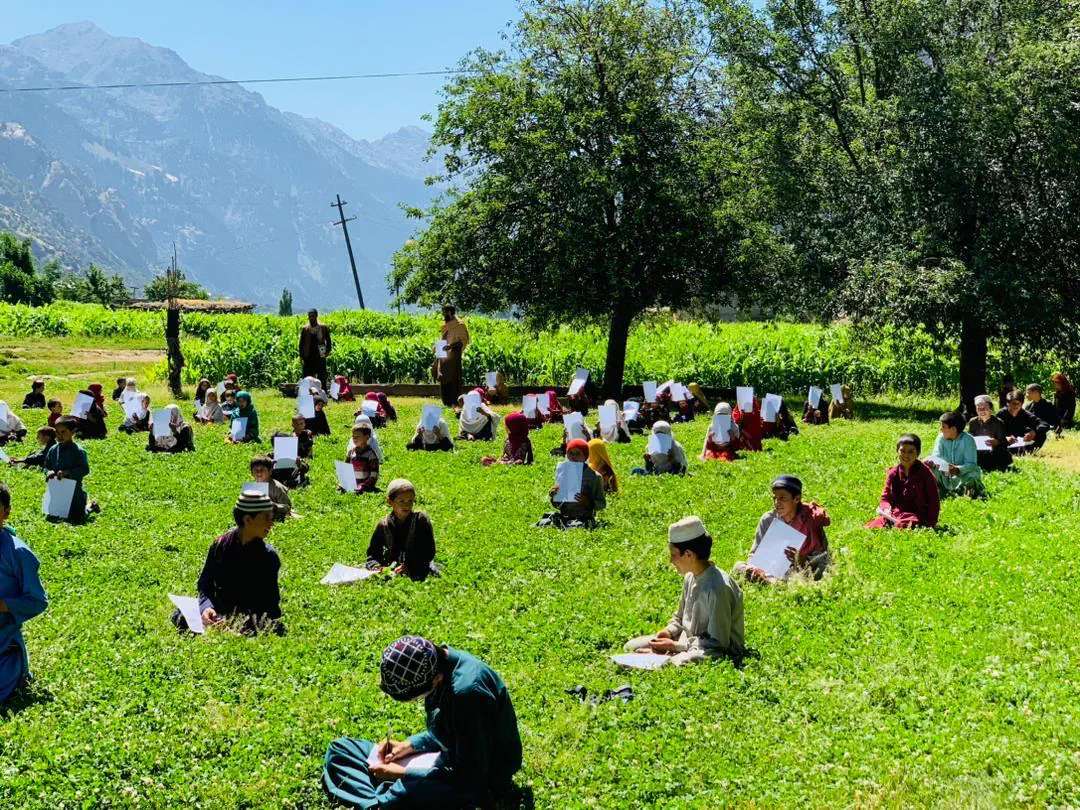
Open-air exams in Kantiwa. Our own photograph.
Who speaks it
The Kata are the largest Nuristani people and the one that gave the language its usual name. From Kantiwa they spread west into Ramgal and Kulam and east over the passes into the upper Bashgal, a movement Alberto Cacopardo dates to about the seventeenth century. The Kom hold the lower Bashgal from their great village of Kombrom, which the maps call Kamdesh, and parts of Kunar; Strand derives their name from the ancient Kambojas, a people of these mountains named in Sanskrit and Persian sources, which is his hypothesis and he presents it as one. The Mumo live in three villages at Mandagal, about fifteen hundred people. The Kshto were driven from their village of Kushtoz by the Kom and now live scattered in the Dungal valley and elsewhere in Kunar. The Jashi, believed to be the valley's original inhabitants who once had a language of their own, live at Gawardesh and in Badugal, and the Binio and Jamcho are small groups attached to the Kom. Below all of them were the bari, the craftsmen who were once enslaved and remain a separate group.
The Kom and the Kata speak dialects of one language but do not claim a common origin. The Kom tradition, which Strand recorded from Qazi Ghulamullah and Vakil Muhammad Kabir in 1992, runs from Khorasan through Kandahar, Kabul and Kapisa to Kama at the meeting of the Kunar and the Kabul rivers, from which they were expelled about a thousand years ago, and then up the Pech to Kamatol before a massacre drove the survivors to the Bashgal. Their genealogy of named descent groups reaches back some twenty-nine generations. In January 1896 Amir Abdur Rahman's army under Ghulam Haidar Charkhi came up the Kunar, took the Kom elders hostage at Barikot, sacked Ushtrot, Pitigal and Saret and captured Kombrom, and the Kshto, Mumo and Kata were conquered after it. The sons of the leaders were taken to Kabul. Kamdesh was where George Scott Robertson had spent the year before, writing the fullest account of the old life, and it has its own pages on this site, as do Kantiwa, Bargi Matal and the 2009 battle below the village.
Numbers in Kati
Richard Strand's Kamviri forms, the dialect of Kamdesh, as used on our words page. The Kata-vari of Kantiwa says diu for two, shtavo for four and vatsa for twenty; the sounds differ, the system does not.
| Number | Kati |
|---|---|
| 1 | ev |
| 2 | dü |
| 3 | tre |
| 4 | što |
| 5 | puč |
| 6 | ṣu |
| 7 | sut |
| 8 | uṣṭ |
| 9 | nu |
| 10 | duć |
| 20 | vići |
| 100 | pučći |
Ten, duts, is the word that shows the whole family's descent: the dental ts here answers to the s of Persian dah and Avestan dasa and the sh of Sanskrit dasha, which is how Morgenstierne proved that Nuristani is a branch of its own. Twenty is vitsi, and the counting goes in twenties from there: dü vitsi is forty, tre vitsi sixty, and putstsi, five twenties, a hundred. The teens keep a trace of counting in tens.
In counting, one is always pronounced ev, even in the dialects that have dropped the final v elsewhere. The word for a thousand, azor, is Persian, and once meant four hundred, twenty twenties, the largest number the old system needed.
How endangered is Kati?
The two big assessments disagree about Kati, and both have a point. This is what each says, with its date, and what the people who have been there recently report.
| Source | What it says |
|---|---|
| UNESCO Atlas of the World's Languages in Danger, 2010 | Kati: definitely endangered, the class UNESCO gives to languages that children no longer learn at home in some part of their area. The Atlas worked from the old low speaker counts. |
| Ethnologue, as reported by Halfmann (2024) | Level 6a, vigorous: used by all generations in the home and the community. The regional experts Liljegren and Akhunzada, writing in 2017 on northern Pakistan, did not dispute it. |
| Jakob Halfmann, fieldwork 2019 to 2022 | All children in native-speaking communities learn the language and speak it throughout their lives; some monolinguals remain. The threats he names are integration, education in Pashto and Dari, and new roads. The only clearly threatened community is Badugal in Chitral. His estimate: 80,000 to 90,000 speakers. |
| Richard Strand, 1997 to 2011 | Shift to Pashto and Persian in the villages that border Pashto- or Persian-speaking country: Persian has replaced Kata-vari in four villages of Ramgal, and Pashto has replaced Kamviri in six Kom villages on the Kunar. |
| Glottolog and the Catalogue of Endangered Languages, 2022 | Agglomerated Endangerment Status: shifting. The Catalogue rates it threatened, 20 per cent certain on the evidence available. |
| Forum for Language Initiatives, Chitral, 2021 to 2022 | A community of about six to ten thousand in Chitral agreed a spelling in April 2021, released a keyboard and printed five books by October 2022; the government now schools its children, and literacy in the language is low. |
Help us record them
We are gathering recordings from the valleys: a greeting, a proverb, a few lines of a song, counted numbers, in each language and as many dialects as we can reach. If you or your family speak a Nuristani language, record a minute on your phone, tell us who is speaking and where they are from, and send it to us. We will credit every voice and publish the recordings here.
Asked about Kati
What is the Kati language?
Kati, also called Kamkata-viri, Katë, Kata-vari or Kamviri, is the largest of the five Nuristani languages, a branch of the Indo-Iranian family. It is spoken by about 80,000 to 90,000 people across Nuristan province in Afghanistan, from the Kantiwa, Ramgal and Kulam valleys in the west to the Bashgal valley in the east, and by a few thousand more in Chitral in Pakistan.
Are Kati and Kamviri the same language?
Yes, by the current judgement. Kata-vari is the speech of the Kata and Kamviri that of the Kom of Kamdesh, and they differ enough that the ISO standard gave them two codes. But the dialects run in a continuum, speakers understand each other well, and Jakob Halfmann's 2024 grammar concludes there is no good reason to treat them as two languages. Richard Strand has always called them one, Kamkata-viri.
Why is Kati called Bashgali?
Because the first book about it, Colonel Davidson's Notes on the Bashgali (Kafir) Language of 1902, was written in Chitral, where the Khowar name for the Bashgal valley was used for the people who came from it. Kati speakers in Chitral find the name insulting and call their language Shekhani or Kataviri. Kati itself comes from Morgenstierne's mishearing of the Persian form Katë-i in 1926.
How many people speak Kati?
About 80,000 to 90,000, on Jakob Halfmann's 2024 estimate from official district populations: roughly 79,600 in Nuristan, 230 in the Munjan valley of Badakhshan and 6,800 in Chitral, plus the diaspora in Kabul, Jalalabad, Peshawar and abroad. Older counts were 20,000 in 1935 and 22,000 in 1975; Ethnologue's 150,000 is almost certainly too high.
Is Kati spoken in Pakistan?
Yes, in Chitral, by families who moved from Nuristan in the late nineteenth century: in Gobor at the head of the Lutkuh valley, in Shekhandeh above the Kalash villages of Rumbur and Bumburet, and in Langurbats and Badugal on the main Chitral river. Pakistan's 2018 census counted 6,803 people in those villages; the community says ten thousand. Since 2021 it has led the effort to write the language.
Is Kati endangered?
UNESCO rated it definitely endangered in 2010, while Ethnologue rates it vigorous, and the recent fieldwork supports the second view inside the valleys: every child in the Kati-speaking villages still learns it. The pressure is at the edges, where Persian has replaced it in four villages of Ramgal and Pashto in six Kom villages of Kunar, and in schools that teach only in Pashto and Dari.
Is Kati written?
Not in any standard way. The Afghan Academy of Sciences published an alphabet in 1987 that is now forgotten; most people who write Kati adapt Pashto or Persian spelling, increasingly on the model of Sulayman Sun-Aro's 2016 dictionary; and in Chitral the Forum for Language Initiatives agreed a spelling and keyboard in 2021 and has printed books in it. Linguists use Roman transcriptions.
What does Kamkata-viri mean?
The Kom-and-Kata language. Vari or viri is the Kata-vari word for language or speech, and the name joins the two largest peoples who speak it, the Kom and the Kata; the fuller form adds the Mumo and the Kshto. Richard Strand coined it from a proposal by the Kom scholar Qazi Ghulamullah, because the language had no name of its own.
On this site
- The Nuristani languages, valley by valley
- Words and numbers in the five languages, side by side
- Kamdesh district and the Bashgal valley, home of the Kom
- Kantiwa district, the ancestral valley of the Kata
- Bargi Matal, the upper Bashgal
- Mandol district: Ramgal and Kulam
- Nuristani names: the surname and the old names Robertson recorded at Kamdesh
- The Battle of Kamdesh, 2009
- Chitral and the Kalash, over the passes
- Prasun, the language of the Parun valley
- Jakob Halfmann, A Grammatical Description of the Katë Language (Nuristani), doctoral thesis, University of Cologne, 2024, open access
- Richard F. Strand, Nurestâni languages, Encyclopaedia Iranica (2000, updated 2018)
- Richard F. Strand, The Kâta, Kom, Mumo, Kṣto, Binio, J̌âmčo and J̌âša (nuristan.info, 2007, revised 2011)
- Richard F. Strand, The Kâta (nuristan.info), with the village lists
- Richard F. Strand, The Kom (nuristan.info), with the history of 1896
- Richard F. Strand, Peoples and Languages of Nuristân (nuristan.info, 1998, revised 2011)
- Richard F. Strand, Kâmboǰâs and Sakas in the Holly-Oak Mountains: On the Origins of the Nûristânîs (2022 and 2023)
- J. Davidson, Notes on the Bashgalī (Kāfir) Language (Asiatic Society of Bengal, Calcutta, 1902), scan
- Jakob Halfmann, Terminological proposals for the Nuristani languages, Himalayan Linguistics 20(1), 2021
- Glottolog: Katë (kati1270) and the Kamviri dialect (kamv1242), with the UNESCO citation
- V. Kushev, Gryunberg-Tsvetinovich, Encyclopaedia Iranica (2002), on the 1980 Kati grammar
- Forum for Language Initiatives, Developing a Nooristani language in Chitral (15 April 2021)
- Forum for Language Initiatives, One another Chitral's language turned into written form (3 October 2022)
- Max Planck Institute, Numeral Systems of the World's Languages: Kati (2002)
- Christopher Moseley (ed.), Atlas of the World's Languages in Danger, third edition (UNESCO, 2010), as tabulated for Afghanistan
- Wiktionary, Kamkata-viri lemmas and numerals, citing Strand's Nûristânî Etymological Lexicon and Halfmann 2024
Plan your Nuristan journey
Ready to plan a visit, source Nuristani products, or discuss an investment? Your message goes to Obaid, who is from Nuristan, and his team in Afghanistan and the UK. We reply to every message.