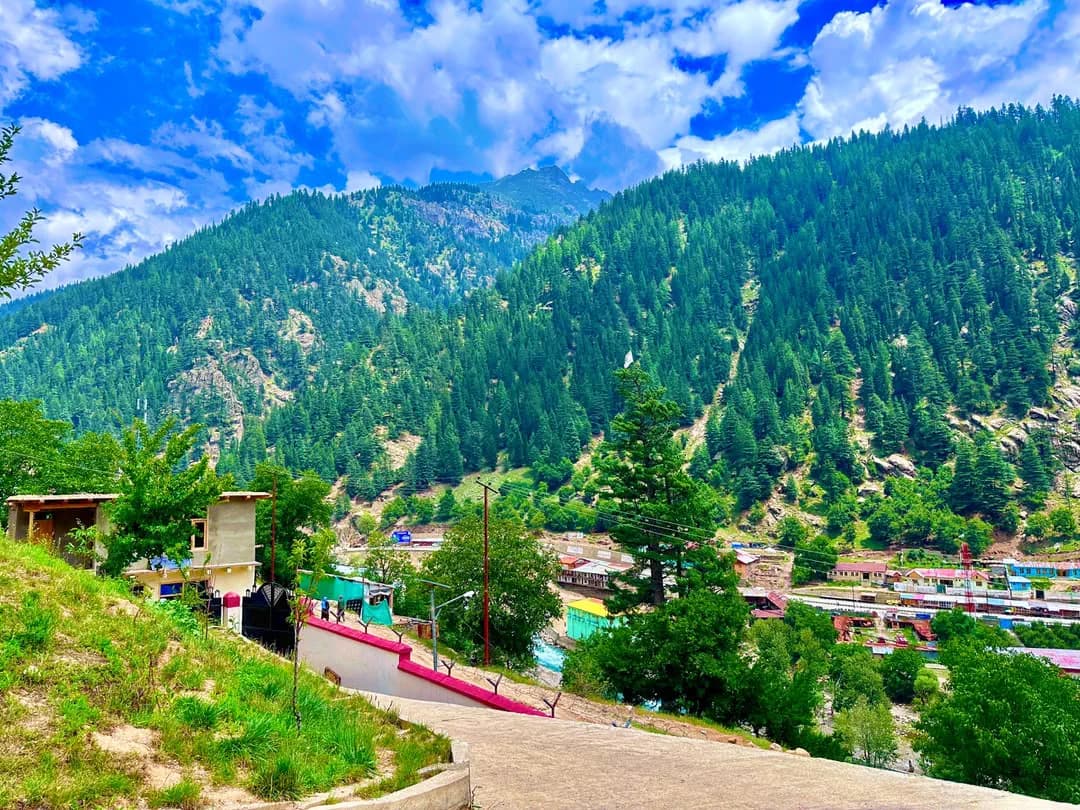
Prasun, the language of the Parun valley
Its speakers call it Vasi-vari. It is spoken in six villages along twenty kilometres of one high river, by a few thousand people, and no other Nuristani can follow it. The most distinct of the five languages, and the home language of the provincial capital.
What Prasun is, and why nobody else understands it
Prasun is the Nuristani language of the Parun valley, the high valley at the top of the Pech basin where the provincial capital stands. Its speakers call themselves Vasi and their language Vasi-vari. Prasun is what the Kati call them, Paruni is the Persian name of the valley, and the old books wrote Presun, Viron, Wasi-weri. Richard Strand calls it the most aberrant of the Nuristani languages: its sounds changed so far from the common stock that speakers of the other four have virtually no comprehension of it, and Georg Buddruss, who spent sixty years on it, described it as the most isolated, most difficult and least adequately known of the Nuristan languages.
It is spoken in six villages strung along about twenty kilometres of the Parun river, mostly on its right bank, between roughly 2,500 and 2,850 metres, by somewhere between three and eight thousand people depending on who is counting and when. Until 1896 these villages were the religious heart of old Kafiristan, and since 1993 the lowest of them, Pashki, has been the seat of the province. On 20 July 2026 a flash flood came down the valley and through Parun town. This page is about the language; the flood has a page of its own.
- Own name
- Vasi-vari, the language of the Vasi
- Family
- Nuristani branch of Indo-Iranian; a branch of its own within it
- Where
- The six villages of the Parun valley, Parun district
- Villages
- Pashki, Tsutsum, Kushteki, Dewa, Pronz, Shtive
- Speakers
- About 3,000 to 8,000, by source and year
- Dialects
- Lower, central and upper, along one river
- Codes
- ISO 639-3 prn; Glottolog pras1239
- UNESCO status
- Definitely endangered (2010)
Six villages along twenty kilometres of river
The whole speech community lives within a day's walk of itself. From lowest to highest, these are the villages, in the Vasi names Strand records, the names on the maps, and the names Robertson heard in the Bashgal in 1891.
Ushüt is Pashki, the lowest village and now the provincial seat, which Robertson wrote Puskigrom. Zumu is Tsutsum, his Satsumgrom. Üshüt, a different word with a different first vowel, is Kushteki, his Kstigigrom, the village of the great temple. Üchü, the one village on the left bank, is Dewa, his Diogrom. Sech is Pronz, his Pontzgrom, the dialect most often quoted in the reference books. Shupu is Shtive, also written Ishtevi, his Shtevgrom, the uppermost village, where the stream from the Kamah pass joins the river. Robertson's names all end in grom, the Kati word for village, because he heard them from the Kom. The language has three dialects: the upper, in Shupu alone; the lower, in Ushüt alone; and the central, in the four villages between.
Robertson, who came over the Kungani pass from the Bashgal on 28 September 1891 and marched down the valley, found a high, easy valley with excellent grazing and a rigorous winter, whose people were cut off from every neighbour once the passes closed, the only way in being up the Pech. That is still true in winter. In summer the road from Asadabad up the Pech through Wama reaches Parun in two days from Kabul. The Vasi were never numerous. Buddruss put them at about three thousand; Strand at three to six thousand; Almuth Degener and Ethnologue, from 2011, at about eight thousand. Parun district as a whole, which includes officials and traders who are not Vasi, had an estimated 15,279 people in 2020 and the town 11,563 in 2025.
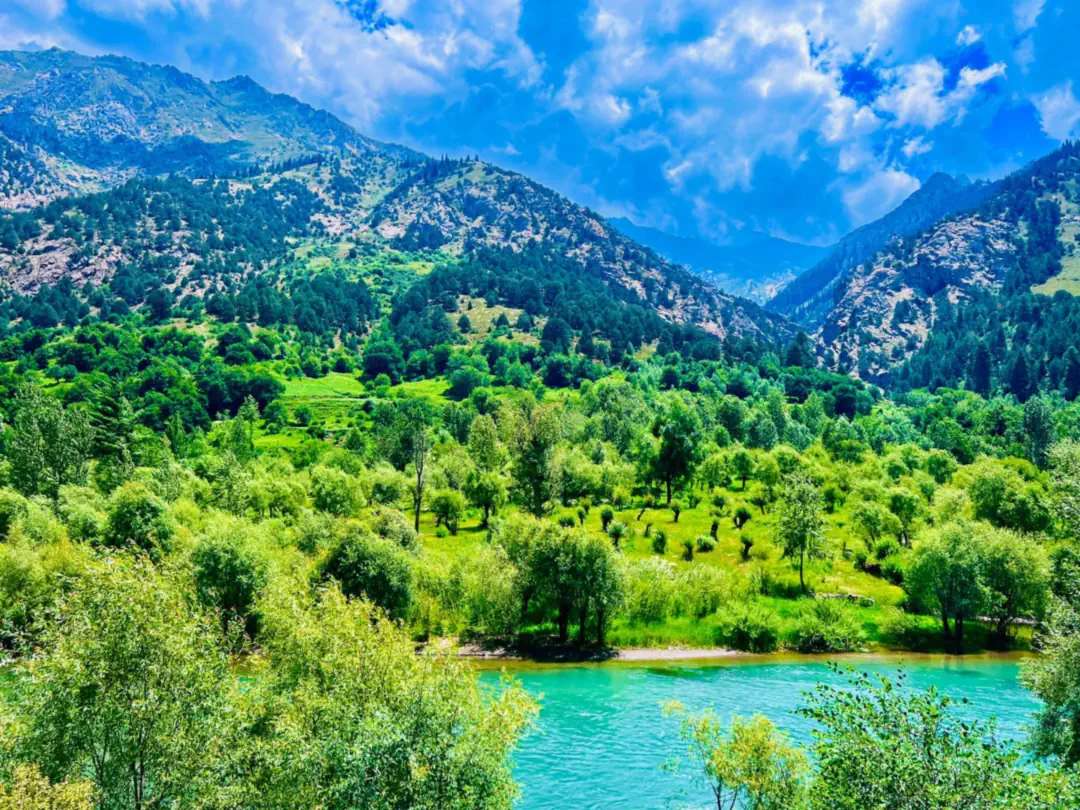
Imra's meadows
Robertson described the river flowing placidly down the valley through meadow-land set aside for the service of Imra and past all the Presun villages, before it turned abruptly to leave the valley for the country of the Sanu below. Every village, he was told, was under the care of one god, and in Presungul there was a distinct atmosphere of religion that he found nowhere else.
The Kom, he wrote, behaved like owners of the country, and the Presun carried loads for them. Kati was the common language of the province, and the Vasi learnt it; nobody learnt Vasi-vari. That one-way traffic, as we explain below, is written into the language itself.
The Parun river. Our own photograph.
A Nuristani language, and a branch by itself
Prasun is one of the five Nuristani languages, which together form a third branch of the Indo-Iranian family beside Iranian and Indo-Aryan, a position Morgenstierne argued for from 1926. Where Prasun sits within the five has changed with the evidence. Morgenstierne in 1974, and Strand on his website from 1997 and in the Encyclopaedia Iranica in 2000, paired it with Kati in a northern group on the strength of shared sound changes, while Strand noted in the same breath that Prasun had been isolated from the developments the core languages share. Glottolog now gives Prasun a primary branch of its own, with lower, central and upper Prasun under it, and groups Kati with Ashkun and Waygali-ala.
Strand himself came round to that view. In a paper given at Rome in 2022 and published in 2023 he proposed eliminating the northern Nuristani subgroup altogether. His reasoning is worth a lay summary: the vowel-dropping that Prasun and Kati share happened at different stages and in more places in Prasun, so it cannot be a change inherited from a common ancestor; and when Degener gave him the full Prasun lexicon from the Harvard volumes, he found that eighteen per cent of the 1,406 words with known origins were borrowed from Kati, the common language of the province, which is one reason Prasun and Kati had seemed closer than they are. No Prasun word, by contrast, has been recorded as a loan in any other Nuristani language, because almost nobody outside the valley speaks it. In most measures, he concludes, Vasi-vari stands out from the rest of the family.
Strand goes further and reads the names Vasi and Prasun as hither Sakas and further Sakas, descendants of the ancient steppe people, which would make the Vasi a different strand of the Nuristani story from the Kati-speaking Kambojas. That is one scholar's new proposal, published in 2023 and not yet weighed by others, and we present it as such. The older tradition, which Strand also records, is simply that the Nuristanis came up from the plains fleeing Mahmud of Ghazni in the eleventh century and that the Vasi, being less powerful, ended up in the highest and least desirable valley.
Dropped consonants, a d that became l, and a verb to have
What makes Prasun impossible for a Kati speaker to follow, in Strand's analysis, which builds on Morgenstierne's of 1949.
The first thing is that the beginnings of words fell away. In Prasun the old initial consonants k, g, j, t and p were lost, b became v, and the family's dental affricates became z. So where Kati has duts for ten, Prasun has leze; where Ashkun has patu for feather, Prasun has vita for wing; the word for thou is yu and for father ya; a thief is ishtne and a bone ichi. The second is that an old d became l, a change Prasun shares with Bactrian, Pashto and Munji, the Iranian languages to its north: two is lü, hand is lust where Kati says dusht, a daughter is lüsht where Kati says jü, and the wheat plant is ulyum. Strand thinks the whole sound system was shaped by the Munji spoken over the passes in Badakhshan, down to the loss of nasals before voiced consonants.
Add to that the squeezing-out of vowels from the middle of words, which gives pshik for cat and psnok for thing, and vowels that bend towards each other across a word, ü and ö among them, so that eye is izhin and a bridge üshköp, and the result is a language that looks and sounds like none of its relatives. Four is chpu, where the others say chata or shtavo; spring is usti where Kati says vasut; a tree trunk is ishtobu where Kati says shtum.
- Prasun has a we that includes the person spoken to and a we that excludes them, marked on the verb, which no other Nuristani language has.
- It tells the past from the doer's point of view, with a past active participle in ok, and so it lacks the split-ergative past of Kati, Waygali-ala and Ashkun; in Prasun it is the definite object, not the past agent, that gets marked.
- It has a verb to have, la, used for possession and as a helping verb, which the other Nuristani languages do without.
- Its words for me, and-esh, and thee, üt-esh, look nothing like Kati's. Its oblique case ends in sh, from an ancient genitive. It has a rich set of directional words, which can be prefixed even to pronouns, and verb forms that mark surprise, the mirative, which the Harvard grammar treats at length.
Morgenstierne, then sixty years of Buddruss
Robertson's visit in 1891 was too short, as Klimburg says, for more than a few observations and a description of the temple, and he recorded of the language only that it was quite different from the Wai's and the Siah-Posh's. The first study was Morgenstierne's The Language of the Prasun Kafirs, published in the Norwegian journal of linguistics in 1949, nearly a hundred and fifty pages, and Strand credits it with working out the sound changes set out above. The German expedition of 1935 had already recorded the Prasun calendar, an exceptionally detailed order in Klimburg's words, which Wolfgang Lentz published in 1939.
Then came Georg Buddruss of Mainz. A member of the German Hindu Kush expedition of 1955, he collected texts in the Parun valley in 1956 and again in 1970, prose and a few songs, and spent the rest of a long life working them up. When he applied for funding in 2012, in his eighties, he described a language with almost nothing certain known about its grammar. With Almuth Degener he published Materialien zur Prasun-Sprache des afghanischen Hindukusch in two parts in the Harvard Oriental Series: the texts and glossary in 2015, 946 pages, with lists of numbers, place names, personal names and the calendar, and the grammar in 2017, 507 pages, covering the verb, subordination, mirativity and what the publisher calls the complicated system of directional morphemes. It is the first comprehensive grammar of Prasun and the most detailed description of any Nuristani language in print. Buddruss died in Mainz on 13 August 2021, aged ninety-one. Peter Snoy had printed short versions of his Prasun myths as early as 1962, and Buddruss's own analysis of a Prasun text about the god Mara building a mill appeared in 2005.
Strand visited the valley in August 1973 and recorded conversations with Zaman Khan, leader of the Pazgam clan of Shupu, the family that had been the keepers of the creator god before Islam; the interviews were in Kamviri, because that was the language they shared. Degener supplied the Prasun numerals to the Max Planck database in 2013 and the lexicon to Strand for his 2023 study, and Julian Kreidl of Indiana published new Prasun etymologies in 2024. The Danish botanist Lennart Edelberg, who worked in the valley from the 1940s, published Paruni myths and hymns in 1972 and the temple of Imra in 1959, and Klimburg wrote up the arts and culture of Parun, Kafiristan's sacred valley, in 2002.
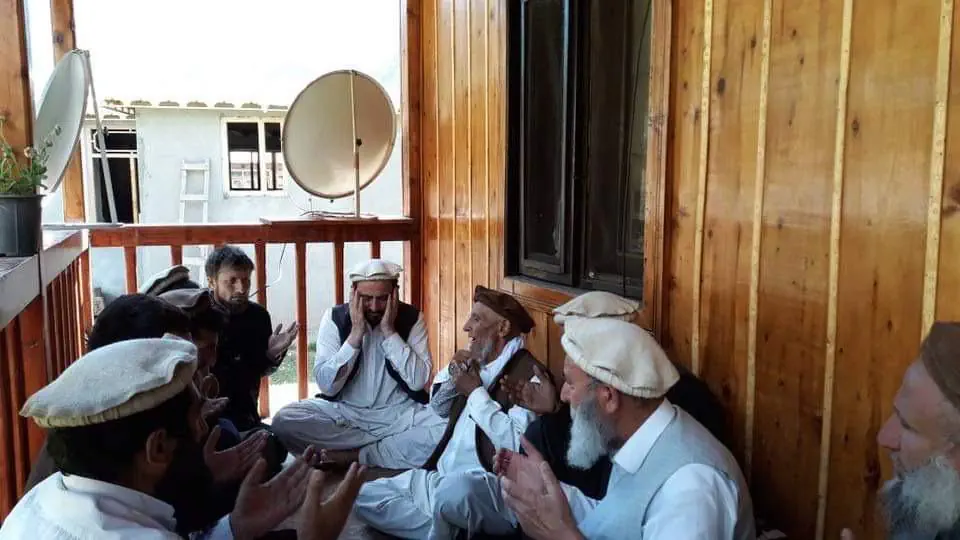
The only people who speak it
Everything written about Prasun was written by visitors who stayed a season at most, and the fullest of it was published when the man who collected it was eighty-six. The language lives in the six villages and nowhere else: it is not taught, not broadcast and not written, and it has no diaspora to speak of.
We are gathering recordings from the valley for this page, with the speaker's name and village, and we would be glad of yours.
Elders at prayer on a veranda in Parun. Our own photograph.
The sacred valley and what happened to it
Robertson judged the Presun a very ancient people, entirely different from the Siah-Posh on one hand and the Wai and Ashkun on the other, remarkable for their more peaceful disposition, simple, very industrious and capable of wonderful feats of endurance, and he saw two of them at Kamdesh sitting with their arms round each other's necks as though alone in a crowd of aliens, which, he added, was probably the case. Those are a Victorian outsider's judgements. What is beyond dispute is the valley's old religious standing. The purest form of the Kafir religion, Robertson wrote, was probably to be found in Presungul, and at Kstigigrom, Kushteki, stood the chief temple of Imra, between fifty and sixty feet square and twenty high, with a carved portico as large again, the most sacred village in the whole of Kafiristan. Klimburg calls it by far the largest religious building in Kafiristan, drawing pilgrims from the whole region; its people knew it as the temple of Mara, the god's Prasun name. Prasun religious ideas spread to the Kom, the Wai and the Kalasha, and the Vasi kept the craftsman caste out and did their own carving.
The Afghan army under Amir Abdur Rahman conquered the valley with the rest in the winter of 1895 to 1896; the temple and the effigies were burned, more than thirty wooden figures were carried to Kabul, and the country was renamed Nuristan. The houses of the upper valley, Robertson had noted, were largely underground against the cold, and the people dressed in thick grey blanketing unlike anything the Siah-Posh wore. Klimburg sums the old Prasun culture up as the polar opposite of the status-hungry societies of Waygal and Ashkun: a people who lived, as he puts it, in some fear of their more martial neighbours, among whom only one family held real rank, given by the god. The history of the valley since, from the province's founding in 1993 to the flood of 2026, is on the Parun district page.
Numbers in Prasun
Richard Strand's forms, as used on our words page, which match the numerals Almuth Degener supplied to the Max Planck database in 2013 from Morgenstierne and Buddruss. Set them beside any other Nuristani language and the distance shows at once.
| Number | Prasun |
|---|---|
| 1 | upün |
| 2 | lü |
| 3 | ćši |
| 4 | čpu |
| 5 | vuču |
| 6 | vuṣ |
| 7 | sata |
| 8 | âsta |
| 9 | nu |
| 10 | leza |
| 20 | źu |
Two is lü, where every other Nuristani language has du or dü: the old d became l. Ten is leze, against Kati duts and Waygali-ala dosh. Four, chpu, has lost the vowel between its first two consonants, and six, vush, and eight, asta, show the dropped and shifted consonants described above. Five, vuchu, and nine, nu, are the ones a Kati speaker might recognise.
Counting is in twenties, as across the family: twenty is zhu, forty two twenties, a hundred five twenties and four hundred twenty twenties, and the word for a thousand is a loan from Iranian that originally meant four hundred. The upper village, Shupu, and the lower, Ushüt, each say the numbers a little differently from the four villages between.
How endangered is Prasun?
Prasun has always been a small language in one valley, and the assessments reflect that rather than any collapse in use. Here they are, with their dates.
| Source | What it says |
|---|---|
| UNESCO Atlas of the World's Languages in Danger, 2010 | Prasun (Wasi-wari): definitely endangered, the class for languages that children no longer learn as a mother tongue at home in part of their area. The same grade as Kati, Ashkun and Waygali-ala. |
| Georg Buddruss, 2012 | An unwritten language still spoken by about 3,000 people, the most isolated, most difficult and least adequately known of the Nuristan languages, of whose grammar very little was yet certain. |
| Richard Strand, 1998 to 2023 | A Vasi population of 3,000 to 6,000. Totally unintelligible to other Nuristanis. Eighteen per cent of its vocabulary borrowed from Kati, the province's common language, and no Prasun word borrowed by anyone else, because almost no outsider speaks it. |
| Almuth Degener (2013) and Ethnologue (2011 figure) | Approximately 8,000 speakers. Ethnologue's own current page could not be read when this guide was written. |
| Glottolog and the Catalogue of Endangered Languages, 2022 | Agglomerated Endangerment Status: threatened. The Catalogue rates it vulnerable, 40 per cent certain on the evidence available. |
| Constitution of Afghanistan, 2004 (suspended since 2021) | Named Nuristani as a third official language where it is spoken and promised teaching in mother tongues; neither reached the Parun valley, where schooling runs in Pashto and Dari. |
Help us record them
We are gathering recordings from the valleys: a greeting, a proverb, a few lines of a song, counted numbers, in each language and as many dialects as we can reach. If you or your family speak a Nuristani language, record a minute on your phone, tell us who is speaking and where they are from, and send it to us. We will credit every voice and publish the recordings here.
Asked about Prasun
What is the Prasun language?
Prasun, called Vasi-vari by its speakers, is the Nuristani language of the Parun valley in central Nuristan, Afghanistan, where the provincial capital stands. It is spoken in six villages by a few thousand people and is the most divergent of the five Nuristani languages: speakers of the other four cannot understand it.
Where is Prasun spoken?
In the Parun valley at the top of the Pech basin, in six villages along about twenty kilometres of the Parun river at roughly 2,500 to 2,850 metres: Pashki, the provincial seat, Tsutsum, Kushteki, Dewa, Pronz and Shtive. Their own names are Ushüt, Zumu, Üshüt, Üchü, Sech and Shupu.
How many people speak Prasun?
Between about 3,000 and 8,000, depending on the source and the year. Georg Buddruss and Max Klimburg said about 3,000; Richard Strand 3,000 to 6,000; Almuth Degener and Ethnologue about 8,000 from 2011. Parun district as a whole, including people who are not Vasi, had an estimated 15,279 people in 2020.
Why is Prasun so different from the other Nuristani languages?
Because its sounds changed in ways the others did not: the consonants at the beginning of words were lost, an old d became l, as in Pashto and Munji, vowels were squeezed out of the middle of words, and the grammar developed a verb to have, an inclusive and exclusive we and a past told from the doer's point of view. Its people were also isolated at the top of the Pech, learning Kati to talk to neighbours who never learnt Prasun. Glottolog now treats it as a branch of its own within Nuristani.
Is Prasun related to Kati?
Both are Nuristani languages, so yes, distantly. Older classifications paired them in a northern group, but Richard Strand showed in 2023 that the resemblance owes much to the eighteen per cent of Prasun's vocabulary borrowed from Kati, the common language of the province, and he withdrew the northern group. Glottolog gives Prasun its own primary branch.
Is Prasun endangered?
UNESCO rated it definitely endangered in 2010 and the Catalogue of Endangered Languages calls it vulnerable. It is spoken at home in all six villages, but it has only a few thousand speakers, is unwritten, is not taught in schools, which run in Pashto and Dari, and has no community outside the valley.
Is there a Prasun dictionary or grammar?
Yes, since 2015 and 2017. Georg Buddruss and Almuth Degener's Materialien zur Prasun-Sprache des afghanischen Hindukusch, in the Harvard Oriental Series, gives the texts and a glossary in its first part and a full grammar in its second, from material Buddruss collected in 1956 and 1970. It is in German, and it is the most detailed description of any Nuristani language yet printed. Before it there was only Morgenstierne's study of 1949.
What does Vasi-vari mean?
The language of the Vasi, which is what the people of the Parun valley call themselves; vari is the word for language, as in Kata-vari. Prasun is the Kati name for them, Paruni the Persian name from the valley, and Presun and Viron are what Robertson heard in 1891.
On this site
- Parun district: the capital, the valley, the flood
- The Parun flood of July 2026: what happened and how to help
- The Nuristani languages, valley by valley
- Words and numbers in the five languages, side by side
- Kati, the language the Vasi learnt to talk to their neighbours
- Ashkun, the language of Wama below the valley
- Kafiristan: the valleys before 1896
- Nuristani architecture: the tiered timber villages
- Support Nuristan: what the valleys need
- Richard F. Strand, The Vâsi (nuristan.info, 1998, revised 2011)
- Richard F. Strand, Nurestâni languages, Encyclopaedia Iranica (2000, updated 2018)
- Richard F. Strand, The Evolution of the Nuristâni Languages (nuristan.info, 2008, updated 2022)
- Richard F. Strand, Kâmboǰâs and Sakas in the Holly-Oak Mountains, in Roots of Peristan (ISMEO, Rome, 2023), on withdrawing the northern group
- Richard F. Strand, Topics in Vâsi Ethnography: conversations with Zamân Xân of Ṣupu (nuristan.info)
- Georg Buddruss and Almuth Degener, Materialien zur Prasun-Sprache des afghanischen Hindukusch, Teil 1: Texte und Glossar (Harvard Oriental Series 80, 2015)
- Georg Buddruss and Almuth Degener, Materialien zur Prasun-Sprache des afghanischen Hindukusch, Teil 2: Grammatik (Harvard Oriental Series 84, 2017)
- Deutsche Forschungsgemeinschaft, project 222132533 (Buddruss, 2012 to 2015), the description of the language and its 3,000 speakers
- Georg Morgenstierne, The Language of the Prasun Kafirs, Norsk Tidsskrift for Sprogvidenskap 15 (1949) (Who Was Who in Indology)
- George Scott Robertson, The Káfirs of the Hindu-Kush (1896), pages 65 to 68, 75 to 81, 119, 357, 377 to 396, 490 to 491 and 521 on the Presun
- Max Klimburg, The Arts and Culture of Parun, Kafiristan's 'Sacred Valley', Arts asiatiques 57 (2002)
- Max Klimburg, Nuristan, Encyclopaedia Iranica (2004, updated 2012)
- Glottolog: Prasun (pras1239), classification and endangerment
- Max Planck Institute, Numeral Systems of the World's Languages: Prasuni, data from Almuth Degener (2013)
- Christopher Moseley (ed.), Atlas of the World's Languages in Danger, third edition (UNESCO, 2010), as tabulated for Afghanistan
- Constitution of Afghanistan (2004), Articles 16 and 43
- Wiktionary, Prasuni numerals, citing Strand's Nûristânî Etymological Lexicon (2016)
Plan your Nuristan journey
Ready to plan a visit, source Nuristani products, or discuss an investment? Your message goes to Obaid, who is from Nuristan, and his team in Afghanistan and the UK. We reply to every message.