People argue about where Nuristanis come from as though the question had been settled in a laboratory. It has not. No study has ever set out to sample Nuristanis, and the whole published genetic record of our people is five men in a supplementary table. Here is that record, what the neighbouring evidence can and cannot tell us, and what the languages and our own traditions say instead.
Search for where Nuristanis come from and you will find confident answers: that we are Greeks, that we are the oldest Indo-Europeans in the Hindu Kush, that DNA has proved one or the other. Almost none of it rests on any Nuristani being tested. We went looking for the actual evidence, read the papers and their supplementary files, and this page is what is in them.
The short version is that the laboratory has very little to say about us, and that what does exist is smaller than most people imagine. The languages and our own traditions carry far more weight, and they tell a story that is stranger and better documented than the legend.
The short version
- No published study has ever set out to sample Nuristanis and describe their ancestry.
- The entire published Nuristani genetic record is five men in the supplementary tables of a 2012 survey of Afghanistan, where they are spelled Nurestani and Norestani.
- Those five carry three common regional lineages. Five men prove nothing about a people, and the study's authors claimed nothing.
- There is no published Nuristani maternal DNA, no genome-wide data, no ancient DNA from Nuristan, and so no figure anyone can honestly quote for steppe or other ancestry.
- The Kalash of Chitral have been studied closely and are the nearest proxy, but a proxy is not the thing itself. Two expert groups disagree in print about whether their West Eurasian ancestry arrived in a datable event, and both decline to call it Greek.
- The strongest evidence about origins is linguistic, and it points to a very early split from the rest of Indo-Iranian followed by a late arrival in these valleys.
The five men who are the whole record
In 2012 a team led by Marc Haber published a survey of the Y chromosome in Afghanistan, testing 204 men against more than eight thousand from surrounding populations. Its abstract names four groups, Hazara, Pashtun, Tajik and Uzbek, which is why every account of it says there is no Nuristani data. The introduction says something different: eight ethnic groups were examined, with a focus on the largest four. The other four are in the supplementary tables, and one of them is ours.
Table S2 of that paper lists five men under the heading Nurestani, with their fathers' birthplaces and their lineages. Three carried R1a1a-M17, one R2a-M124 and one J2a-M410. Only two of the five give a paternal birthplace in Nuristan itself; two come from Kunduz and one from Mazar-e Sharif, in the far north, which fits the Nuristani communities created by deportation in the 1890s and by later migration. The spelling is why nobody cites them. Search the literature for Nuristani and this table does not come up.
What can be said is that none of the three lineages is unusual or European. R1a1a-M17 is the commonest lineage in Afghanistan, carried by about half of the Pashtun men in the same study and found from eastern Europe to northern India. The same study found that R1a1a7-M458, the sublineage that marks the European branch of R1a, is absent in Afghanistan altogether, which quietly disposes of the argument that an R1a result means European ancestry. R2a-M124 is strongly South Asian. J2a-M410 is West Asian, common from Anatolia and the Caucasus through Iran, and associated with the spread of farming.
The study's own conclusion is in its title: Afghanistan's ethnic groups share a Y-chromosomal heritage structured by historical events. Its authors date the common ancestry of the region's men to around ten thousand years ago, at the beginning of farming, with the groups differentiating about 4,700 years ago, in the Bronze Age. Afghans are, genetically, close relatives who diverged late and for historical reasons.
What has not been studied at all
It is worth being precise about the size of the gap, because confident claims fill it. There is no published Nuristani mitochondrial DNA, which is what traces maternal ancestry: the main Afghan maternal dataset, 516 samples published in 2013 under the title Afghan Hindu Kush, contains none of us. There is no Nuristani genome-wide data. There is no ancient DNA from Nuristan, so nobody can say what was in these valleys before. The nearest ancient samples are from Swat in Pakistan, a few valleys east, and they show steppe ancestry arriving in the second millennium BCE, well over a thousand years before Alexander was born.
This means that any figure you see for the Nuristani share of steppe, Iranian farmer or ancient South Asian ancestry has been invented or borrowed from a neighbour. The large 2019 study that produced those figures for South and Central Asia does not contain the word Nuristan.
The Kalash, and why they are not a substitute for us
The Kalash of Chitral, over the passes in Pakistan, are the closest studied population to Nuristan. They kept a religion related to the one these valleys left in 1896, and the Waygal valley's own language carries the same name, Kalasha, in the books. Their genetics has been examined in detail, so they are the nearest available proxy. They are also a different people, in a different country, speaking an Indo-Aryan language rather than a Nuristani one, and their numbers are far smaller, so everything below has to be read as a neighbour's result.
In 2015 a team at the Sanger Institute published an analysis of Kalash genomes and found what they called an ancient isolate: a split from the other populations of the region around 11,800 years ago on one measure, an effective population size that has not been above about twenty thousand and sat below ten thousand for more than twenty thousand years, and the effects of extreme genetic drift. Drift is the mechanism that matters for small mountain populations: in a community of a few thousand that marries among itself, chance alone makes some traits several times commoner than they are next door, and loses others altogether. On Greek descent they wrote that previous Y-chromosome and mitochondrial markers provided no support for the claim. The same paper named Nuristan as the gap that would need filling to understand Kalash origins.
A year later, a group including some of the best-known names in the field published a letter disputing that reading. Using a different method they found strong statistical evidence of admixture with a population resembling present-day West Asians and Europeans, dating it to roughly ninety to a hundred and twenty-five generations ago, which lands in the last millennium BCE. The first team replied the same day, conceding their wording had been too strong while maintaining that the signal was unreliable because it leaned on two small comparison populations. The disagreement was never resolved.
Whether or not this admixture event involved the armies of Alexander the Great is an unresolved question.
That sentence is from the 2016 letter, in the leading journal of human genetics, written by people with every reason to claim a result if they had one. It is the most honest summary of the Alexander question anyone has published. Meanwhile a 2020 study of thirty-four complete Kalash maternal genomes pointed the other way, tracing two lineages that make up about half the Kalash maternal pool to the Mediterranean and calling the dates consistent with Alexander's invasion. And a Y-chromosome study of 2007 that tested the question directly found the Kalash the furthest of three Pakistani populations from Greeks, while finding the one reasonably solid trace of Greek ancestry in the region among Pashtuns: two men carrying a lineage common in Greece, one of whom shared a detailed haplotype with three Greek men.
The irony is worth stating plainly, because the question is so often asked of us. The best genetic evidence of Greek ancestry anywhere in this region is in Pashtuns, not in Nuristanis and not in the Kalash.
What the measurements of the 1960s found
Before DNA there was anthropometry, and one survey measured Nuristanis. The Soviet anthropologist Georgy Debets, working with colleagues from Kabul University, recorded 113 Kati men at Kamdesh and neighbouring hamlets over the winter of 1964 and 1965, and 63 Ashkun men at Nangaraj in the Alingar valley in January 1966, among eighty-six groups across Afghanistan. His tables are the only measurements of Nuristanis that exist, and they do not say what the legend says.
- Light eyes: 2 per cent of the 113 Kati men, and 12 per cent of the 63 Ashkun men. The Ashkun figure is the highest of all eighty-six groups Debets measured. The Kati figure is the same as the Pashtuns of Kunar and Laghman and lower than the Pashai of the Alingar.
- Dark eyes: 80 per cent of the Kati, which sits squarely inside the Pashtun range, and 55 per cent of the Ashkun.
- Skin: not lighter. 83 per cent of Kati and 87 per cent of Ashkun men fell in his light range, against 83 per cent of Durrani Pashtuns and 91 per cent of the Tajiks of Charikar.
- Stature: both groups shorter than their Pashtun neighbours, 166.4 and 164.5 centimetres against 169.4 for the Pashtuns of Kunar.
- Hair: the Ashkun were the lightest-haired group in the survey, with one redhead among the forty-nine men whose hair was recorded. The Kati were about level with the Pashtuns of Kunar.
Debets drew the obvious conclusion himself. The idea that lighter colouring among Nuristanis showed European ancestors was, he wrote, not correct as far as the Nuristanis of the lower Bashgal were concerned: their pigmentation is not lighter than that of the Pashtun, and they lack the other features that would place them closer to European peoples. In a longer passage about the Ashkun he allowed that the European reading was possible but judged its probability small, since in a great many traits they resemble the peoples of north-western India and Pakistan, and preferred an older suggestion of the botanist Nikolai Vavilov that the lighter colouring arose under conditions of isolation. Debets noted that the Ashkun were almost exclusively endogamous, which is the condition that produces exactly that effect. Summarising his work for a congress in Tokyo in 1968 he put it more bluntly, calling the depigmentation of some Nuristanis the result of genetic drift caused by isolation.
Two things follow. The first is that Nuristanis have light eyes is false as a generalisation even in the only dataset that measured us: it is true of one group in one valley system, and not of the Kati of Kamdesh at all. The second is that the man who took the measurements, in the era most inclined to believe the opposite, explained what he found by isolation rather than ancestry.
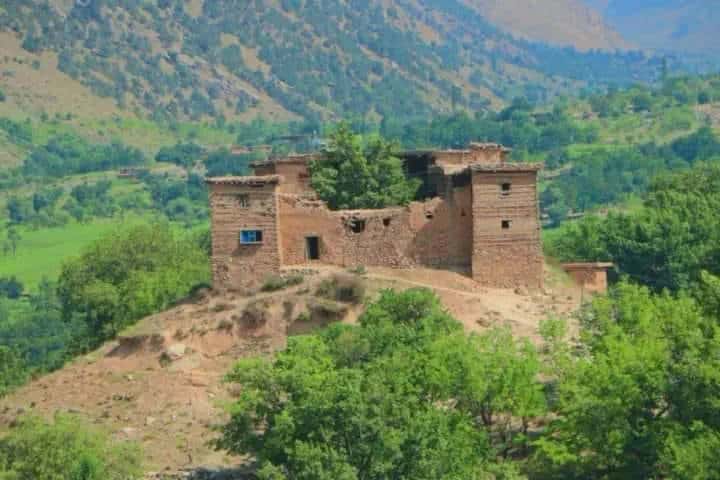
What the languages say, which is a great deal
The strongest evidence about Nuristani origins is not biological at all. It is in the languages, and it is firmer than anything a sample of five can give.
Georg Morgenstierne established in the first half of the twentieth century that the Nuristani languages are not Iranian like Pashto and Persian, nor Indo-Aryan like Hindi and the Kalasha of Chitral, but a third branch of Indo-Iranian standing between them. The argument runs on sound changes. The ancestors of the Nuristani languages shared the earliest changes that define Indo-Iranian, took one later change that marks Iranian, which is why Kamviri says duts for ten where Sanskrit has dasha, and then did not take the changes that completed the Iranian branch. They later picked up Indo-Aryan habits from their neighbours. That pattern places the split very early, around the break-up of Indo-Iranian itself, and it means the Nuristani languages have no connection with Greek beyond the distant common Indo-European root that Greek shares with English and Persian too.
Not every authority draws the tree the same way. Glottolog, the standard reference catalogue, files Nuristani under a node it calls Iranian-Nuristani, making it the sister of the whole Iranian branch rather than a third branch equidistant from both. Richard Strand, who has worked on these languages since 1967, calls his own reconstruction of the history a best-guess scenario. That is the proper register for all of this.
What our own traditions say
Earlier writers assumed that Nuristanis were the first Indo-Europeans into the Hindu Kush, pushed up into the high valleys as later waves arrived. Strand points out that those writers did not know the oral traditions. Several Nuristani groups place their people at Kama, at the north-eastern side of the meeting of the Kabul and Kunar rivers, until about a thousand years ago, having come there by way of Kandahar, Kabul and Kapisa, pushed by the advance of Islam. When Mahmud of Ghazni took the Kabul valley, the tradition runs, they fled into the sparsely inhabited interior of the upper Pech and Laghman valleys, displacing the people already there. By their own account, Strand writes, the Nuristanis were late arrivals in the region.
What makes this more than one scholar's reading is that Robertson heard a version of it at Kamdesh in 1890, a century earlier. The Kom told him their people had been Arabs, some said of the Quraysh tribe, who after many vicissitudes in the fighting over the spread of Islam found themselves at Kandahar and later at a place in Ramgal. The Arab pedigree is almost certainly fiction: the anthropologist Augusto Cacopardo notes that the supposed connection runs through a Quraysh man who was an enemy of the Prophet, which makes the story a claim to pre-Islamic antiquity rather than to Arab blood. But the route through Kandahar is the same route, recorded independently a hundred years apart.
Robertson, who was honest about his limits, wrote that with no literature and no writing in Kafiristan it was hardly possible to do more than guess in an unscientific way at the traditions people repeated. He also recorded a Katir account that their tribe had split in two, the wealthy half going to London and the rest settling in Kafiristan, with a warning not to believe the Kom if they claimed kinship with him, since the Kom were really more akin to the Russians. It is a useful reminder of how pedigrees work when a stranger with power is listening.
Where the Greek story came from
Cacopardo traced the legend's paper trail in 2011, and it does not begin in Nuristan. Traditions of descent from Alexander belonged to the Muslim princely houses of these mountains, recorded by Marco Polo for the kings of Badakhshan and later claimed by rulers in Hunza, Nagar, Skardu and Chitral. They cannot predate Islam in the region. The idea was attached to the Kafirs by Mountstuart Elphinstone, who in 1809 connected them with a different Alexander-descended tribe mentioned in a Mughal chronicle; the mistake was identified and explained in 1882 and went on being repeated anyway, because, as Cacopardo puts it, the thought that the Hindu Kush might conceal stray descendants of Alexander's colonists had deeply fascinated British writers.
The oral traditions of the Nuristanis, he writes, make no mention of the Greeks or of Alexander. He found a single instance in the whole literature of Kafirs saying their ancestors came with Alexander: a delegation to the Afghan commander Ghulam Haidar in May 1891, four years before the conquest, which he reads as a people in mortal danger presenting themselves as kin to the powerful empire next door. Something similar happened at Jalalabad in 1839, when a delegation claimed kinship with the British. Robertson's own book never mentions Macedonians, and his one remark about Greece suggests cultural influence on Kafir rituals and furniture by way of the Greek colonists of the region, not descent.
That the idea proved so hard to kill owes something to who wanted it. The German Hindukush Expedition of 1935 travelled through these valleys ostensibly looking for the ancestor of wheat. Its doctor, Albert Herrlich, an anthropologist, was interested in what he called the last riddle of Central Asia, and the party measured the heads of 250 Nuristanis looking for Aryan traces. Herrlich sorted the people he met into three types, the third tall, blond and blue-eyed, of whom he wrote that if you dressed such a man differently and brought him to Germany he would not stand out at all, and would probably be taken for a Tyrolean. The expedition was funded by the German research council, and the framework it worked in was the one that divided humanity into the worthy and the unworthy. Skull measurement establishes nothing about ancestry. The idea of a lost European tribe in the Hindu Kush has that history attached to it, and it is a good reason to be wary.
Are Nuristanis Pashtuns, then, or something else?
Nuristanis are Nuristanis. Afghanistan's 2004 constitution lists the nation as comprising Pashtun, Tajik, Hazara, Uzbek, Turkman, Baluch, Pachaie, Nuristani, Aymaq, Arab, Qirghiz, Qizilbash, Gujur, Brahwui and other tribes, and adds that the word Afghan applies to every citizen. It names Nuristani among the country's languages and makes it a third official language where most people speak it. Linguistically the gap with Pashto is thousands of years deep: Pashto is an Eastern Iranian language, Nuristani is a branch of its own, and a Pashto speaker and a Kamviri speaker cannot follow each other.
Genetically there is nothing to say, and that is the point. The five Nuristani men carry lineages that also occur among Pashtuns and Tajiks, because nearly everyone in this region shares a deep common ancestry that long predates any of the names we use. A landmark survey of human genetic variation found that differences between individuals within a population account for ninety-three to ninety-five per cent of all genetic variation, and differences between the major groupings of humanity for three to five per cent. Who a people are is a matter of language, descent, memory and history. It cannot be read off a chromosome, and in our case nobody has tried.
What we would like to see
It would not be difficult to do this properly. A study that sampled Nuristani men and women across the valleys, with consent, with the results explained to the people who gave them and published where they can read them, would settle a good deal of what this page has had to leave open. It would need the languages, the permissions and people the villages trust, which is work our team does for researchers already.
Until then, the honest answer to where Nuristanis come from is the one our grandparents give: from the valleys, by way of Kama and Kandahar, a long time ago. It is a better answer than the legend, and unlike the legend, two independent records a century apart agree on it.
Read on
- Who are the Nuristani people? Origins, tribes and daily life
- Why some Afghans have blue eyes and blonde hair
- Why do some Pashtuns have light eyes?
- The Nuristani languages: a branch of their own
- The Kalash people, and what their DNA studies found
- Kafiristan: the history of Nuristan before 1896
- Is The Man Who Would Be King a true story?
- Nuristani names: the surname and the names before it
Questions people ask
Has anyone studied Nuristani DNA?
Barely. No published study has set out to sample Nuristanis and describe their ancestry. The only Nuristani genetic data in print is five men in the supplementary tables of a 2012 survey of Afghanistan's Y chromosomes, where they are spelled Nurestani and Norestani. There is no published Nuristani maternal DNA, no genome-wide data and no ancient DNA from Nuristan. The team that studied the neighbouring Kalash wrote that a survey including Nuristan would be needed to understand their origins.
What Y-chromosome haplogroups do Nuristanis have?
The five Nuristani men in the 2012 Afghan survey carried three lineages: three had R1a1a-M17, one R2a-M124 and one J2a-M410. All three are ordinary lineages of the region, found from India and Pakistan through Iran to Central Asia. Five men support no percentage and no conclusion about Nuristanis as a people, and the authors drew none.
Is there genetic evidence that Nuristanis descend from Alexander's soldiers?
No evidence has been found, and the question has barely been tested on Nuristanis at all. In the neighbouring Kalash, one group of geneticists found no support for Greek descent and another found a West Eurasian admixture signal from roughly the last millennium BCE and wrote that whether it involved Alexander's armies is an unresolved question. The only reasonably solid Y-chromosome trace of Greek ancestry in the whole region turned up in Pashtuns, not in Nuristanis or the Kalash.
Are Nuristanis related to the Kalash of Chitral?
Closely in culture and history, and nobody has tested the genetic side properly. The Kalash kept a religion related to the one Nuristan left in 1896 and live over the passes in Chitral, and the Waygal valley's own language carries the same name, Kalasha. Their DNA has been studied in detail; ours has not, which is exactly the gap the Kalash researchers pointed out.
What ethnicity are Nuristanis?
Nuristani. Afghanistan's 2004 constitution lists Nuristanis among the fourteen named peoples of the nation, separately from Pashtuns, Tajiks, Hazaras and the rest, and names Nuristani among the country's languages. The languages are a branch of Indo-Iranian of their own, so Nuristanis are an Indo-Iranian people of the eastern Hindu Kush, Muslims since 1896, with their own history.
Where do Nuristanis come from?
Their own traditions and the linguistic evidence agree on a long journey. Richard Strand recorded traditions among several Nuristani groups placing them at Kama, where the Kunar meets the Kabul river, until about a thousand years ago, having come by way of Kandahar, Kabul and Kapisa, and fleeing into the high valleys when Mahmud of Ghazni took the Kabul valley. Robertson recorded a version of the same journey through Kandahar at Kamdesh in 1890. By their own account Nuristanis were late arrivals in these particular valleys, after a much older history on the edge of the Iranian-speaking world.
What does the Nuristani language say about Nuristani origins?
More than the genetics does. Georg Morgenstierne established that the Nuristani languages are a third branch of Indo-Iranian, beside Iranian and Indo-Aryan, because they share the earliest Indo-Iranian changes but not the later ones that mark the other two. That makes the split very old, around the break-up of Indo-Iranian itself, and it rules out any close connection with Greek beyond the common Indo-European inheritance both share with English and Persian.
Did the 1935 German expedition prove anything about Nuristani ancestry?
No. The German Hindukush Expedition of 1935 travelled through Nuristan ostensibly to find wild wheat, and its doctor, Albert Herrlich, measured the heads of 250 Nuristanis looking for Aryan traces, in the race science of the day. Craniometry establishes nothing about ancestry, and the theory behind it was the one that divided people into worthy and unworthy. It is the pedigree of the lost European tribe idea, and a reason to be wary of it.
Sources
- Haber and others, Afghanistan's ethnic groups share a Y-chromosomal heritage structured by historical events (PLoS ONE, 2012). The five Nuristani men are in supplementary Tables S2 and S4
- Di Cristofaro and others, Afghan Hindu Kush: where Eurasian sub-continent gene flows converge (PLoS ONE, 2013), the main Afghan maternal dataset, which contains no Nuristani samples
- Lacau and others, Afghanistan from a Y-chromosome perspective (European Journal of Human Genetics, 2012)
- Ayub and others, The Kalash genetic isolate: ancient divergence, drift, and selection (American Journal of Human Genetics, 2015), including the call for a survey in Nuristan
- Hellenthal and others, The Kalash genetic isolate? The evidence for recent admixture (American Journal of Human Genetics, 2016), the letter with the unresolved-question sentence
- Ayub and others, Response to Hellenthal and others (American Journal of Human Genetics, 2016)
- Hellenthal and others, A genetic atlas of human admixture history (Science, 2014), for the Kalash admixture date
- Rahman and others, Exploring European ancestry among the Kalash population: a mitogenomic perspective (Zoological Research, 2020)
- Firasat and others, Y-chromosomal evidence for a limited Greek contribution to the Pathan population of Pakistan (European Journal of Human Genetics, 2007)
- Mansoor and others, Investigation of the Greek ancestry of populations from northern Pakistan (Human Genetics, 2004)
- Narasimhan and others, The formation of human populations in South and Central Asia (Science, 2019), for the Swat ancient DNA; the paper does not mention Nuristan
- Rosenberg and others, Genetic structure of human populations (Science, 2002), for the 93 to 95 per cent figure
- G. F. Debets, Physical Anthropology of Afghanistan (Peabody Museum, 1970), translated by Eugene V. Prostov: the Kati and Ashkun samples, the comparison tables and his own interpretation
- Richard F. Strand, Peoples and Languages of Nuristan, and the history and traditions pages (nuristan.info)
- Glottolog: the Nuristani family, classified under a node named Iranian-Nuristani
- George Scott Robertson, The Kafirs of the Hindu-Kush (1896), chapter XI on origins and appearance
- Augusto S. Cacopardo, Are the Kalasha really of Greek origin? The legend of Alexander the Great and the pre-Islamic world of the Hindu Kush (Acta Orientalia, 2011)
- Thomas Ruttig, The hunt for the holy wheat grail: a not so botanical expedition in 1935 (Afghanistan Analysts Network, 2015)
- Constitution of Afghanistan (2004), Articles 4 and 16