Waygali-ala, the language of Waygal
The books call it Kalasha-ala, Waigali or Nuristani Kalasha. In the valley we call it Waygali-ala, and it is the language this site's team grew up speaking. Where it is spoken, how it works, who wrote it down, and how it stands.
What we call it, and what the books call it
Waygali-ala is the Nuristani language of the Waygal valley in southern Nuristan, spoken in the villages of Waygal, Ameshdesh, Jamach and Zhonchigal in the upper valley, in Nishigram, Kegal, Akun and Muldesh in the lower, in the hamlet of Want, and in a few settlements over the ridges on the Kunar side. Alâ means language, so Waygali-ala is the language of Waygal, and that is the name people in the valley use for it, or simply Waygali. This site's team is from the valley, and this is the language of our homes.
The scholars' names are different and it helps to know them. The Linguistic Survey of India recorded Wai-ala, the language of the Wai, from speakers in Waygal village in 1919; Georg Morgenstierne changed it to Waigeli in 1926 and Waigali in 1954, and that spelling is still the official one in the ISO code wbk and in Glottolog. Speakers who were asked for the language's own name gave Kalaṣa-alâ, the Kalasha language, after the name the people of the valley use for themselves, and that is the form in Almuth Degener's grammar and Samiullah Taza's dictionary. In 2021 the linguist Jakob Halfmann proposed Nuristani Kalasha, to keep it apart from the Kalasha of Chitral in Pakistan, an Indo-Aryan language that shares the name and nothing closer. All of these are one language. On this site it is Waygali-ala.
- Own name
- Waygali-ala; Kalasha-ala in the books
- Family
- Nuristani branch of Indo-Iranian
- Group
- Southern, with Ashkun and Tregami
- Where
- The Waygal valley, Waygal and Want districts
- Speakers
- About 10,000 to 12,000 on published estimates; Strand says perhaps 10,000 to 30,000
- Dialects
- Upper valley (Varjan) and lower valley (Chima-Nishei)
- Codes
- ISO 639-3 wbk; Glottolog waig1243
- UNESCO status
- Definitely endangered (2010)
Nine villages and a hamlet
The Waygal river runs south off the lower Pech, and the language runs the length of it, in two halves that sound different.
Richard Strand, who has worked on the Nuristani languages since 1967, names the villages. The upper valley is the country of the Väi, also written Vai or Wai, whom their neighbours call Varjan, the upper people: Waygal village itself, Ameshdesh, Jamach and Zhonchigal, with the side valleys that run off them, Arans and Sewketra among others. The lower valley belongs to the Chima-Nishei: Nishigram, with outlying settlements in the Charigal and Shinagal valleys, and Muldesh, Kegal and Akun. Between them sits the hamlet of Want, whose people came as refugees from Tregam and are counted as neither. Since 2023 the lower valley has been Want district, and the upper remains Waygal district.
The language has also crossed the ridges. Strand records Waygali-ala speakers in the Veligal, Chuki and Dungal valleys off the middle Kunar, where the Kshto people of Dungal speak it, and a colony at Zamia in the Chapa Dara valley, west along the Pech, whose speech the Russian linguist Aleksandr Grjunberg studied in 1963 under the name Zemiaki. Its people, four or five hundred of them, are said to have left Nishigram after a quarrel some centuries ago, and their language has drifted far enough that it has no grammatical gender and a great many Pashto words.
How many speakers there are nobody knows. Ethnologue's figure, as Wikipedia reports it, is ten to twelve thousand from 2011; Strand writes perhaps ten to thirty thousand; the Joshua Project counts thirty-six thousand people in the ethnic group. Waygal district alone had an estimated 19,100 people in 2010, before Want was split from it. The honest range is somewhere between ten and thirty thousand, and the lower figures are the ones most often printed.
Two dialects, and people who can tell them apart in a word
Strand calls the split between the Väi and the Chima-Nishei a major dialect division, with minor differences from village to village on top of it, most of all among the upper villages. Taza, who is from Zhonchigal, writes of the war-jen, the upper people, and the ber-jen, the lower people. The lower dialects have taken on something from Ashkun, their neighbour to the west.
The differences are the kind families notice at once. Mother is ei in Waygal village and iei in Nishigram; father is tata above and tâti below; a woman is däbili above and meši below. The upper valley keeps long and short vowels apart, so that hand is dōšt in Zhonchigal and dost in Nishigram, and the lower valley does not. Degener's grammar and Strand's lexicon both describe Nishigram; Taza's dictionary describes Zhonchigal; Waygal village itself, the largest, has had least written about it.
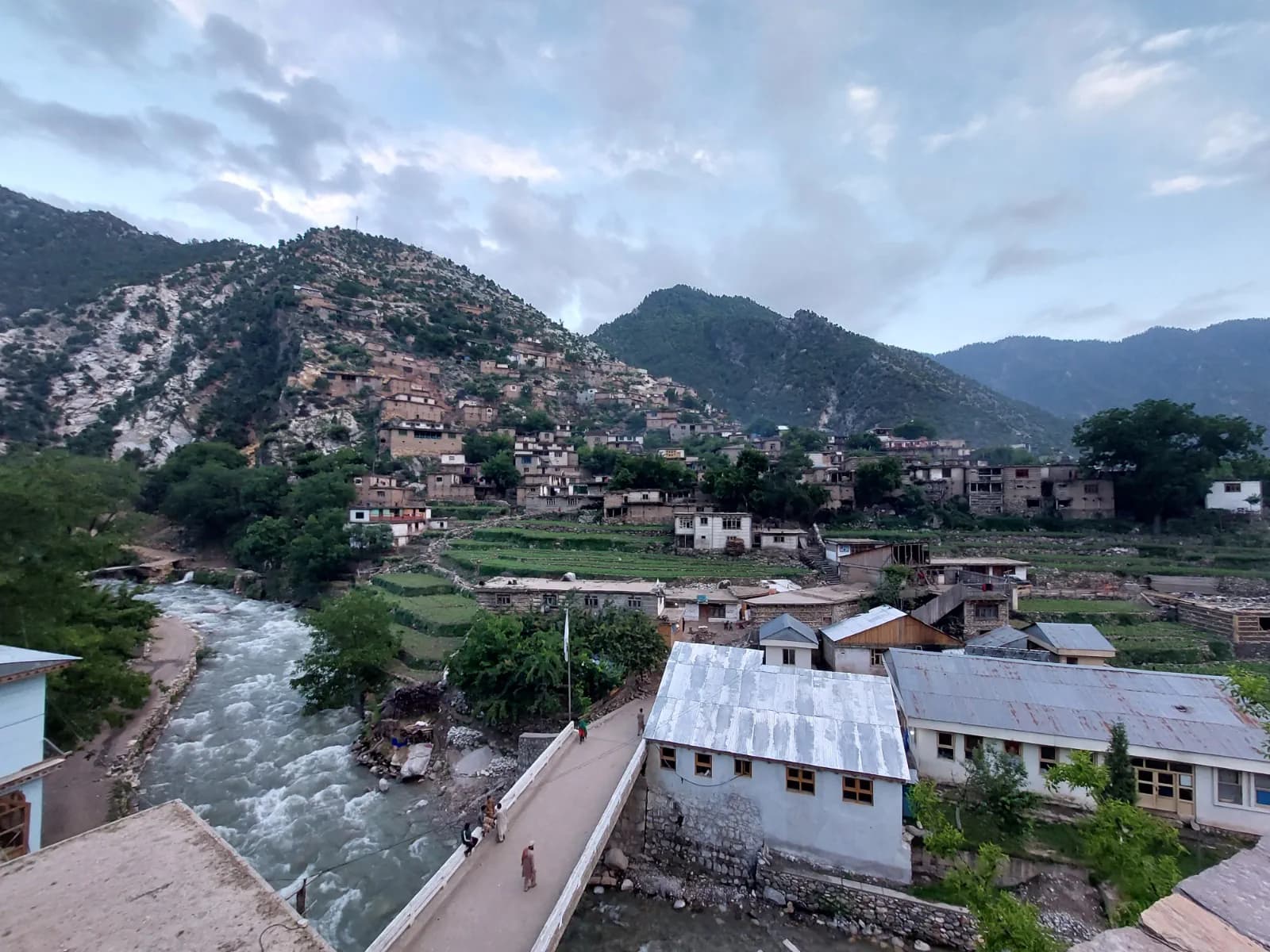
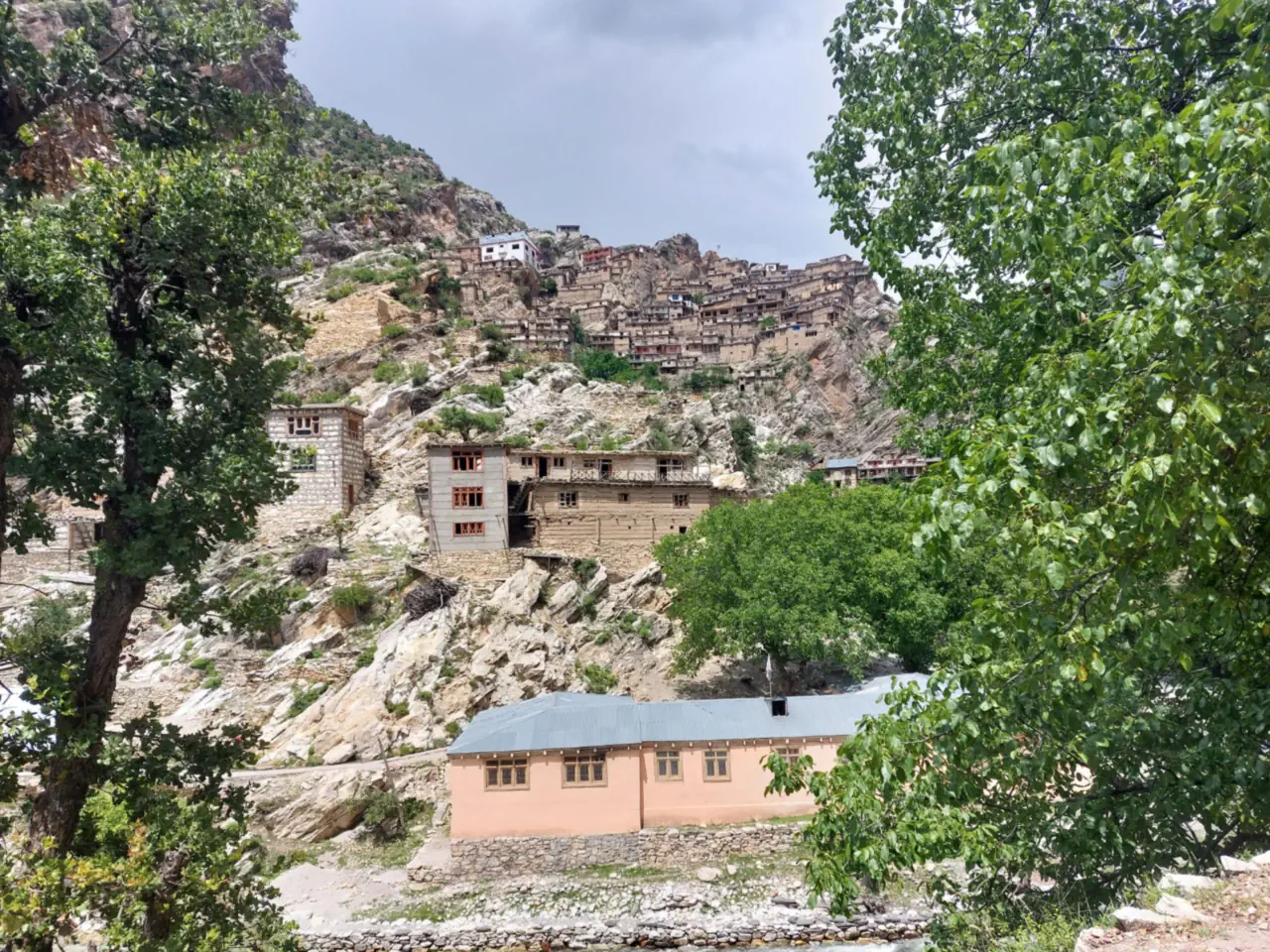
A village in the Waygal valley, photographed by our own team.
A southern Nuristani language, and the other Kalasha
Strand places Waygali-ala with Ashkun and Tregami in the southern group of the Nuristani languages, against Kati and Prasun in the north, on the strength of sound changes they share. Tregami, in three villages of the Tregam valley just east, is so close in vocabulary that Morgenstierne put its words into his Waygali dictionary, and Glottolog now files the two together in a single node; whether Tregami is a separate language or a third dialect of ours is still, in Halfmann's words, an open question. Zemiaki in Chapa Dara is a fourth offshoot.
The Nuristani languages as a whole form their own branch of Indo-Iranian, beside Iranian and Indo-Aryan, a position Morgenstierne argued for in 1926 and most linguists accept. Halfmann's 2025 book goes further and argues that the branch is historically closer to Iranian than to Indo-Aryan, while noting that Waygali-ala, Kati, Ashkun and Tregami have been so shaped by contact with Indo-Aryan neighbours that in many respects they look like New Indo-Aryan languages. That contact is why Waygali-ala's word for tongue, ǰip, and its word for ten, doš, are borrowings, while Kati keeps the older duć.
Then there is the name. The Kalasha of Chitral, across the border in Pakistan, speak Kalasha-mun, an Indo-Aryan language of the Chitral group related to Khowar, and keep a religion related to the one our valleys left in 1896. The two peoples share the name Kalasha and old ties, and nothing closer in language than cousins. Strand records a Väi tradition that a group from Waygal invaded lower Chitral in the fifteenth century and gave the name to the people there; Halfmann writes that we cannot yet say which group had the name first. Both are set out on our page about the Kalasha language, which compares the two word by word.
Sounds, cases, twenties and hearsay
What a learner notices first, from Strand's description of the Nishigram dialect and Degener's grammar.
Waygali-ala has the retroflex consonants that mark the whole Nuristani family, made with the tip of the tongue curled back: ṭ, ḍ, ṣ, ẓ, ṇ, a retroflex flap ṛ that Strand describes as a forward-moving flap of the tongue tip, and ň, a strongly nasalised retroflex sound heard between vowels. Beside them are three sets of ch and j sounds, dental, retroflex and palatal, which outsiders struggle to tell apart. The vowels include ü, ö and ä, fronted vowels that Persian and Pashto lack, and nasal vowels, as in pũč, five. Stress usually falls on the last syllable of a word.
The grammar is of the Nuristani kind. The verb comes at the end of the sentence and the describing word before the thing described. Nouns have cases, a direct form, an oblique form that also carries the plural, and endings for instrument and place, with a possessive built on the oblique. Nouns are masculine or feminine, which shows in agreement rather than in the noun itself. Words for relatives must carry a marker for whose relative they are. The way the doer of an action is marked changes with the tense, the pattern linguists call split ergativity, and the verb has different helping words for what is close at hand, what is going on, and what is past and done.
- Counting goes in twenties. Twenty is viši, forty dü viši, two twenties, sixty tre viši, and a hundred pũčči, five twenties. Persian and Pashto count in tens; so did the Nuristani languages' Indo-Iranian ancestor, and the twenties were picked up from the mountains, as the Dardic languages next door picked them up too.
- There is a word, le, that marks what you are saying as something you were told rather than something you saw. Kati has mem and Kata-vari mma for the same job. Stories begin with it.
- Thank you is ṣaṣü bü; for a gift of ghee or cheese the thanks is par bü; and par böi is what you say when you pass someone on a path. These are Strand's Nishigram phrases, and the greetings of our own valley will be added here with recordings.
From a word list in 1860 to a two-thousand-page dictionary in 2017
The first Waygali words in print were collected by Harry Lumsden in 1860 from men he met on a mission to Kandahar, mixed with Tregami and not separable. George Scott Robertson, who lived at Kamdesh in 1890 and 1891, called the valley's people Waigulis and could do no more than note that they spoke a tongue quite different from their neighbours'. The 1911 Britannica, following him, listed the chief Wai villages and recorded that children from any valley picked up the Wai speech easily. The Linguistic Survey of India took down the name Wai-ala in 1919.
Georg Morgenstierne, the Norwegian who put the whole family on the map, published the first grammatical sketch and vocabulary, The Waigali Language, in 1954, after fieldwork that included a journey through the valleys in 1949. Georg Buddruss of Mainz spent 1969 and 1970 recording stories at Nishigram and in Kabul, and the forty-three texts he brought back became the basis of the fullest grammar there is, Almuth Degener's Die Sprache von Nisheygram im afghanischen Hindukusch, published in 1998 with nearly six hundred pages of analysis, texts and glossary. Degener went on to publish Waygali songs about the Islamisation of Kafiristan, hunters' lore and proverbs from the valley.
Strand recorded Nishigram speech from Muhammad Alam Melabâr, a graduate student at Indiana University in 1971, and again during two months in the Waygal and Parun valleys in 1974; Melabâr, Strand records, was later tortured to death in a communist prison for having studied in America. Strand's online lexicon of about 1,900 words is the one free dictionary of the language. The other is the work of a native speaker: Samiullah Taza of Zhonchigal, who printed an alphabet for the Nuristani languages in 1995, a collection of the valley's oral literature in 2000, and in 2017, with SIL in Kabul, a dictionary of Kalaṣə-alā with Pashto and Dari meanings that runs to about two thousand pages. Buddruss's recordings are kept in the Language Archive at Cologne and three tapes at Indiana. The latest scholarship is Halfmann's, in 2021 and 2025.
What the books cannot give you
Everything above was written by people who visited. The language lives in houses like ours, in the greetings on the path, the proverbs our grandparents used and the songs sung at weddings and at the maize harvest. Very little of that is on paper, and the oldest speakers who hold the most of it are leaving us.
We are recording what we can: a greeting, a counted ten, a few lines of a song, from as many villages as we can reach, and we will publish them on this page with the speaker's name and village. If your family is from Waygal, send us a minute on your phone.
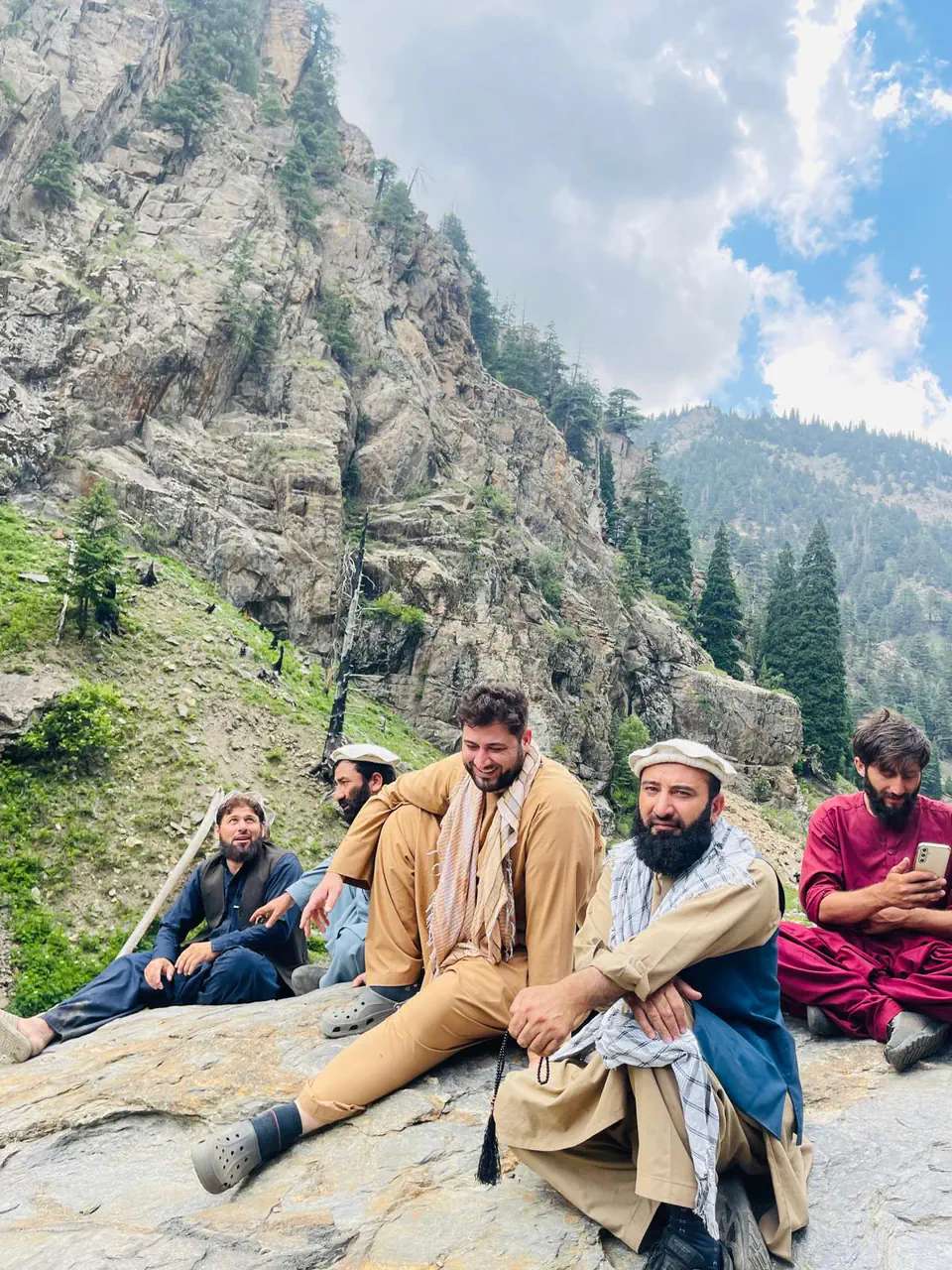
Our director with family and friends in Waygal. Our own photograph.
Who the speakers are
The people of the valley call themselves Kalasha, and Strand counts at least three distinct peoples under the name: the Väi of the upper valley, the Chima-Nishei of the lower, and the Vântä of Want. Their own traditions, as Strand recorded them, say that the Väi fled a Ghaznavid invasion of the Kama region near Jalalabad in the eleventh century, followed the Kunar north and crossed into Waygal, and that the Chima-Nishei descend from Ashkun-speaking settlers from the Titin valley who took the lower basin, drove its earlier inhabitants out into Tregam, and adopted the Väi language. Taza, writing from inside, gives the name a wider reach: one of the great tribes of the Nuristani people, taking in the Ashkun country and Wama as well as Waygal and the three villages of Tregam.
In the 1890s outsiders divided Kafiristan into three: the Siah-Posh of the Bashgal, the Waigulis, and the Presun of Parun. The Waygal people were converted with the rest in the winter of 1895 to 1896, and the songs about that winter, sung in Waygali-ala, were still being recorded by Degener a century later. In 1949, Strand notes, the Kalasha sided with the government against their Safi Pashtun neighbours. The valley fought again in 2008 at Wanat, which has its own page here. Through all of it the language stayed the language of the home.
Numbers in Waygali-ala
Richard Strand's Nishigram forms, the same ones used on our words page. Each can be checked against the entries on Wiktionary, which cite his etymological lexicon of 2016.
| Number | Waygali-ala |
|---|---|
| 1 | ev |
| 2 | dü |
| 3 | tre |
| 4 | čatâ |
| 5 | pu˜č |
| 6 | ṣu |
| 7 | sot |
| 8 | oṣṭ |
| 9 | nu |
| 10 | doš |
| 20 | viši |
| 100 | pu˜čči |
Four, čatâ, shows the fronted ch sound that Waygali-ala shares with Tregami and the northern languages do not have. Six, ṣu, keeps the Nuristani word but with a retroflex ṣ taken from Indo-Aryan. Ten, doš, is a borrowing from an Indo-Aryan neighbour; the inherited Nuristani ten survives in Kati's duć. Twenty is viši, and from there the counting goes in twenties: dü viši is forty, tre viši sixty, and pũčči, five twenties, a hundred.
These are the lower-valley forms. In the upper valley the vowels run longer, and a few words differ; we will add the Waygal village forms, spoken, as our recordings come in.
How endangered is Waygali-ala?
Waygali-ala is still learnt at home in every village of the valley, and it is still unwritten, unschooled and unbroadcast. Both things are true, and the assessments below put dates to them.
| Source | What it says |
|---|---|
| UNESCO Atlas of the World's Languages in Danger, 2010 | Waigali: definitely endangered, the same class as Kati, Ashkun and Prasun. In UNESCO's scale this means children no longer learn the language as a mother tongue in the home in some part of its area, or are not expected to in the next generation. In the Waygal valley itself children still learn it; the pressure is in the lower villages and the towns. |
| Richard Strand, 1998 to 2011 | Population perhaps 10,000 to 30,000. The Nuristani languages have no tradition of writing. Strand's 1,900-word Nishigram lexicon is online and free. |
| Ethnologue, as reported by Wikipedia (2011 figure) | About 10,000 to 12,000 speakers, and 76 to 80 per cent lexical similarity with Tregami. Ethnologue's own page could not be read when this page was written. |
| Glottolog and the Catalogue of Endangered Languages, 2022 | Agglomerated Endangerment Status: shifting. The Catalogue rates it threatened, with the note that the judgement is 20 per cent certain on the evidence available. |
| Constitution of Afghanistan, 2004 (suspended since 2021) | Article 16 made Nuristani a third official language in the areas where most people speak it, alongside Pashto and Dari, and Article 43 promised teaching in mother tongues. Neither was put into practice in Waygal; schooling has always been in Pashto and Dari. |
| The dictionaries | Two exist: Strand's online lexicon of the Nishigram dialect, and Samiullah Taza's trilingual dictionary of about two thousand pages, printed in Kabul in 2017 and hard to find outside Afghanistan. There is no agreed alphabet; people who write the language spell by ear in the Arabic script they learnt for Pashto. |
Help us record them
We are gathering recordings from the valleys: a greeting, a proverb, a few lines of a song, counted numbers, in each language and as many dialects as we can reach. If you or your family speak a Nuristani language, record a minute on your phone, tell us who is speaking and where they are from, and send it to us. We will credit every voice and publish the recordings here.
Asked about Waygali-ala
What language is spoken in the Waygal valley?
Waygali-ala, one of the five Nuristani languages, which the books call Kalasha-ala, Waigali or Nuristani Kalasha. It is spoken in Waygal, Ameshdesh, Jamach, Zhonchigal, Nishigram, Kegal, Akun, Muldesh and Want, and in a few settlements on the Kunar side. Everyone in the valley also speaks Pashto, and most speak Dari.
Is Waigali the same as Kalasha?
Waigali, Kalasha-ala and Waygali-ala are the same language, the Nuristani language of the Waygal valley. The Kalasha language of Chitral in Pakistan, Kalasha-mun, is a different language of the Indo-Aryan family. The two peoples share the name Kalasha and old ties, and their languages are cousins rather than siblings.
How many people speak Waygali-ala?
Nobody has counted. Ethnologue's figure, as reported by Wikipedia, is about 10,000 to 12,000 speakers from 2011; Richard Strand gives perhaps 10,000 to 30,000; the Joshua Project counts about 36,000 people in the ethnic group. Waygal district alone had an estimated 19,100 people in 2010.
What are the dialects of Waygali-ala?
Two main ones. The upper valley, the Väi or Varjan villages of Waygal, Ameshdesh, Jamach and Zhonchigal, and the lower valley, the Chima-Nishei villages of Nishigram, Kegal, Akun and Muldesh, with smaller differences from village to village and the speech of Want between them. The upper dialect keeps long and short vowels apart; the lower has taken on something from Ashkun. Zemiaki in Chapa Dara is an offshoot of the lower dialect.
Is Waygali-ala endangered?
UNESCO rated it definitely endangered in 2010, and Glottolog records it as shifting. In the valley it is still the language of every home, but it is unwritten, it is not taught in schools, which run in Pashto and Dari, and it is not broadcast. The pressure is strongest in the lower villages near the road and among families who have moved to the towns.
Is Waygali-ala written?
Not in daily life. There is no agreed alphabet; Samiullah Taza printed one for the Nuristani languages in 1995 and his dictionary of 2017 uses the Arabic script, while Strand and Degener use Roman transcriptions. People who write the language at home spell by ear in the letters they learnt for Pashto.
What does Waygali-ala mean?
The language of Waygal. Alâ is the word for language, and the same ending appears in Nishei-alâ, the language of Nishigram, and Kalasha-ala, the language of the Kalasha, which is the name speakers gave the scholars. Waigali, the scholars' spelling, comes from the Pashto and Persian name of the valley, Waigal.
Can I get something translated into Waygali-ala?
Yes. Our team speaks it as a first language and translates and interprets between Waygali-ala, Pashto, Dari and English, for researchers, broadcasters and organisations working in the valley. There is a page about that service on this site.
On this site
- Waygali-ala translation and interpreting, by people from the valley
- The Nuristani languages, valley by valley
- Words and numbers in the five languages, side by side
- The Kalasha language of Chitral, and the other Kalasha
- Tregami, the three-village language next door
- Waygal district: the valley, its villages and how to reach it
- Want district, the lower valley
- The Sewketra valley, where our family is from
- Nuristani music and dance: the songs of Waygal
- Richard F. Strand, The Kalaṣa of Kalaṣüm (nuristan.info, 1998, revised 2011)
- Richard F. Strand, The Sound System of Nišei-alâ (nuristan.info, 2011)
- Richard F. Strand, Kalaṣa-alâ Lexicon: the Nišei-alâ dialect, about 1,900 entries (nuristan.info, 2011 to 2019)
- Richard F. Strand, Nurestâni languages, Encyclopaedia Iranica (2000, updated 2018)
- Richard F. Strand, Ethnolinguistic and genetic clues to Nûristânî origins, International Journal of Diachronic Linguistics and Linguistic Reconstruction 19 (2022), pages 267 to 353
- Jakob Halfmann, Terminological proposals for the Nuristani languages, Himalayan Linguistics 20(1), 2021, pages 28 to 64, on the names, the dialects and Taza's dictionary
- Jakob Halfmann, The Diversification of Indo-Iranian and the Position of the Nuristani Languages (Reichert, 2025)
- Georg Morgenstierne, The Waigali Language, Norsk Tidsskrift for Sprogvidenskap 17 (1954), pages 146 to 324 (Strand's bibliography)
- Almuth Degener, Die Sprache von Nisheygram im afghanischen Hindukusch (Harrassowitz, 1998), reviewed by Richard Salomon, Journal of the American Oriental Society 120.3 (2000)
- Almuth Degener, list of publications (University of Mainz)
- Glottolog: Nuristani Kalasha (waig1243), classification and endangerment
- ISO 639-3: wbk, Waigali
- Christopher Moseley (ed.), Atlas of the World's Languages in Danger, third edition (UNESCO, 2010), as tabulated for Afghanistan
- Constitution of Afghanistan (2004), Articles 16 and 43
- Nuristani Archive Cologne: the Waigali recordings in the Language Archive Cologne and at Indiana
- Encyclopaedia Britannica, 1911: Kafiristan, on the Waigulis and the Wai villages
- Wiktionary, Waigali lemmas: the numerals, each citing Strand's Nûristânî Etymological Lexicon (2016)
- Wiktionary, Waigali Swadesh list, for the upper and lower valley forms compared
- Wikipedia: Nuristani Kalasha language and Zemiaki language, for the Ethnologue and Grünberg figures
Plan your Nuristan journey
Ready to plan a visit, source Nuristani products, or discuss an investment? Your message goes to Obaid, who is from Nuristan, and his team in Afghanistan and the UK. We reply to every message.