Tregami, the language of three villages
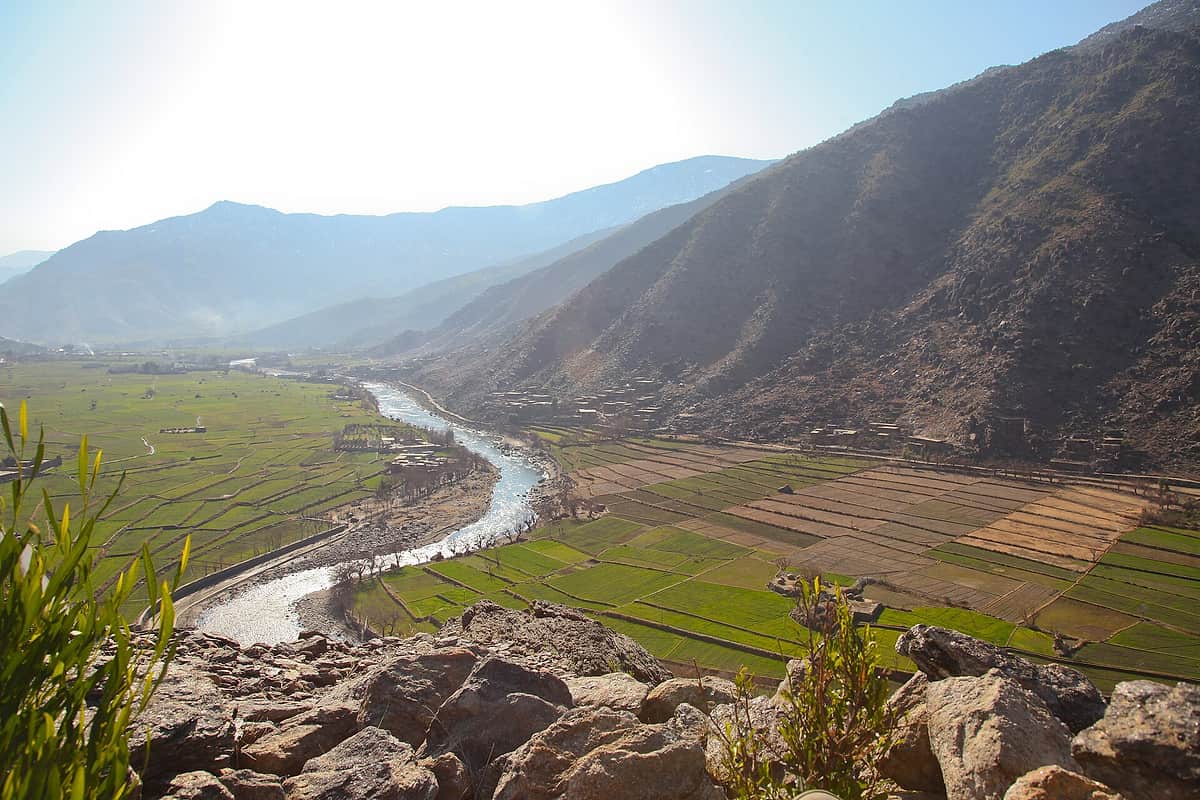
Gambir, Katar and Devoz, in side valleys of the Tregam valley off the lower Pech in Kunar: a Nuristani language just outside Nuristan's border, close kin to Waygali-ala, and the least recorded of the five.
A Nuristani language outside Nuristan
Tregami is the smallest and least documented of the five Nuristani languages. It is spoken in three villages, Katar, Gambir and Devoz, in the eastern side valleys of the Tregam valley, a northern tributary of the lower Pech river in Watapur district of Kunar province. The provincial line puts the three villages outside Nuristan, which is one reason so few people have heard of them. Tregam means three villages, a name given by the Indo-Aryan speakers of the lower valley.
Its words are so close to those of Waygali-ala, the language of the Waygal valley to the west, that the Norwegian linguist Georg Morgenstierne put the two into one dictionary. Its grammar, as far as anyone has recorded it, is different enough that he and most scholars since have counted it a language of its own. Everything published about it fits in a few dozen pages: a sixteen-page sketch from 1952 and a single folktale printed in 2022. Nobody has counted its speakers; the usual guesses run from three to five thousand, all of them bilingual in Pashto, and UNESCO rates it severely endangered.
- Family
- Nuristani branch of Indo-Iranian
- Group
- Southern, with Waygali-ala and Ashkun
- Where
- Tregam valley, Watapur district, Kunar
- Villages
- Katar, Gambir and Devoz
- Speakers
- About 3,000 to 3,500 on the usual guesses
- Closest relative
- Waygali-ala, with most of its vocabulary shared
- UNESCO status
- Severely endangered (2010)
- Written
- No. The name its speakers give it is unrecorded
Three villages off the lower Pech
The Tregam valley runs north from the Pech a little east of Nangalam. Its floor is Pashtun; the Nuristani villages are up the side valleys on its eastern slope.
Richard Strand, who has documented the Nuristani languages since the 1960s, places the Tregami in an area that takes in some eastern tributaries of the upper Tregam valley, and names the villages from lowest to highest as Katar, Gambir and Devoz, which is also called Davi. The valley itself is about eighteen kilometres long, walled by ridges that top three thousand metres, and its floor along the Gambir river is farmed by Safi Pashtuns. The whole valley held somewhere between ten and twenty thousand people when the US Army studied it in 2011; the Tregami villages are a small part of that.
The three villages are not alone on their slopes. After the Afghan conquest of Nuristan in 1895 and 1896 the Amir settled Shinwari Pashtun families among them to keep the Nuristani population in check, according to field notes by the anthropologist Lincoln Keiser that Strand reports, and the two peoples have lived intermixed ever since. In March 2022 Pajhwok Afghan News reported that Gambir and Katar still had no road and that people moved goods on animals, which is how the valley has kept its language this long.
Two names cause confusion. Katar, the Nuristani village, is not Katarqala on the valley floor, where an Indo-Aryan language called Wotapuri-Katarqalai was spoken until it went under Pashto in the twentieth century. And Tregami is not Zemiaki, the Nuristani speech of the village of Zamia in the Chapa Dara valley further west, whose people are said to have come from Waygal centuries ago.
A language, or a dialect of Waygali-ala?
The vocabulary says one thing and the grammar another, and the question is still formally open.
Strand groups Tregami with Waygali-ala, which the books call Kalasha-ala, and with Ashkun in the southern group of Nuristani languages, and says plainly that its vocabulary is close to Waygali-ala's. When Morgenstierne published his account of Waygali-ala in 1954 he folded his Gambir words into the same vocabulary, because on the whole they agreed closely and because in the older word lists the two could not be told apart. But from the scraps he had gathered about its grammar he judged that Tregami differed markedly, and on that account, he wrote, it must be reckoned a separate language.
That is where matters have stood for seventy years. ISO 639-3 gives Tregami its own code, trm. Glottolog, the reference catalogue of the world's languages, puts it in a single node with Waygali-ala that it calls Nuristani Kalasha-Tregami. The linguist Jakob Halfmann wrote in 2021 that whether Tregami is a separate language or a variety of Waygali-ala is still an open question, and that it is not yet clear whether the upper and lower dialects of Waygali-ala are closer to each other than either is to Tregami. More recorded speech is needed to settle it, and almost none has been recorded.
The people themselves draw the circle wider than the linguists. Samiullah Taza's Waygali-ala dictionary of 2017 says that the name Kalasha, in its broad sense, takes in the people of the Ashkun and Wama areas and the Waygal valley together with the three villages of Tregam. Strand notes the same: the name is used for neighbours who speak Ashkun and Tregami, not only for the Waygal people. Tregami speakers have a name for the valley in Waygali-ala, tregamä, but what they call their own language has never been written down.
What the sixteen pages tell us
Nearly everything known about how Tregami works comes from the pages Morgenstierne wrote after his journey to Afghanistan in 1949, published in 1952 under the heading Dialects of Tregam in the Norwegian journal of linguistics. He had very little time with the speakers. Strand's summary of that sketch, in his Encyclopaedia Iranica article on the Nuristani languages, gives the features that set Tregami apart.
- Its past tense does not work like its neighbours'. Most Nuristani languages mark the doer of a past action in a special way only in some constructions, a pattern linguists call split ergativity. Tregami, like Prasun, does not. Instead the doer of a past action takes a special pronoun of its own: in Morgenstierne's example, žepe to źyatem, I saw you.
- Its pronouns have three cases, one for the subject, one for the doer in the past, and one for the object. Strand thinks this came from contact with the Indo-Aryan languages next door.
- Its present tense is built with a k: źäkom, I see. Strand finds this reminiscent of the Pashai dialects spoken further down the Pech.
- Its sounds pattern with Waygali-ala in most of the historical changes Strand has traced, with some influence from Kata-vari, the Kati of the north, which fits the tradition that part of the population came from Kantiwa.
- There are small differences between the speech of Gambir, which Morgenstierne recorded, and Katar, and the Devoz dialect was not written down at all until Almuth Degener published a folktale in it in 2022.
- It is unwritten. Anyone who writes it would do so by ear in the Arabic script learnt for Pashto.
From a word list in 1860 to a folktale in 2022
The first outsider to write down Tregami words was Harry Lumsden, a British officer, who published a vocabulary of the Kafir language as spoken in Traieguma and Waigul in 1860, collected from men he met on a mission to Kandahar rather than in the valley. The Tregam words in it cannot be separated from the Waygal ones. The German expedition of 1935 passed close enough for Wolfgang Lentz to record the valley's name and learn that it meant three villages.
Morgenstierne's brief recording of 1949 and his sketch of 1952 remain, in Strand's words, all that is published on this language. Georg Buddruss, working in 1960 on the Indo-Aryan speech of Wotapur and Katarqala in the lower valley, confirmed that Tregami was a different thing altogether. Strand wrote about it in his 1973 survey of the Nuristani and Dardic languages, Aleksandr Grjunberg gave it a chapter in the Russian handbook of Dardic and Nuristani languages in 1999, and Strand's etymological lexicon of 2016 is the source of the numerals on this page.
Then, in 2022, Degener published The Wolf and the Kids in the Devozi dialect of Tregami, the first text in the language ever printed, in the proceedings of a workshop on the Nuristani languages held at Cologne in 2019. The same volume carried Irén Hegedűs's work towards a reconstruction of the parent language, which is why Glottolog now groups Tregami and Waygali-ala together. Halfmann's 2025 book on the position of the Nuristani languages uses Tregami forms throughout its comparisons. That is the whole library.
Tregam and Waygal
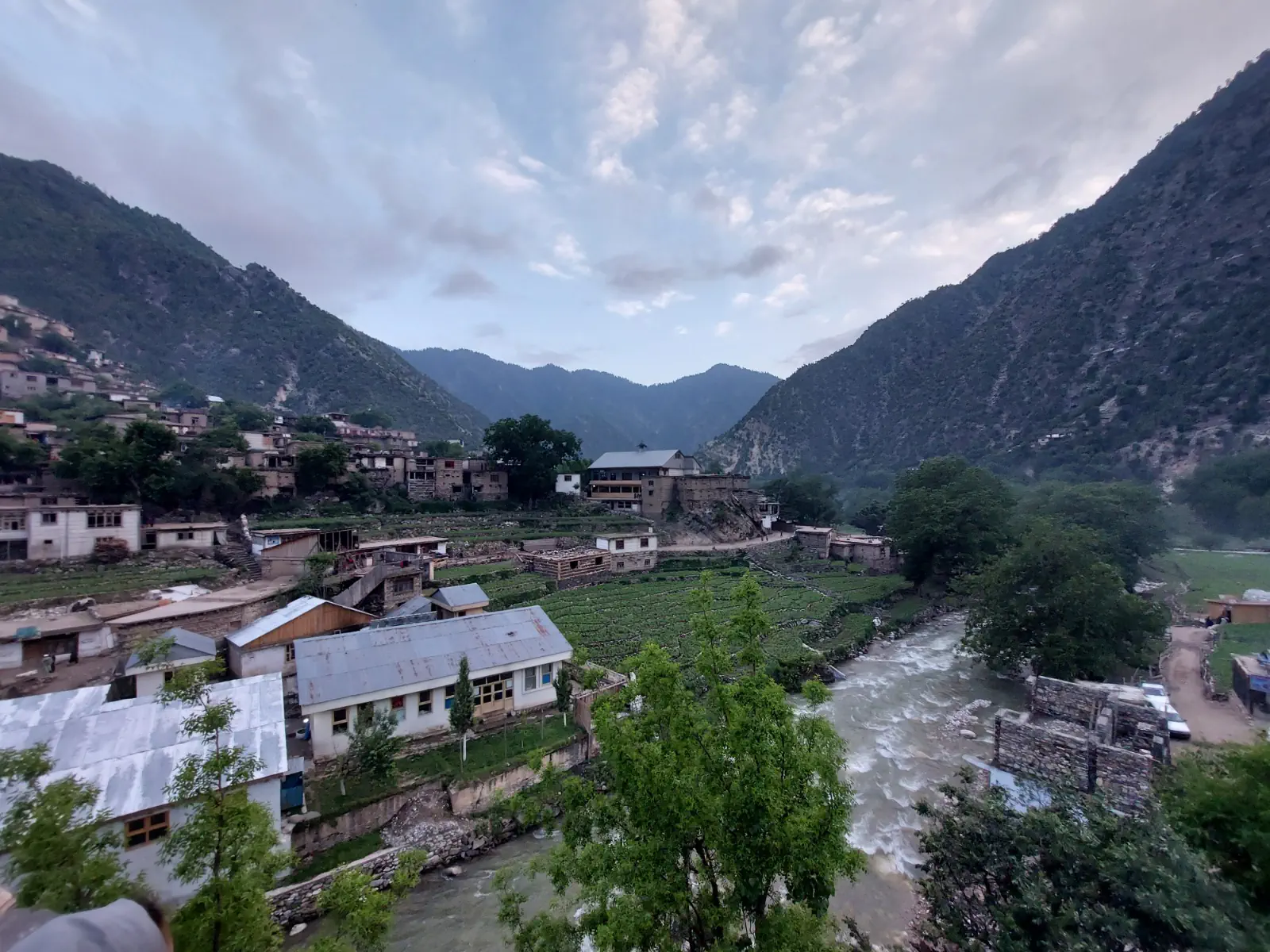
The Waygal valley lies immediately west of Tregam, over the ridge, and the two have traded people for centuries. Strand records that when the Chima-Nishei came down into the lower Waygal they drove the earlier inhabitants out into Tregam, and that the hamlet of Want in Waygal was founded by refugees fleeing the other way, from Muslim incursions into Tregam before the final conquest.
Part of the Tregami population is said to have come from Kantiwa, in Kata-vari-speaking central Nuristan, and a Kalash tradition recorded at Urtsun in Chitral traces one of its lineages to Katar and Gambir. Strand's conclusion is that the Tregami are a mixed people, perhaps ancient exiles from several Nuristani groups. Nobody has recorded their own account of where they came from.
The Waygal valley, photographed by our own team. We have no photographs of Gambir, Katar or Devoz yet; if you have one, we would like to publish it with your name.
Who lives in the three villages
Strand put the population at perhaps three thousand in 2000. Ethnologue's figure, as Wikipedia reports it, is about 3,500 speakers in 2011, and the Joshua Project lists around 4,900 people. A Gambir resident told Pajhwok in 2022 that thousands lived in Gambir and Katar together. None of these is a count. The people are Sunni Muslims, farmers and goat-herders on steep ground, and they speak Pashto as well as Tregami, as every outside account since the 1950s has noted.
Their conversion to Islam belongs to the same campaign that reached the rest of Nuristan. The US Army's history of the valley says the Afghan government converted the Nuristanis of the northern Watapur by force in the late nineteenth century, and Strand's note on the Shinwari settlements places them just after the conquest. Tregam had seen Muslim pressure before that, enough to push some families west to Want, but no source we have found supports the claim sometimes made that the valley converted long before 1896.
The valley was also fought over in the recent wars. Soviet troops landed at Katarqala in May 1980; American units fought in the Korengal, the next side valley of the Pech, from 2006 until they withdrew in 2010; and in June 2011 Operation Hammer Down put American and Afghan soldiers on the ridges above Gambir for a week, with five Americans killed. The Army's own account records that the villagers of Gambir wanted nothing to do with any of it. That history is told elsewhere on this site, in the pages on the Battle of Wanat and Kunar; here it matters only because it kept the valley closed to linguists for another twenty years.
Numbers in Tregami
The numerals of the Gambir dialect, as Richard Strand records them in his Nuristani etymological lexicon. Set beside the Waygali-ala words on the words page, they show how close the two languages are, and where they part.
| Number | Tregami |
|---|---|
| 1 | yo |
| 2 | du |
| 3 | tre |
| 4 | čâtâ |
| 5 | po˜č |
| 6 | ṣu |
| 7 | sut |
| 8 | voṣṭ |
| 9 | nu˜ |
| 10 | dåš |
| 20 | viši |
One is yo, where Kati and Waygali-ala both say ev; Tregami kept the old Indo-Iranian word for one that most of the family replaced. Ten, dåš, is borrowed from an Indo-Aryan neighbour, as Waygali-ala's doš is; Kati's duć keeps the older Nuristani sound. Four, čâtâ, shares with Waygali-ala a fronted ch sound that the northern languages do not have. The nasal vowels in põč, five, and nu, nine, are part of the language, not a slip of the pen.
Twenty is viši, and counting goes on in twenties, as it does across Nuristan: forty is two twenties and sixty three. No word for a hundred has been recorded.
How endangered is Tregami?
Nobody has counted Tregami speakers or asked whether the children of Gambir, Katar and Devoz still learn it. The assessments below are the only ones there are, with their dates.
| Source | What it says |
|---|---|
| UNESCO Atlas of the World's Languages in Danger, 2010 | Gambiri (Tregami): severely endangered, the only Nuristani language in that class. The other four are rated definitely endangered. In UNESCO's scale, severely endangered means the language is spoken by grandparents and older; the parents' generation may understand it but does not speak it to the children. |
| Richard Strand, 2000 | Population perhaps 3,000. The villages are intermixed with Shinwari settlements planted after the conquest. Morgenstierne's brief account of 1952 is all that is published on the language. |
| Ethnologue, as reported by Wikipedia (2011 figure) | About 3,500 native speakers, 75 to 80 per cent lexical similarity with Waygali-ala, and most speakers also speak Pashto. |
| Glottolog, 2022 assessments | Agglomerated Endangerment Status: shifting. The Catalogue of Endangered Languages: threatened, with the note that the judgement is 20 per cent certain on the evidence available. |
| Almuth Degener, 2022 | A complete folktale recorded in the Devoz dialect and published with a grammatical commentary, which shows that fluent adult speakers existed in the 2010s. It is the only published text in the language. |
| Pajhwok Afghan News, March 2022 | Gambir and Katar have no road; residents carry goods on animals. The isolation that kept the language alive is also what keeps it unrecorded. |
Help us record them
We are gathering recordings from the valleys: a greeting, a proverb, a few lines of a song, counted numbers, in each language and as many dialects as we can reach. If you or your family speak a Nuristani language, record a minute on your phone, tell us who is speaking and where they are from, and send it to us. We will credit every voice and publish the recordings here.
Asked about Tregami
What is the Tregami language?
Tregami, also called Gambiri, is the smallest of the five Nuristani languages, a branch of the Indo-Iranian family. It is spoken in the three villages of Katar, Gambir and Devoz in the Tregam valley of Kunar province, Afghanistan, by a few thousand people who also speak Pashto. Its closest relative is Waygali-ala, the language of the Waygal valley in Nuristan.
Where is the Tregam valley?
In Watapur district of Kunar province, eastern Afghanistan. The valley runs north from the Pech river a little east of Nangalam, between the Waygal valley to the west and the Korengal to the east. Its floor is farmed by Safi Pashtuns; the three Nuristani villages are up the side valleys on its eastern slope, outside the border of Nuristan province.
Is Tregami a dialect of Waigali?
It depends who you ask, and the question is formally open. Its vocabulary is so close to Waygali-ala that Morgenstierne put the two into one dictionary in 1954, but he judged the grammar different enough to count Tregami a separate language, and the ISO standard gives it its own code. Glottolog groups the two in a single node, and the linguist Jakob Halfmann wrote in 2021 that whether it is a language or a variety of Waygali-ala has not been settled.
How many people speak Tregami?
Nobody has counted. Richard Strand estimated perhaps 3,000 in 2000; Ethnologue's figure is about 3,500 from 2011; the Joshua Project lists around 4,900 people. All speakers are bilingual in Pashto.
Is Tregami endangered?
Yes. UNESCO's Atlas of the World's Languages in Danger rated it severely endangered in 2010, a class above the other four Nuristani languages, which are definitely endangered. The villages have been mixed with Pashtun settlements since the 1890s and the Indo-Aryan language of the lower valley, Wotapuri-Katarqalai, has already disappeared under Pashto. No fieldwork on whether children still learn Tregami has been published.
What does Tregam mean?
Three villages. The name comes from the Indo-Aryan language once spoken at Katarqala in the lower valley, and refers to Katar, Gambir and Devoz. What the Tregami call their own language and themselves has never been recorded.
Is Tregami written?
No. There is no alphabet, no dictionary and no literature on paper. The only published text is a folktale, The Wolf and the Kids, recorded in the Devoz dialect and printed by Almuth Degener in 2022 in a linguists' volume. The only grammatical description is sixteen pages by Georg Morgenstierne from 1952.
On this site
- The Nuristani languages, valley by valley
- Waygali-ala, Tregami's closest relative
- Words and numbers in the five languages, side by side
- Kunar and Nuristan: the Pech and the road in
- Waygal district: the valley over the ridge
- The Battle of Wanat, 2008, in the Waygal valley
- Waygali-ala translation and interpreting
- Kafiristan: the valleys before 1896
- Richard F. Strand, The Tregâmi (nuristan.info, 2000)
- Richard F. Strand, Nurestâni languages, Encyclopaedia Iranica (2000, updated 2018)
- Richard F. Strand, Peoples and Languages of Nuristân (nuristan.info, 1998, revised 2011)
- Richard F. Strand, The Kalaṣa of Kalaṣüm (nuristan.info), on the movements between Waygal and Tregam
- Georg Morgenstierne, Linguistic Gleanings from Nuristan, Norsk Tidsskrift for Sprogvidenskap 16 (1952), pages 117 to 135, with Tregami on pages 120 to 135; and The Waigali Language, NTS 17 (1954), pages 158 to 159 on Gambiri
- Jakob Halfmann, Terminological proposals for the Nuristani languages, Himalayan Linguistics 20(1), 2021, pages 28 to 64
- Almuth Degener, The Wolf and the Kids in the Devozi dialect of Tregami, in The Nuristani languages in synchrony and diachrony (Reichert, 2022), pages 79 to 112 (Glottolog record)
- Glottolog: Tregami (treg1243), classification and endangerment
- Fridrik Thordarson, Morgenstierne, Encyclopaedia Iranica (2005, updated 2012)
- Christopher Moseley (ed.), Atlas of the World's Languages in Danger, third edition (UNESCO, 2010), as tabulated for Afghanistan
- Ryan D. Wadle, Hammer Down: The Battle for the Watapur Valley, 2011 (Combat Studies Institute Press, 2014)
- Pajhwok Afghan News, Watapur district of Kunar without link roads, 28 March 2022
- UNHCR Sub-Office Jalalabad, District Profile: Kunar, Wata Pur (June 2002)
- Wiktionary, Tregami lemmas: the numerals, each citing Strand's Nûristânî Etymological Lexicon (2016)
- Wikipedia: Tregami language, for the Ethnologue figures
Plan your Nuristan journey
Ready to plan a visit, source Nuristani products, or discuss an investment? Your message goes to Obaid, who is from Nuristan, and his team in Afghanistan and the UK. We reply to every message.