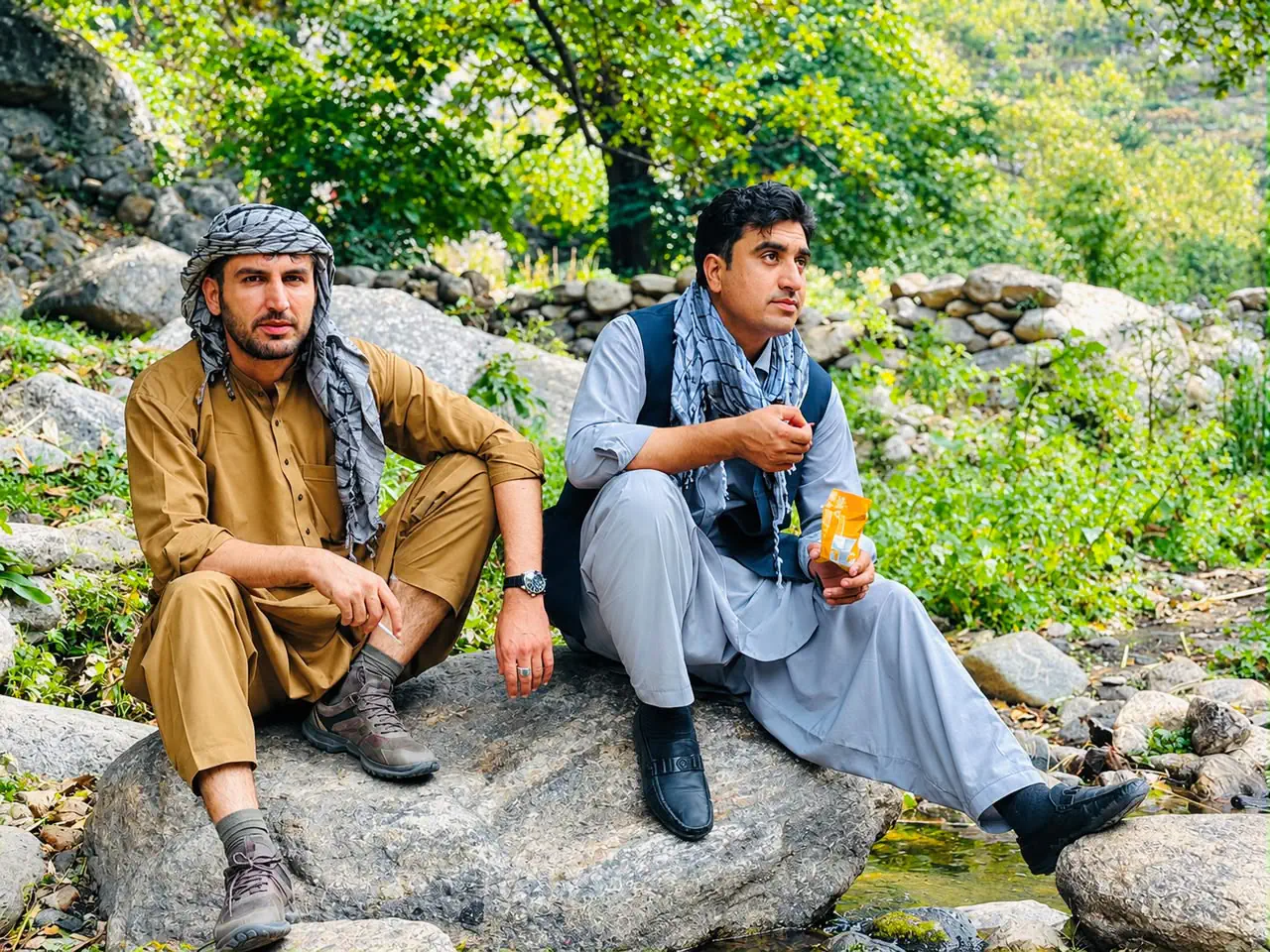
Ashkun, the language of Wama and the Alingar valleys
Three peoples, the Ashkunu, the Sanu of Wama and the Gramsana of Achanu, speak it in two dialects across the watershed between the Pech and the Alingar. It has no name that covers them all, no dictionary, and more speakers than anyone counted until recently.
What Ashkun is, and who speaks it
Ashkun is the Nuristani language of the middle Pech and the valleys over the ridge to its west. Richard Strand, who recorded it at Wama in 1968, describes three peoples speaking dialects of a single language: the Ashkunu proper, in the Bazgal, Masegal and Titin valleys that drain west into the Alingar, now in Du Ab and Nurgaram districts; the Sanu of Wama on the Pech, whose own name for their great village is Shama; and the Gramsana of Achanu, a little further up the Pech. No native word takes in all three. Ashkun is the Kati name for the first of them, Ashkun, which George Scott Robertson was the first to print in 1896, and the linguists have kept it for the whole language. Outsiders also say Wamai, from the Pashto name of Wama.
It is the language of the Nuristani valleys closest to the plains, and the first the outside world heard: a German missionary, Ernst Trumpp, published Ashkun words in 1862 from men who called their country Wamasthan, and Morgenstierne made it the first Nuristani language he described in detail, in 1929, from two men he had found in Kabul and Peshawar. Yet it remains among the least known. There is no dictionary in print, no written form, and until 2014 the standard reference gave it twelve hundred speakers, a number smaller than the population of Wama district alone. The real figure is somewhere between ten and forty thousand.
- Names
- Ashkun; Ashkunu-veri, Sanu-viri, Gramsana-viri by people; Wamai in Pashto
- Family
- Nuristani branch of Indo-Iranian
- Where
- Wama and Achanu on the Pech; Bazgal, Kolatan and Titin on the Alingar side
- Districts
- Wama, Nurgaram, Du Ab
- Speakers
- Strand: perhaps 10,000 to 30,000; Ethnologue: 40,000 (2011)
- Dialects
- An Alingar dialect and a Pech dialect
- Codes
- ISO 639-3 ask; Glottolog ashk1246
- UNESCO status
- Definitely endangered (2010); Ethnologue says vigorous
The Pech side and the Alingar side
On the Pech, the Sanu villages run from Shama, which the maps call Wama, through Paunts, Kamgal, Akataban, Wau and Buni, and the Gramsana live at Gramsana Gram and Sabligal, the place Pashto speakers call Achanu, known for its pomegranates. Wama district has about 13,400 people by the 2024 estimate; it lost ground to the new districts of Parun and Nurgaram in 2004. Over the ridge to the west, on the eastern flank of the Alingar, the Ashkunu proper hold three valleys. Bazgal in Du Ab, with the villages of Bazgal, Kuri and Paigalak; Masegal in Nurgaram, with a dozen settlements of which Kolatan is the one most often named; and Titin, also in Nurgaram, where the village of Nakara stands, the home of the founders of Nishigram in Waygal and the place hit by the landslide of February 2024. Ethnologue adds Malil wa Mushfa and a presence in Chapa Dara district of Kunar.
The village names tell a story. Many of the Alingar-side settlements end in dara or da, boys, as in Dingor Da, the clan descended from Dingor, and in lam, community, both borrowed from Pashai. Strand reads this as a sign that Ashkun speakers spread over the top, as Nuristanis say, from Shama into valleys that had been Pashai country, which fits the old religious standing of Wama with its great orchard, Indra Kun, said to have been planted by the god Indra himself. The Kolatan clans still call themselves Wamai, and when the Soviet anthropologist Georgy Debets measured the Ashkunu of the Alingar basin in 1965 they told him their people were Wama.
How many speak Ashkun has been one of the family's puzzles. Ethnologue printed twelve hundred speakers, dated to 2000, in its fifteenth and sixteenth editions, a figure copied into UNESCO-era lists and still quoted; from the seventeenth edition of 2014 it became forty thousand, dated to a 2011 survey, with four thousand monolinguals. Strand gives perhaps ten to thirty thousand for all three peoples; a provincial profile of about 2012 put the Ashkori or Wamayee at twelve per cent of Nuristan, roughly seventeen thousand. The old figure cannot have covered the Alingar valleys at all. The truth lies in the tens of thousands, and Ashkun is probably the second-largest Nuristani language after Kati.
The Alingar side
The Bazgal valley in Du Ab is Ashkun-speaking, in a dialect of its own; the district as a whole, lower and warmer than the Pech valleys, has about 9,500 people and is reached from Laghman. Nurgaram, with Kolatan and Titin, is the most populous district in the province, about 39,100 people, and its lower reaches are Pashai and Pashto country.
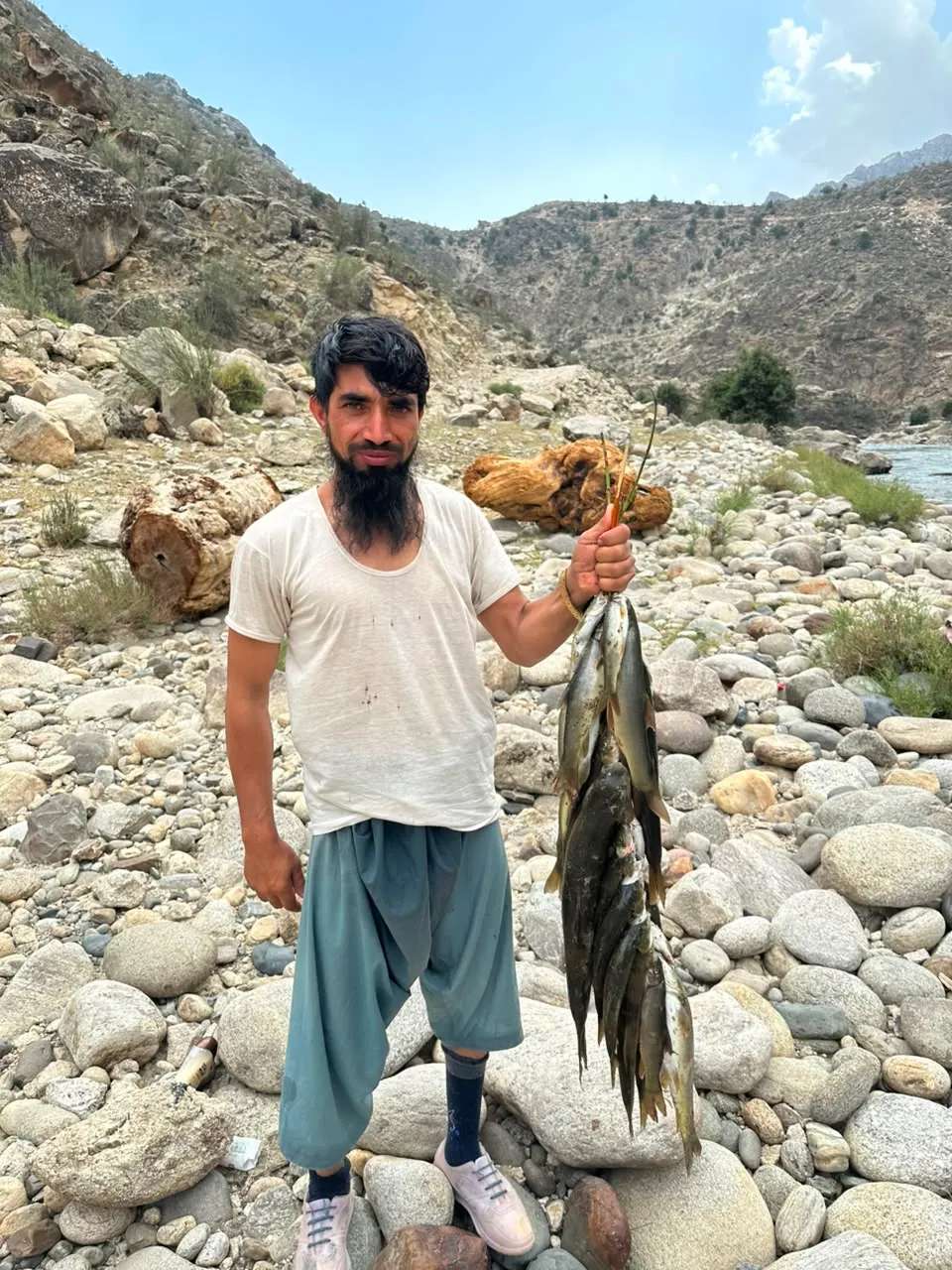
This is where the Alingar dialect lives, shaped by its Pashai neighbours. We have no photographs of Wama or the Ashkun villages of the Alingar yet; the pictures on this page are from Nurgaram and Du Ab.
On the Dani Pajagal river in Du Ab. Our own photograph.
Where the r turns into l
Strand writes that the Ashkunu of the Alingar side have taken on sound habits from the Pashai of the Alingar valley and form a dialect group of their own, Ashkunu-veri, distinct from the more conservative dialects of the Pech, Sanu-viri at Wama and Gramsana-viri at Achanu, with smaller differences among the three Alingar valleys. The Russian linguist Aleksandr Grjunberg thought the Wama and Achanu dialects were the same; Strand keeps them apart because the peoples are distinct. The linguist Jakob Halfmann sums it up as a division by watershed into an Alingar dialect and a Pech dialect, with the position of Titin not fully clear.
The clearest mark of the Alingar dialect was noticed by Morgenstierne in 1924, from his informant from Masegal: after the consonants k, g, p, b, m and v, an r becomes l, as it does in Pashai. So brother is bra on the Pech and bla on the Alingar, roof is krum and klom, work is kram and klam, and a village is gram at Wama and glam at Kolatan, the same word that is grom in Kati. Trumpp's Ashkun of 1862 already had glam, which is how Morgenstierne knew his men had come from the Alingar side. In the Masegal dialect, Strand adds, the retroflex approximant has become l altogether.
Southern Nuristani, or the sister of Kati?
Ashkun is one of the five Nuristani languages, which form a third branch of Indo-Iranian beside Iranian and Indo-Aryan. Morgenstierne, who built the family tree, found its vocabulary to a great extent identical with that of Waygali-ala and also saw special resemblances to Kati. Strand places it with Waygali-ala and Tregami in a southern group, which he also calls the Kalasha group, and notes that the lower-valley dialects of Waygali-ala show Ashkun influence from the west. The Waygal people count the Ashkun country and Wama inside the wider name Kalasha, which is also why early visitors heard the Wama people spoken of as Kalasha.
Not everyone draws the tree that way. Glottolog, following Irén Hegedűs's reconstruction of the parent language, pairs Ashkun with Kati in a node it calls Ashkun-Kate, inside a larger group with Waygali-ala, and Halfmann declines to adopt a northern and southern split at all, finding no shared innovations that prove it. Ethnologue's statement that Ashkun is not intelligible with the other Nuristani languages is true of speech, whatever the tree says. Its three dialect names in Ethnologue and Glottolog, Ashuruveri, Gramsukraviri and Suruviri, are, Halfmann shows, a failed machine scan of Strand's Ashkunu-veri, Gramsana-viri and Sanu-viri, and should be ignored.
The name itself means nothing that anyone can show. Grierson's Linguistic Survey of India printed Ashkund and said it meant bare mountain; Morgenstierne's informants pronounced it Aski or Askari and denied it had any meaning, and the d and the gloss were dropped. Strand has lately suggested that Ashkunu and Sanu may preserve the names of the ancient Arsacids and Sakas. That is his hypothesis, and we present it as one.
A nasal flap, long and short, and counting in twenties
From Strand's sound system of Sanu-viri and his Iranica survey, and Morgenstierne's notes of 1926.
Ashkun has the retroflex consonants of the whole family, with the tongue tip curled back, and two kinds of r, an upward flap and a forward one. Its signature sound, shared with Waygali-ala, is a strongly nasalised retroflex flap, written ň by Strand, which Halfmann calls very difficult for an English speaker to pronounce; it is the sound in the names of the Sanu and the Gramsana and in kaňa, blind. The dental affricates ts and dz that mark Nuristani are there too, and Ashkun keeps a voiced z apart from dz, which not all the languages do. Vowel length matters: bas is vapour and baas is twelve. The accent falls on the last syllable as a rule, and the unmarked vowel a is said high in the mouth, almost like the vowel in English put without the lips.
The grammar runs with Kati and Waygali-ala, the core of the family. The verb ends the sentence; the doer of a past action is marked in the oblique case, the split-ergative pattern; the past is built on an old participle in i, and there is a present progressive in n, which Ashkun says as ň. The pronoun for me is yun and for thee to. A prefix pa marks place, to, at or in, and Ashkun, like Prasun, can put directional pointers on its pronouns, so that he can mean he up there or he down there. Morgenstierne wrote down the whole present tense of to be from his Titin informant in 1924: sem, ses, sat; semis, seg, sen.
- Counting is in twenties. Twenty is vishi; thirty is vishia dos, twenty and ten; forty du-vishi, two twenties; a hundred ponts-vishi, five twenties; two hundred dos-vishi, ten twenties; and the old largest number, four hundred or twenty twenties, was azaar, the Persian word for a thousand.
- Several numerals are borrowings from Indo-Aryan neighbours, as Halfmann's etymologies show: one, ats, from a form like ekka; six, sho; eight, osht; twelve, baas; and twenty itself. Two, three, four, five and seven are inherited.
- Morgenstierne asked an Ashkun man for the names of flowers and was told: how can we have a name for a thing we do not eat?
From Trumpp's Kafirs to Strand's lexicon
Ashkun words reached print before any other Nuristani language's. Ernst Trumpp, a missionary scholar, published a study of the language of the so-called Kafirs in 1862 and 1866 from men he met in Peshawar who called their homeland Wamasthan; Morgenstierne later found his material practically identical with the Masegal dialect. The Pashtun missionaries Fazl Haqq and Nurullah brought back a song from Nakara in the 1860s, Henry Tanner named the Sanu Kafirs in 1881 and gave a few sentences, and Robertson, from Kamdesh in 1890 and 1891, confessed that his ignorance of the Ashkun was almost complete: no Kafir could tell him much, except that they spoke a language somewhat like the Wai's, were friendly to the Wai, lived in thick forest, were brave and particularly well armed with matchlocks, and were at war with every other tribe.
Morgenstierne found an Ashkun man in Kabul in 1924, said to be the only one of his people there, and another in Peshawar on his way home, and from them and two later consultants, Abdul Karim of Masegal and Abdur Razak, probably of Wama, wrote The Language of the Ashkun Kafirs in 1929, the first detailed description of any Nuristani language, with additional notes in 1934 and a sketch of the Wama dialect in 1952. Wolfgang Lentz of the German expedition of 1935 reported from Wama itself that the people insisted on their independence as a tribe but agreed their language was the same as Ashkun. Debets measured the Ashkunu of the Alingar in 1965, for anthropology rather than language, and recorded that the languages were fully preserved though the men also knew Pashto and Dari.
Grjunberg collected sentences at Wama in the 1960s, published in 1981, and wrote the Russian handbook chapter in 1999. Georg Buddruss recorded texts at Wama in 1956 and 1970 and printed three of them, with a short grammar, in 2006. Strand's own field data from Wama in 1968 became his online Sanu-viri lexicon in 2008 and his sound system of 2011, still marked under construction in 2024, and the Wama dialect stands for Ashkun in his etymological lexicon of the whole family. Max Klimburg's two volumes of 1999 on the art and society of the Waygal and Ashkun Kafirs are the standard ethnography. Halfmann's papers of 2021 and 2025 are the latest word. There is still no printed dictionary, no primer and no school book in Ashkun.
Who they are, and when they became Muslims
No account of the Ashkun peoples' own history has been recorded, Strand writes. The other Nuristanis say the Sanu came up the Pech with the rest, fleeing Mahmud of Ghazni in the eleventh century; a description of horse effigies given in 1874 by a man apparently from Wama hints that the Sanu may once have been horsemen of the plains; and the Kom trace an early home of their own to Kamgal, a side valley of Wama. All of this is tradition and hypothesis, and we leave it open. What the record does show is that Wama was a religious centre of old Kafiristan, with the orchard of Indra, and that Klimburg found the Waygal and Ashkun societies alike: extroverted, martial and consumed with rank, where a man became a big man through feasts and deeds of war, where the carved posts called dal that honoured such men carried a peg-hole for each man killed, and where, unlike anywhere else in Kafiristan, carvers made pairs of embracing figures.
The Ashkun became Muslims before the conquest. Robertson in 1890 already called the people of Tsaru, as the Kom named Wama, and the lower Ashkun village Shaikhs, converts, and Debets was told in 1965 that the Ashkunu had taken Islam a few years before Abdur Rahman's campaign of 1895 and 1896 and so set themselves apart from the jadidi, the new converts of the other valleys. The men of Nishigram and the Muslim Ashkun, Robertson noted, would hurry to help their Shaikh brethren if Chitral and the Kom ever attacked. The Wama and Nurgaram pages on this site carry the rest: the pomegranates of Achanu, the walnuts, the Pashai of Kordar, the road and the floods.
Numbers in Ashkun
Richard Strand's Wama forms, the Sanu dialect, as used on our words page. Morgenstierne's Masegal list of 1926, ats, du, tre, tsata, ponts, su, sot, ost, no, dus, matches it almost sound for sound.
| Number | Ashkun |
|---|---|
| 1 | âc̣ |
| 2 | du |
| 3 | tra |
| 4 | ćâtâː |
| 5 | po˜ć |
| 6 | ṣo |
| 7 | soːt |
| 8 | oːṣṭ |
| 9 | no |
| 10 | dos |
| 20 | viši |
| 100 | po˜s-viši |
One, ats, is a borrowing from an Indo-Aryan neighbour, where Kati and Waygali-ala keep ev; six, sho, and eight, osht, are borrowings too. Two, three, four, five and seven are inherited Nuristani words, and the dental ts in ponts, five, and in tsata, four, is the sound that marks the family. Ten, dos, is the Indo-Aryan word that also replaced the old ten in Waygali-ala.
Twenty is vishi, and from there the count goes in twenties: vishia dos is thirty, du-vishi forty, ponts-vishi a hundred and dos-vishi two hundred. The old top of the system was azaar, twenty twenties or four hundred, the Persian word for a thousand borrowed and reused.
How endangered is Ashkun?
The two big databases disagree about Ashkun, and the disagreement comes from the numbers. Here is what each says, with its date.
| Source | What it says |
|---|---|
| UNESCO Atlas of the World's Languages in Danger, 2010 | Ashkun: definitely endangered, the class for languages that children no longer learn as a mother tongue at home in part of their area. The Atlas placed Ashkun in Kunar by the old boundaries and gave it under seven thousand speakers, drawing on the twelve-hundred figure then in print. |
| Ethnologue, 2014 to 2022 editions | 40,000 speakers (2011), increasing; 4,000 monolinguals; level 6a, vigorous, used in all domains by all ages with positive attitudes; most also use Pashto; literacy in the language nil; unwritten; not known to be taught in schools. The 2007 and 2012 editions had said 1,200 (2000). |
| Richard Strand, 1998, updated 2024 | Perhaps 10,000 to 30,000 for all three ethnic groups. Morgenstierne's field data remain the major source on the language; Strand's own Wama lexicon is online and his sound system is still under construction. |
| Glottolog and the Catalogue of Endangered Languages, 2022 | Agglomerated Endangerment Status: shifting. The Catalogue, following George van Driem, rates it threatened, 20 per cent certain on the evidence available. |
| Nuristan provincial profile, about 2012 | Ashkori or Wamayee, twelve per cent of the province, living mostly in Wama; Nuristani languages spoken by 78 per cent of the population and Pashai by 15 per cent. |
| Georgy Debets, fieldwork 1965 | The languages are fully preserved, though the men also know Pashto and Dari; the Pashai neighbours on the Alingar use Pashto in the bazaars and government offices. Sixty years on, that is still the shape of the pressure. |
Help us record them
We are gathering recordings from the valleys: a greeting, a proverb, a few lines of a song, counted numbers, in each language and as many dialects as we can reach. If you or your family speak a Nuristani language, record a minute on your phone, tell us who is speaking and where they are from, and send it to us. We will credit every voice and publish the recordings here.
Asked about Ashkun
What is the Ashkun language?
Ashkun is one of the five Nuristani languages, a branch of the Indo-Iranian family, spoken on the middle Pech river around Wama and Achanu and in the Bazgal, Kolatan and Titin valleys on the Alingar side of the watershed, in Wama, Nurgaram and Du Ab districts of Nuristan, Afghanistan. Three peoples speak it, the Ashkunu, the Sanu of Wama and the Gramsana of Achanu, and it has no native name covering all three.
How many people speak Ashkun?
Between ten and forty thousand, depending on the source. Ethnologue gives 40,000 from a 2011 survey; Richard Strand gives perhaps 10,000 to 30,000; a provincial profile of about 2012 put the Wamayee at twelve per cent of Nuristan, roughly 17,000. The figure of 1,200 still found in some lists came from Ethnologue's editions before 2014 and is smaller than Wama district alone.
Is Wamai the same as Ashkun?
Yes. Wamai or Wamayi is the Pashto name for the language and people of Wama, whose own name for the village is Shama and for themselves Sanu. Linguists use Ashkun, the Kati name for one of the three peoples who speak it, for the whole language. Sanu-viri is the Wama dialect in particular.
What are the dialects of Ashkun?
Two main ones, divided by the watershed. The Alingar dialect of the Ashkunu proper in Bazgal, Kolatan and Titin has taken on Pashai habits, most noticeably turning r into l after certain consonants, so that village is glam rather than gram. The Pech dialect of Wama and Achanu is more conservative. The position of Titin is not fully clear.
Is Ashkun endangered?
UNESCO rated it definitely endangered in 2010, working from the old figure of 1,200 speakers; Ethnologue, with 40,000 speakers from 2011 and children learning it in every village, rates it vigorous. Both agree it is unwritten, not taught in schools and under pressure from Pashto, which almost all speakers also use.
Is Ashkun written?
No. It has no alphabet, no dictionary in print, no primer and no school book, and Ethnologue records literacy in the language as nil. The only lexical resources are Richard Strand's online lexicon of the Wama dialect, his etymological lexicon of the family, and Morgenstierne's vocabulary of 1929.
What does Ashkun mean?
Nothing that can be shown. Grierson's Linguistic Survey of India printed the name as Ashkund and claimed it meant bare mountain, but Morgenstierne's Ashkun informants denied the name had any meaning and the d was dropped. It is the Kati form of the name of the Ashkunu people, which Robertson was the first to print in 1896.
Were the Ashkun converted to Islam in 1896 with the rest of Nuristan?
Earlier. Robertson in 1890 already described the people of Wama and the lower Ashkun village as Shaikhs, converts, and the Ashkunu of the Alingar told the anthropologist Debets in 1965 that their people had accepted Islam a few years before Amir Abdur Rahman's campaign of 1895 and 1896, which is why they distinguished themselves from the new converts of the other valleys.
On this site
- The Nuristani languages, valley by valley
- Words and numbers in the five languages, side by side
- Wama district: Shama, Achanu and the Pech
- Nurgaram district: Kolatan, Titin and the Alingar
- Du Ab district and the Bazgal valley
- Waygali-ala, Ashkun's neighbour to the east
- Kati, the largest Nuristani language
- Nuristani woodcarving: the posts, the chairs and the carvers
- Richard F. Strand, The Âṣkuňu, Saňu, and Gřâmsaňâ (nuristan.info, 1998, updated 2024)
- Richard F. Strand, The Sound System of Saňu-viːri (nuristan.info, 2011, updated 2024)
- Richard F. Strand, Nurestâni languages, Encyclopaedia Iranica (2000, updated 2018)
- Richard F. Strand, The Evolution of the Nuristâni Languages (nuristan.info, 2008, updated 2022)
- Jakob Halfmann, Terminological proposals for the Nuristani languages, Himalayan Linguistics 20(1), 2021, section 4.4 on Ashkun
- Georg Morgenstierne, Report on a Linguistic Mission to Afghanistan (Oslo, 1926), pages 44 to 46 on Ashkun, scan
- Georg Morgenstierne, The Language of the Ashkun Kafirs, Norsk Tidsskrift for Sprogvidenskap 2 (1929), pages 192 to 289, and Additional Notes on Ashkun, NTS 7 (1934) (Strand's bibliography)
- George Scott Robertson, The Káfirs of the Hindu-Kush (1896), pages 75 and 80 to 82 on the Ashkun
- G. F. Debets, Anthropological research in Afghanistan, Sovetskaya Etnografiya 1967 no. 4, pages 75 to 93 (in Russian)
- Max Klimburg, Nuristan, Encyclopaedia Iranica (2004, updated 2012)
- Max Klimburg, The 'Enclaved' Culture of Parun in Former Kafiristan, Asien 104 (2007), on the Waygal and Ashkun big-man culture
- Glottolog: Ashkun (ashk1246), classification and endangerment
- Ethnologue, Ashkun, seventeenth edition (2014), archived copy with the 40,000 figure and the EGIDS rating
- Max Planck Institute, Numeral Systems of the World's Languages: Ashkun, data from Strand (1999) and Coyle (2020)
- Nuristan Provincial Profile (MRRD, about 2012), archived copy
- Christopher Moseley (ed.), Atlas of the World's Languages in Danger, third edition (UNESCO, 2010), as tabulated for Afghanistan
- Wiktionary, Ashkun lemmas: the numerals, citing Strand's Nûristânî Etymological Lexicon and Halfmann 2025
Plan your Nuristan journey
Ready to plan a visit, source Nuristani products, or discuss an investment? Your message goes to Obaid, who is from Nuristan, and his team in Afghanistan and the UK. We reply to every message.