Geneticists have gone back to the Kalash of Chitral again and again, and they still disagree about what they found. We are their neighbours across the passes in Nuristan, and we are asked the same questions about Greeks and Europeans. This is what the published studies of Kalash DNA tested, how many people were in them, and what they found.
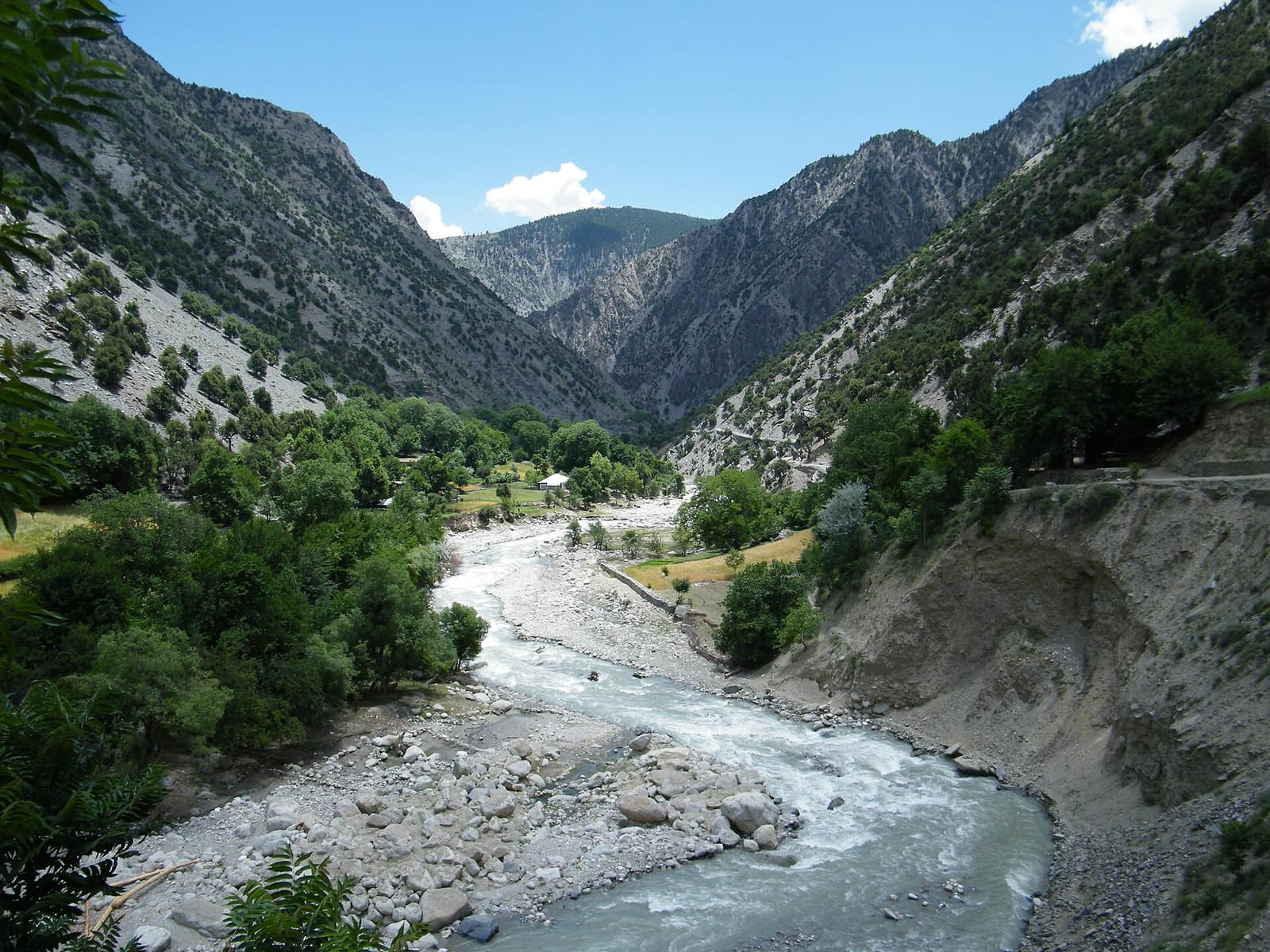
The Kalash live in three valleys of Chitral, in Pakistan, a hard day's walk from our own border. They kept a religion related to the one Nuristan left in 1896, and the story that they descend from Alexander's Greeks is told of them as it is of us. Because they are few and distinct, geneticists have gone back to them again and again. We have read the papers, and this page sets out what is in them.
Two cautions first. The studies are small, and several of them used the same stored samples. And they are studies of the Kalash, in Pakistan. They are not studies of Nuristanis, whatever is said online.
The short version
- About ten papers since 2002 have tested Kalash DNA. The largest had 111 people and the best known had 23.
- The studies agree on a small population with little variety in it, the mark of a people who have married among themselves for a very long time.
- Mothers' lines are western Eurasian almost without exception. Fathers' lines are few.
- A 2015 genome-wide study concluded that the Kalash separated from their neighbours about 11,800 years ago, and found no detectable mixing since.
- A second team disputes that. It dates a mixing event to between 910 and 220 BC and says the source looked western Eurasian. The first team replied that the evidence is not reliable, and called the disagreement unresolved.
- Tests of fathers' lines in 2002 and 2007 found no support for descent from Greeks. A 2020 study of mothers' lines argued that two of them could have come from the Mediterranean at about the right time. Nobody has settled it.
Who was tested, and how few
Several of the best-known papers share their samples. Cell lines grown from the blood of 25 Kalash were deposited with a French research foundation, which by 2015 had been sending them to laboratories for more than a decade. The 2015 genome study used ten of those and thirteen more, the 2014 study an overlapping set, and the 2020 study all 25 with nine of its own. So the same few dozen people stand behind several of the papers below.
| Study | Kalash tested | What was read | What it found |
|---|---|---|---|
| Qamar and others, 2002 | 44 men | The Y chromosome, father to son | The Kalash stand apart from other Pakistani groups. No support for a Greek origin of their fathers' lines |
| Mansoor and others, 2004 | Not given in the summary | 122 markers on the other chromosomes, compared with Greeks | The Kalash are genetically distinct. A small Greek share was suggested for two other peoples, not for them |
| Quintana-Murci and others, 2004 | 44 people | Mitochondrial DNA, mother to child | Western Eurasian lineages only, and the least variety of 23 populations |
| Firasat and others, 2007 | Part of 875 Pakistani men | The Y chromosome in more detail, with 77 Greeks | Only eight lineages among the Kalash. No large Greek contribution anywhere in Pakistan |
| Hellenthal and others, 2014 | An overlapping set of samples | Markers across the whole genome | Mixing with a western Eurasian source, dated by the authors to 910 to 220 BC |
| Ayub and others, 2015 | 23 men | A chip of about 2.5 million markers, and one whole genome | A split from their neighbours about 11,800 years ago and no mixing detected since |
| Rahman and others, 2020 | 34 people | Whole mitochondrial genomes | Eight lineages, all western Eurasian. Two of them traced to the Mediterranean |
| Siddiqi and others, 2021 | 111 people | Part of the mitochondrial genome | About 98 per cent western Eurasian lineages, in only 14 distinct types |
| Shahid and others, 2025 | 98 men | 23 markers on the Y chromosome, and 22 elsewhere in 71 of the men | A distinct people shaped by drift, with some likeness to western Eurasians |
Sample sizes are as each paper gives them. The 2014 and 2015 studies overlap in the people tested, as the 2016 letter says. The 2014 dates are given here as the authors restated them in 2016; the 2015 paper quotes them as 990 to 210 BC.
A small people, long apart
The one thing the studies agree on is that the Kalash have been few for a long time. The 2015 genome study worked out that the number of people who passed on their genes had never risen above about twenty thousand, and had been below ten thousand for more than twenty thousand years. The 2004 study of mothers' lines found less variety among the Kalash than in any of the other 22 populations it compared, from Turkey to India. The 2007 study found eight fathers' lineages among them, against twelve in Greeks, fifteen in Pashtuns and seventeen in the Burusho of Hunza. The 2021 study found only fourteen different maternal types in 111 people.
In a community that small, chance does a great deal of work. A lineage carried by a few families can become the commonest in the valley within some generations, and another can vanish. Geneticists call this drift. It is why the Kalash look so distinct in every chart, and it is also why they are hard to read: drift can copy the effect of ancient separation and can hide the signs of old mixing.
The 2015 team put the separation of the Kalash from the other peoples of South and Central Asia at about 11,800 years ago, with a range of 10,600 to 12,600. They found the Kalash to share ancestry with a boy who lived in Siberia about 24,000 years ago, whose people also contributed to the ancestry of Europeans, and with the Yamnaya herders of the Russian steppe. Their reading was that the Kalash are a drifted descendant of that ancient northern population, and that this old shared ancestry had been mistaken for recent mixing with Europeans.
Did the Kalash mix with outsiders? The disagreement
A year earlier, a different team had published a method for dating when peoples mixed, and had applied it to populations round the world. For the Kalash it found a mixing event which the authors date to between 910 and 220 BC. The incoming side resembled a wide range of present-day peoples of West Asia and Europe. A similar signal, a little less European in character, appeared in the Baloch, Brahui, Makrani, Pashtuns and Sindhi.
When the 2015 paper reported no mixing at all, that team answered in a letter to the same journal. They pointed out that one of the 2015 paper's own tables showed strong statistical evidence of mixing, dated to between 92 and 125 generations ago, and that the tests which found nothing can be blinded by heavy drift. Their conclusion was that the Kalash have not been isolated for eight thousand years.
The 2015 authors replied in the same journal. They agreed that they should have discussed that table. They also said that the signal appeared in 14 of 406 comparisons, that most of those rested on two reference groups of fewer than twenty people each, and that the same test found six times as many such events in the seven other Pakistani populations. They asked readers to take their sentence as saying no reliable evidence of mixing, and wrote that the two conclusions remain unresolved. Both sides ended by pointing to ancient DNA from old burials in the region as the way to settle it.
Fathers' lines and mothers' lines
The Y chromosome passes from father to son and mitochondrial DNA from a mother to all her children, so each traces a single line of descent out of the thousands a person has. They are cheap to test, which is why most of the Kalash studies use them.
On the mothers' side the picture is consistent. In 2004 all 44 Kalash tested carried western Eurasian lineages, with none of the East Asian or South Asian lineages found in their neighbours. The commonest were U4, U2e, J2 and the lineage later papers call R0a, and the particular forms the Kalash carry were rare or absent in the peoples around them. In 2021, among 111 people, about 98 per cent of lineages were western Eurasian and 0.9 per cent South Asian, and a form of R0a was the most frequent at 28.8 per cent.
On the fathers' side there is less to say. The 2002 study found that a lineage carried by 28 per cent of Greek men was absent from its 44 Kalash, while a lineage typical of this region made up a quarter of them. Its statistical estimate of a Greek share of Kalash Y chromosomes still came out at 20 to 40 per cent, which the authors put down to drift and to the coarse markers of the time, since the Greek lineage itself was missing. The 2025 study of 98 men did not test the lineages directly. It predicted them by software from other markers, which is less certain, and arrived at R2 in about a third of the men, G2a2 and J2b2a in about a fifth each, and smaller numbers of J2a1, H1a1a, Q, L1c and R1a.
Why do some Kalash look European?
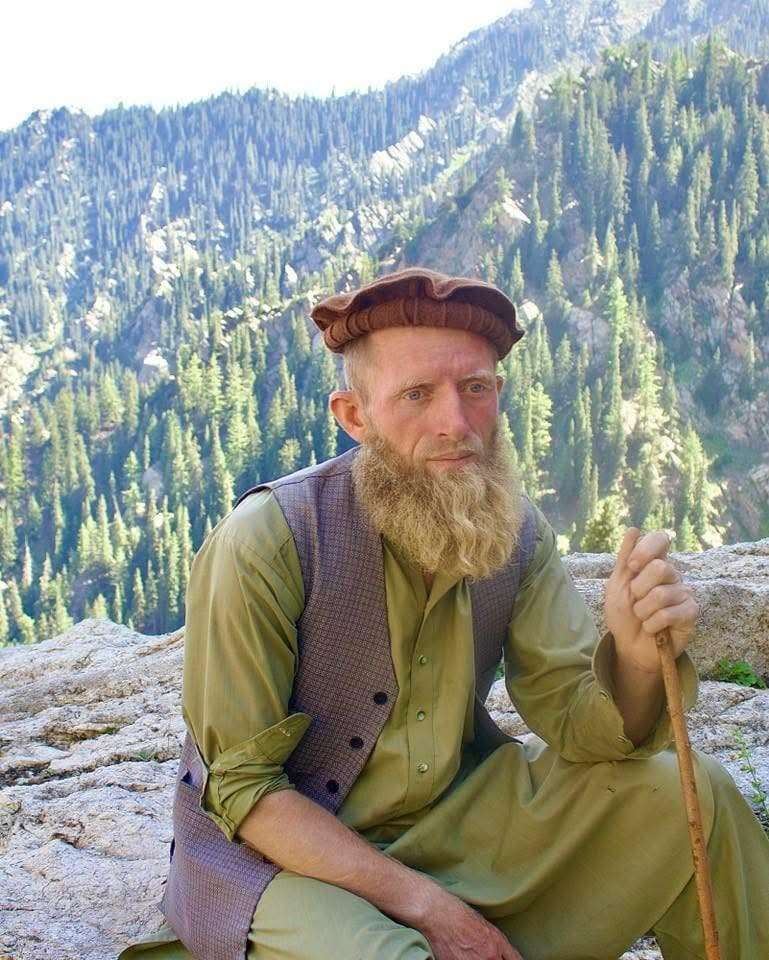
Some Kalash have fair hair or light eyes, as some Nuristanis and some Pashtuns do, and photographers choose those faces. Nobody has counted how common they are among the Kalash. What the genetics offers is the 2015 team's account: the Kalash share a good deal with an ancient northern Eurasian people from whom Europeans also descend in part, and in a small population drift can make an uncommon trait a common one. On that account the likeness comes through distant shared ancestors, and needs no recent arrival from Europe to explain it.
The gene variants that lighten eyes, hair and skin are far older than any nation and are found from Ireland to the Himalayas. We have set out what is known about them in our article on Afghans with blue eyes.
Are the Kalash descended from Alexander's soldiers?
The story is told in the Kalash valleys today, as it is told in ours, and many people hold to it. The scholar Augusto Cacopardo, who traced it, found that it was not part of the Kalash's own inherited tradition and reached Rumbur in the 1970s. Alexander's army did cross the Hindu Kush, and invaded the Indian subcontinent in 327 and 326 BC. So the question is a fair one to put to the evidence.
The tests of fathers' lines found no support for a Greek origin. The 2002 authors wrote that there was no support for a Greek origin of Kalash Y chromosomes, and added a caution of their own: that this assumes modern Greeks resemble Alexander's army. The 2007 study, which compared 77 Greek men directly, found the one clear trace of Greek ancestry in the region among Pashtuns, in two men, and none among the Kalash.
Two findings point the other way, and neither is proof. The mixing event dated to between 910 and 220 BC spans Alexander's years, but its source could not be identified, and a similar signal appears in neighbouring peoples, most of whom have no such legend. And the 2020 study of mothers' lines traced two lineages, about half of the Kalash maternal pool, to the Mediterranean, and dated their rise among the Kalash to about 2,260 and 3,010 years ago, each with a margin of about 1,500 years either way. Its authors called that consistent with Alexander's invasion and suggested that women travelling with Greek armies might explain it. The central estimate of the older one is more than six centuries before Alexander.
Whether or not this admixture event involved the armies of Alexander the Great is an unresolved question.
That is how the team who found the mixing signal put it in 2016, and it is still the fairest summary. The evidence has not shown Greek descent and has not ruled out a small contribution. We leave it open, as we do for our own valleys.
What the Kalash studies do not tell you about Nuristanis
The Kalash are often used as a stand-in for us, because we are neighbours, because their religion is related to the one our great-grandparents followed, and because the language of our own Waygal valley, Waygali-ala, shares the name Kalasha in the books. The stand-in fails on the facts. The Kalash speak an Indo-Aryan language and the Nuristani languages are a branch of their own. And where the Kalash have about ten studies, the whole published genetic record of Nuristanis is five men in a table at the back of a paper on Afghanistan.
The 2015 authors saw the gap themselves. They called Nuristan the ancestral homeland of the Kalash and wrote that a larger survey including its people would tell more about where the Kalash came from. We know of no such survey since.
Questions people ask
How many Kalash people have had their DNA tested?
Few. The published studies tested between 23 and 111 people each: 44 men in 2002, 44 people in 2004, 23 men in 2015, 34 people in 2020, 111 in 2021 and 98 men in 2025. Some of them used the same stored samples, so the number of different people behind the whole record is smaller than those figures added together.
What haplogroups do the Kalash have?
On the mother's side every study has found western Eurasian lineages almost alone: U4, R0a, U2e and J2 are the common ones, and a 2021 study of 111 people put western Eurasian lineages at about 98 per cent. On the father's side a 2007 study found only eight lineages among Kalash men, and a 2025 study of 98 men predicted R2 in a third of them, with G2a2 and J2b2a at about a fifth each.
How long have the Kalash been a separate people?
A 2015 study of Kalash genomes estimated that they split from the other peoples of South and Central Asia about 11,800 years ago, with a likely range of 10,600 to 12,600 years, and that their numbers stayed small throughout. Other geneticists accept that the Kalash are small and distinct but argue that they also mixed with a western Eurasian people in the first millennium BC.
Did the Kalash mix with other peoples?
The geneticists disagree. One team dated a mixing event among the Kalash to between 910 and 220 BC, from a source resembling peoples of West Asia and Europe. The team that studied Kalash genomes in 2015 found no reliable sign of it and put the likeness down to very old shared ancestry. In 2016 that team wrote that the two conclusions remain unresolved, while the other held that the evidence of mixing is strong.
Are the Kalash lactose intolerant?
The 2015 genome study found that all 23 Kalash men it tested carried only the older form of the gene that switches off milk digestion in adults, while the form that keeps it going has a frequency of about 29 per cent in Pakistan on average. The authors took this as a further sign of long isolation, but noted that the Kalash have no reported lactose intolerance and suggested that other variants may be at work. It is a finding about a gene in 23 men, not a medical survey.
Sources
- Ayub and others, The Kalash genetic isolate: ancient divergence, drift, and selection (American Journal of Human Genetics, 2015)
- Hellenthal and others, The Kalash genetic isolate? The evidence for recent admixture (American Journal of Human Genetics, 2016), the letter
- Ayub and others, Response to Hellenthal and others (American Journal of Human Genetics, 2016), the reply
- Hellenthal and others, A genetic atlas of human admixture history (Science, 2014)
- Qamar and others, Y-chromosomal DNA variation in Pakistan (American Journal of Human Genetics, 2002)
- Mansoor and others, Investigation of the Greek ancestry of populations from northern Pakistan (Human Genetics, 2004), summary
- Quintana-Murci and others, Where west meets east: the complex mtDNA landscape of the southwest and Central Asian corridor (American Journal of Human Genetics, 2004)
- Firasat and others, Y-chromosomal evidence for a limited Greek contribution to the Pathan population of Pakistan (European Journal of Human Genetics, 2007)
- Rahman and others, Exploring European ancestry among the Kalash population: a mitogenomic perspective (Zoological Research, 2020)
- Siddiqi and others, on the mitochondrial control region of 111 Kalash (Mitochondrial DNA Part B, 2021)
- Shahid and others, Phylogenetic analysis of the enigmatic Kalash population in Pakistan (Scientific Reports, 2025)
- Photograph of the river in the Rumbur valley: Majduddin, CC BY-SA 3.0, via Wikimedia Commons